The courtroom had been preparing for this moment for months, but nothing about it felt prepared. Not the polished statements, not the practiced arguments, and certainly not the families sitting on opposite sides of a tragedy that began in seconds and will echo for a lifetime.
When the judge finally delivered a 35-year sentence to Karmelo Anthony for the death of 17-year-old Austin Metcalf, the legal process reached its conclusion. But for those who loved Austin, closure remained out of reach.
What unfolded afterward was not just a sentencing hearing, but a raw, emotional reckoning. One by one, Austin’s family members stepped forward to speak about the boy whose absence has reshaped every day since the tragedy.
His mother’s voice trembled as she tried to hold herself together. She spoke of grief that does not fade with time, only changes shape. In her words, the courtroom seemed to disappear, replaced by a quieter, more painful reality: a home where laughter once lived but now echoes with absence. She described visiting his grave and speaking to him as if he might answer, even knowing he cannot. Birthdays, holidays, and ordinary days have become reminders of what was taken.
She also spoke of the simplest things that now feel unbearable. A bedroom left untouched. Clothes that still carry his scent. A life paused in place while the world continues to move forward. Each sentence she spoke was less about the courtroom and more about survival—learning how to exist in a world that no longer includes her son.
Then came his aunt, who painted a different but equally painful portrait of Austin. She remembered a teenager who was full of warmth, someone who never hesitated to help others and never seemed to pass a moment without kindness. He was the kind of boy who lifted younger cousins onto his back during family gatherings, who stayed longer at the table just to keep conversations going, and who made even ordinary days feel lighter.
Her words carried a sense of disbelief, as if she were still trying to reconcile memory with reality. How could someone so full of life be reduced to a name in a courtroom file? How could a future so clearly unfolding simply stop?
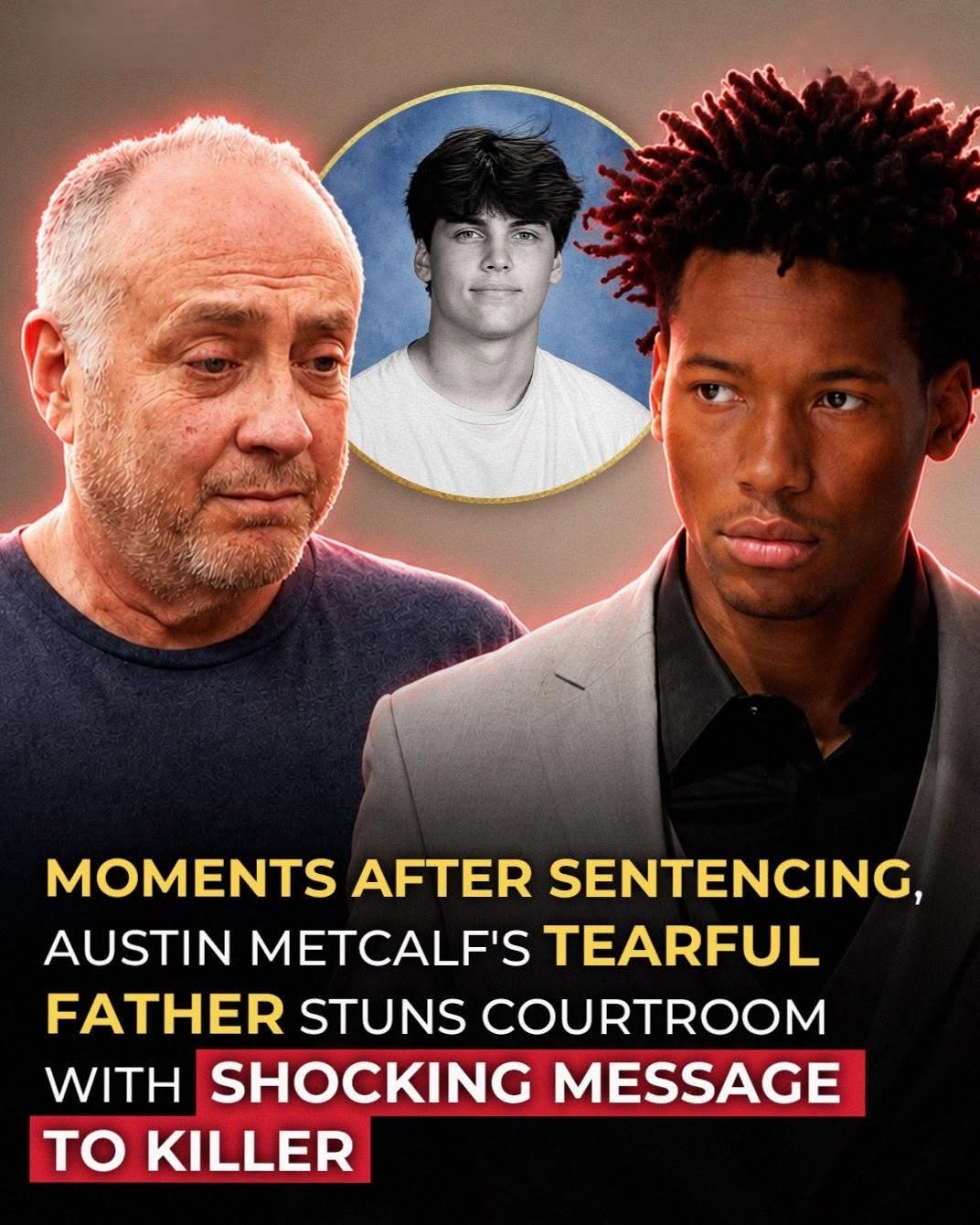
But it was Austin’s father who brought the most intense moment of the hearing.
When he stood, the room shifted. There was no script in his hands, no careful phrasing designed for public consumption. There was only a father trying to speak through a grief that had clearly become part of him. He spoke about Austin not as a victim in a legal case, but as a son who had dreams, ambitions, and a future that stretched far beyond the moment it was taken.
He talked about a scholarship created in Austin’s honor, a symbolic attempt to ensure that his name would continue in classrooms and graduation ceremonies even though he would never sit in one again. He spoke of leadership qualities others saw in his son, of the kind of young man who was expected to shape his community, who instead became the center of a tragedy no family should ever have to endure.
Then his tone changed.
Turning toward the defendant, he delivered words that cut through the silence of the courtroom with unmistakable pain. “You can’t even look me in the eye right now, but you can stab my son in the heart,” he said, his voice shaking between anger and disbelief. The sentence hung in the air longer than any legal ruling, heavier than any written judgment.
Around him, the courtroom remained still. No movement, no interruption just the weight of a moment that could not be undone.
Behind him sat Austin’s twin brother, a young man bound to the tragedy in a way few could fully understand. Twins share more than childhood memories; they share identity, rhythm, and a sense of future that is often imagined together. For him, the loss was not only emotional but structural. It meant waking up each day and confronting the absence of someone who had always been there.
He listened quietly as his family spoke, holding onto faith in a way that seemed both fragile and necessary. In earlier statements, he had wrestled with the idea of forgiveness, though it remained uncertain whether such a thing could ever feel complete. He spoke of the milestones Austin would never reach graduations, weddings, the possibility of children who will now exist only in imagination.
Every word from the family seemed to widen the space left by Austin’s absence.
The sentencing itself marked the end of a legal chapter that had stretched across investigations, testimony, and public attention. The court had weighed evidence, heard arguments, and ultimately concluded with a decision that would define the next decades of Anthony’s life. But for Austin’s family, the number 35 did not translate into relief. It translated into permanence.
A number cannot restore a life. It cannot replay a moment. It cannot reverse the chain of events that began with an argument and ended in irreversible loss.
Outside the formal language of law, the reality remained unchanged. One family would visit a prison. Another would visit a cemetery. Both paths are marked by absence, but only one carries the finality of death.
Friends and relatives of Austin described him repeatedly in similar terms: kind, loyal, full of energy, someone who made others feel seen. Those descriptions now serve as both tribute and reminder. They preserve his identity while emphasizing what was lost.
As the hearing concluded, there was no sense of resolution in the room. Only exhaustion, grief, and the lingering recognition that justice however defined cannot fill the space left behind.
The court may have closed the case file, but the story continues in quieter ways. In empty rooms. In birthdays that arrive without him. In family gatherings where one voice is permanently missing.
For Austin Metcalf’s family, the sentence marks the end of proceedings but not the end of pain. It is a legal conclusion, not an emotional one. The verdict has been delivered, the punishment assigned, and the record written.
But in the lives of those who loved him, there is no final page. Only the long, unending experience of living with what remains.