Optical illusions have fascinated people for generations because they reveal something surprising about the way our minds work. We often assume that our eyes simply record reality exactly as it is, but illusions prove that seeing is far more complicated than that.
The brain constantly interprets information, fills in gaps, and makes assumptions about what is in front of us. Sometimes those assumptions are correct. Other times, they create a completely different picture than the one someone else sees.
That is exactly why certain visual puzzles continue to captivate millions of people long after they were first created. A simple image can spark debates, challenge perception, and leave viewers staring at the same picture for minutes trying to understand what everyone else is talking about. Among the most famous examples is a classic illusion that has puzzled people for more than a century: the image commonly known as the Young Woman and Old Woman illusion.
At first glance, many viewers see only one face. They feel confident they understand the picture immediately. Then someone points out another image hidden within the exact same lines, and suddenly everything changes. What seemed obvious moments before becomes difficult to unsee, and the brain begins switching between two entirely different interpretations.
This remarkable illusion has endured through generations because it demonstrates one of the most fascinating aspects of human perception: two people can look at the same image and honestly see different things.
The artwork traces its roots back to the late nineteenth century, a period when illustrated postcards, newspapers, and magazines were among the most popular forms of entertainment. Long before social media challenges and viral internet trends existed, people enjoyed sharing puzzles and visual curiosities that encouraged discussion and debate.
During this era, artists and illustrators experimented with ways to challenge perception. They discovered that carefully arranged lines and shadows could create images containing multiple meanings. These visual tricks became popular because they invited viewers to participate rather than simply observe.
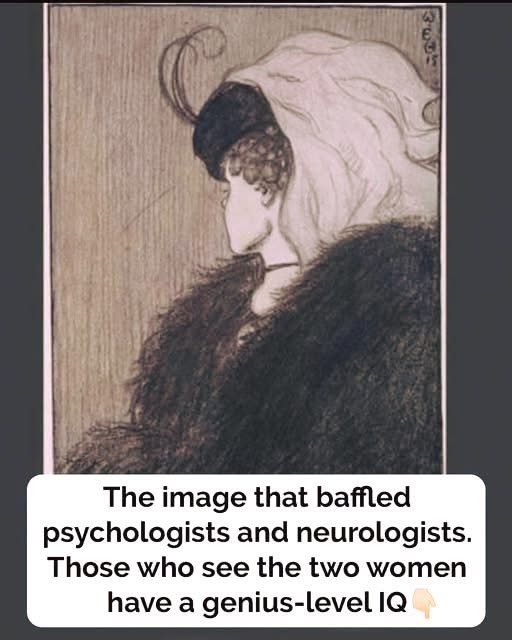
The illusion eventually became associated with British cartoonist and illustrator W. E. Hill, whose version gained widespread recognition. His famous drawing, often titled My Wife and My Mother-in-Law, became one of the most celebrated examples of ambiguous art ever created.
What makes the image so extraordinary is its simplicity. There are no bright colors, moving elements, or complicated patterns. Instead, a few carefully placed lines create two completely different faces.
Some viewers immediately notice a young woman looking away from the observer. She appears elegant and youthful, with her head turned slightly to the side. Others instantly see an older woman with a more pronounced nose and a serious expression.
Neither interpretation is wrong.
The astonishing part is that both images occupy the exact same space. The young woman’s chin becomes the old woman’s nose. What appears to be a necklace transforms into a mouth. Features that seem obvious in one version suddenly take on a completely different meaning in the other.
For many people, spotting the second image feels almost impossible at first. They stare at the drawing and wonder how anyone could see something different. Then, in a sudden moment of realization, the hidden image appears.
Once it does, the experience can be startling.
The brain begins shifting back and forth between the two interpretations, almost like a visual tug-of-war. One moment the young woman dominates the image. The next, the older woman’s face becomes impossible to ignore.
Psychologists describe this type of image as a bistable illusion. Unlike traditional pictures that contain only one interpretation, bistable images allow the brain to alternate between multiple valid perceptions.
These illusions have become valuable tools for researchers studying how human perception works.
Scientists have long been interested in understanding why different people notice different details. Research suggests that the brain does not simply receive information from the eyes and display it like a camera. Instead, it actively constructs reality by combining visual information with expectations, experiences, memories, and attention.
This means perception is not entirely objective.
Two individuals can observe the same scene yet focus on different details based on their backgrounds, personalities, and previous experiences.
The Young Woman and Old Woman illusion demonstrates this principle perfectly.
Studies have even suggested that factors such as age may influence which image people notice first. Younger viewers are sometimes more likely to spot the young woman immediately, while older viewers may recognize the older face first. Although this pattern is not universal, it highlights how personal experience can influence perception.
The illusion also reveals how stubborn the brain can be.
Once we settle on one interpretation, we often resist alternatives. Our minds prefer certainty. They like familiar patterns and recognizable shapes. When presented with conflicting possibilities, the brain frequently chooses one and ignores the rest.
That tendency extends far beyond visual puzzles.
In everyday life, people often interpret situations, conversations, and events through the lens of their existing beliefs. Just as the brain locks onto one image in an optical illusion, it can become attached to a particular interpretation of reality.
Perhaps that is one reason these visual puzzles remain so compelling. They remind us that perception is not always as straightforward as we imagine.
In the digital age, the illusion has found an entirely new audience.
Social media platforms regularly revive the image, challenging users to identify both faces. Posts featuring the illusion often generate thousands of comments from people comparing experiences and debating what they noticed first.
Some users spot both images instantly.
Others struggle for several minutes before finally seeing the hidden face.
Many admit that once they discover the second image, they cannot understand how they missed it in the first place.
This universal reaction has helped keep the illusion relevant more than a century after its creation.
Unlike many internet trends that disappear within days, optical illusions possess a timeless quality. They appeal to a basic human curiosity about how the mind works.
People enjoy testing themselves. They enjoy discovering hidden details. Most of all, they enjoy the moment when something familiar suddenly transforms into something entirely different.
The Young Woman and Old Woman illusion continues to endure because it offers exactly that experience.
A simple collection of lines becomes a challenge, a conversation starter, and a lesson about perception all at once.
More than a hundred years after it first appeared, the image still manages to surprise viewers, spark debate, and remind us that reality is not always as fixed as it seems.
So if you only saw one face at first glance, don’t worry. You’re not alone.
The real magic of the illusion isn’t seeing the hidden image immediately.
It’s realizing that sometimes the difference between what we see and what someone else sees is only a matter of perspective.