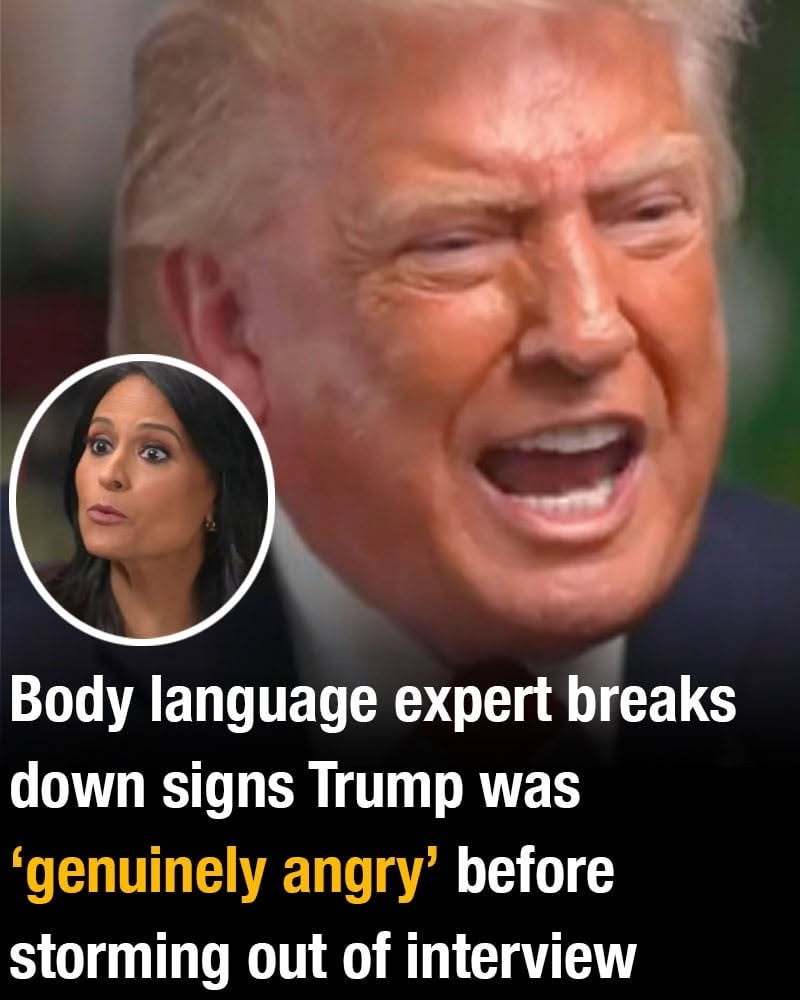
What began as a routine political interview quickly evolved into one of the most talked-about television confrontations of the year.
As questions intensified and tensions rose, viewers witnessed an increasingly uncomfortable exchange between Donald Trump and journalist Kristen Welker. While the discussion itself generated headlines, some experts believe the most revealing part of the encounter wasn’t what was said it was what wasn’t.
According to body language specialists who later analyzed the interview, Trump’s physical reactions may have revealed far more than his words. From subtle facial expressions to shifting posture and changes in hand gestures, experts argue that the former president displayed several classic indicators of genuine frustration as the conversation moved into topics he has long regarded as contentious.
The interview initially appeared calm and controlled. Welker approached the discussion in her usual measured style, asking questions about election integrity, public trust, and claims Trump has repeatedly made regarding past elections. For several minutes, the conversation followed a familiar pattern. Questions were asked, answers were given, and both participants maintained a relatively professional tone.
However, observers noted that the atmosphere began to change when Welker pressed for specific evidence supporting allegations that certain elections had been manipulated or unfairly conducted.
Rather than accepting broad statements, she repeatedly sought details and clarification.
It was at this stage, according to body language analyst Darren Stanton, that visible changes began to emerge.
Experts who study nonverbal communication often point out that genuine emotions can be difficult to conceal entirely, particularly during stressful or emotionally charged situations. While people may carefully choose their words, body language frequently reacts faster than conscious thought.
Stanton noted that one of the earliest signs appeared around Trump’s eyes.
As the questioning became more direct, his eyes reportedly narrowed and his eyebrows lowered. These facial movements are commonly associated with irritation, concentration, and emotional resistance. While such expressions can occur for many reasons, body language specialists often view them as indicators that an individual is becoming increasingly uncomfortable with the direction of a conversation.
At the same time, his posture appeared to change.
According to the analysis, Trump gradually leaned forward as the exchange intensified. In nonverbal communication studies, forward movement is often interpreted as an attempt to establish dominance or regain control within a conversation. People who feel challenged may instinctively move closer to the source of that challenge, particularly when they are attempting to emphasize a point or assert authority.
Observers also highlighted changes in his hand gestures.
Throughout much of his public career, Trump has been known for expressive and animated hand movements. During the interview, some analysts suggested that his gestures became sharper and more pointed as frustration increased. Rather than the broader movements typically associated with public speaking, his motions appeared more directed and deliberate.
Body language experts argue that these shifts can sometimes indicate rising emotional investment. When individuals feel strongly about a topic, their physical behavior often becomes more intense and less restrained.
The interaction grew increasingly tense as Welker continued pressing for evidence rather than moving on to another subject.
Unlike many political interviews where disagreements are quickly redirected, this conversation remained focused on the central issue. Welker repeatedly returned to her original question, asking for factual support behind the claims being discussed.
According to Stanton, this persistence may have altered the balance of the conversation.
One of the more interesting observations involved what experts refer to as “territorial behavior.” During confrontational exchanges, individuals sometimes attempt to establish psychological control through posture, positioning, or proximity.
Analysts suggested that Trump appeared to move into Welker’s conversational space at several points during the discussion. While not necessarily unusual in heated political exchanges, such behavior can be interpreted as an effort to project confidence or authority.
Yet as the interview continued, experts claim another shift became visible.
Rather than continuing to advance physically, Trump’s posture reportedly began to change in the opposite direction.
Stanton described what he called a “gestural retreat.”
Instead of leaning forward aggressively, Trump allegedly started pulling his hands and body slightly backward. In body language analysis, retreating movements can sometimes suggest discomfort, frustration, or a realization that a particular strategy is not producing the desired result.
This does not necessarily indicate defeat or weakness. Human behavior is complex, and body language interpretations are not exact science. However, analysts frequently view such changes as signs that an individual has become unsettled or is reassessing the interaction.
What appeared to surprise some observers was Welker’s consistency throughout the exchange.
Despite increasingly personal remarks and criticism directed toward her, she maintained a relatively calm demeanor. Her tone remained measured, and she continued returning to the original questions without significantly altering her approach.
Communication experts often note that emotional contrast can have a powerful impact during interviews. When one participant becomes visibly frustrated while the other remains composed, viewers naturally notice the difference.
As the discussion progressed, the contrast appeared increasingly pronounced.
Trump continued challenging both the questions and the interviewer, while Welker maintained her focus on obtaining specific answers.
According to analysts, this dynamic may have contributed to growing tension.
Political interviews are often battles not only of facts and arguments but also of perception. Both participants seek to project confidence and credibility while appealing to their audiences. When expectations are disrupted, frustration can emerge quickly.
The interview eventually reached a breaking point.
Following another series of exchanges, Trump abruptly ended the conversation and moved to leave. The decision immediately became one of the most widely discussed aspects of the encounter.
His departure generated intense debate among supporters and critics alike.
Some viewed it as a refusal to engage with what they considered unfair questioning. Others interpreted it as evidence that the discussion had reached a point where he no longer wished to continue defending his position.
Particularly notable was his final remark as he exited.
Dismissing Welker with the word “darling,” Trump delivered a parting comment that instantly became a focal point of media coverage. Reactions varied widely. Supporters described it as characteristic confidence and defiance. Critics argued it reflected irritation and an attempt to diminish the interviewer rather than address her questions.
Body language experts were equally interested in the moment.
The combination of verbal dismissal and physical withdrawal, they argued, created a powerful visual conclusion to an already tense exchange.
In the days that followed, clips from the interview spread rapidly across television networks, news websites, and social media platforms. Millions of viewers watched and rewatched the confrontation, analyzing every expression, gesture, and statement.
For some, the interview was primarily about election claims and accountability. For others, it became a case study in communication under pressure.
Regardless of political perspective, the encounter demonstrated how much attention audiences pay not only to what public figures say, but also to how they behave while saying it.
In an era where every movement can be replayed, slowed down, and scrutinized, body language has become an increasingly important part of public perception. Whether viewers agreed with Trump, supported Welker, or simply observed from a distance, the interview offered a striking reminder that sometimes the most revealing moments occur between the words.
And according to those who study human behavior, those moments may have told a story all their own.