
Personality tests have fascinated people for generations. Whether it’s a detailed psychological assessment, a simple quiz in a magazine, or a viral image shared across social media, people are naturally curious about what their thoughts and instincts might reveal about who they are.
One of the most popular forms of these quick personality challenges involves word perception the idea that the first word your brain notices may offer clues about your mindset, emotions, and the way you experience the world.
At first glance, these exercises may seem like harmless entertainment. Yet many people are surprised by how accurately certain results seem to describe their feelings, habits, or emotional tendencies. The reason these tests attract so much attention is that they encourage us to pause for a moment and reflect on how we think, what we focus on, and what emotions quietly influence our daily lives.
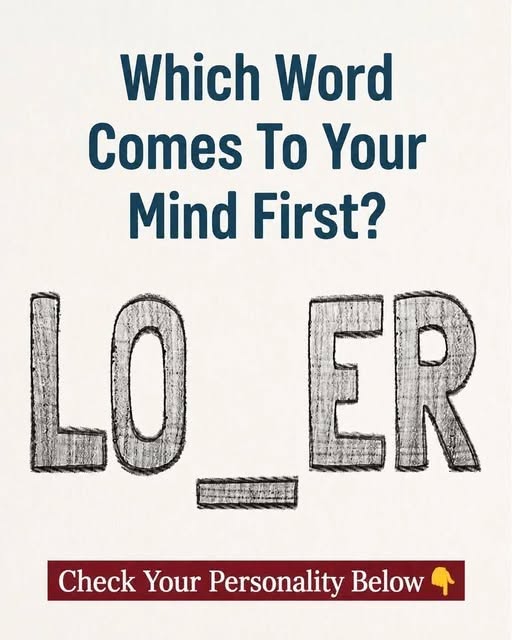
One word challenge that has recently captured widespread attention asks participants to look at a group of letters and identify the first complete word they see. Most people report seeing one of two words immediately: LOVER or LOSER. While the exercise is not a scientific evaluation and should not be treated as a formal psychological assessment, many find the interpretations surprisingly thought-provoking.
What makes this challenge so interesting is not the word itself, but the speed at which the brain recognizes it. Before logic has time to intervene, your attention is naturally drawn toward a particular pattern. Some believe this instinctive choice may reflect certain emotional tendencies, perspectives, or habits that influence how you navigate life.
If the first word you noticed was LOVER, many interpretations suggest that you may be someone who approaches life through connection, empathy, and emotional openness. You may naturally focus on relationships, trust, and the meaningful bonds that bring people together. Rather than immediately looking for problems, your instinct may be to look for possibilities.
People who identify with this description often value loyalty and emotional honesty. They tend to care deeply about the people around them and may find fulfillment in helping others feel supported, understood, and appreciated. Friends and family often turn to them during difficult moments because they are seen as compassionate listeners and dependable sources of comfort.
Those who resonate with the “LOVER” interpretation may also have a strong desire for harmony. They often seek understanding rather than conflict and prefer building bridges rather than creating divisions. While this can be a beautiful strength, it can also come with challenges. Individuals who prioritize others’ feelings may sometimes neglect their own needs, carrying emotional burdens quietly while focusing on everyone else’s well-being.
Their kindness can occasionally make them vulnerable to disappointment. Because they tend to believe in the best in others, they may find themselves hurt when trust is broken or when relationships fail to meet their expectations. Yet despite setbacks, they often continue to choose hope over cynicism.
The “LOVER” personality interpretation is not necessarily about romance. Rather, it reflects a broader tendency toward warmth, compassion, optimism, and emotional connection. These individuals often see relationships as one of life’s greatest treasures and find meaning in creating strong bonds with others.
On the other hand, if LOSER was the first word that caught your attention, the interpretation is very different—but not necessarily negative.
Contrary to what the word itself might suggest, seeing LOSER first does not mean you lack confidence or that you are destined for failure. Instead, some personality interpretations suggest that it may reflect a heightened sense of awareness and caution.
People who notice this word first may have minds that naturally scan for risks, obstacles, or potential disappointments. They tend to analyze situations carefully and often consider what could go wrong before deciding how to proceed. While others may rush ahead based on emotion or optimism, they prefer to evaluate the facts and prepare for possible outcomes.
This tendency can sometimes make them appear skeptical or overly critical, but it often comes from a desire to avoid mistakes and protect themselves from unnecessary harm. They may hold themselves to exceptionally high standards and frequently focus on areas where they could improve rather than celebrating their accomplishments.
Because of this self-awareness, they often possess strong problem-solving skills. They notice details that others overlook and are capable of identifying weaknesses in plans, arguments, or situations before those weaknesses become larger problems.
However, the same vigilance that helps them navigate challenges can sometimes become exhausting. Constantly searching for risks may make it difficult to fully appreciate successes or enjoy moments of peace. They may be harder on themselves than anyone else could ever be.
Yet these individuals often possess remarkable resilience. Because they have spent so much time anticipating challenges, they are often well-equipped to handle adversity when it arrives. Their realism can become a powerful strength, helping them remain grounded and practical even in difficult circumstances.
Interestingly, psychologists often note that the human brain is naturally drawn toward certain patterns based on mood, experience, and attention. Someone who notices LOVER one day might notice LOSER another day depending on what is happening in their life. Stress, confidence, emotions, and recent experiences can all influence perception.
This is one reason why personality exercises like these should be viewed as opportunities for self-reflection rather than definitive judgments. Human beings are far too complex to be accurately defined by a single word or a quick visual test.
In reality, most people possess qualities associated with both interpretations. We all have moments when we approach life with openness and trust, and other moments when caution and self-protection take over. Personality is not fixed. It evolves as we grow, learn, and respond to our experiences.
Perhaps the most valuable aspect of these challenges is not determining whether someone is a “LOVER” or a “LOSER.” Instead, it is the opportunity to consider how we view ourselves and the world around us.
Do we lead with hope or caution? Do we focus on connection or protection? Are we kind to ourselves when we make mistakes, or do we hold ourselves to impossible standards? These questions reveal far more than any word puzzle ever could.
Ultimately, the first word you notice may simply offer a small window into your current mindset. Whether you saw LOVER or LOSER, the result is not a verdict about who you are. It is merely a reminder that perception is powerful, self-awareness matters, and understanding ourselves is often the first step toward growth.
After all, the most revealing part of the test may not be the word your eyes found first it may be the feelings that surfaced when you saw it.