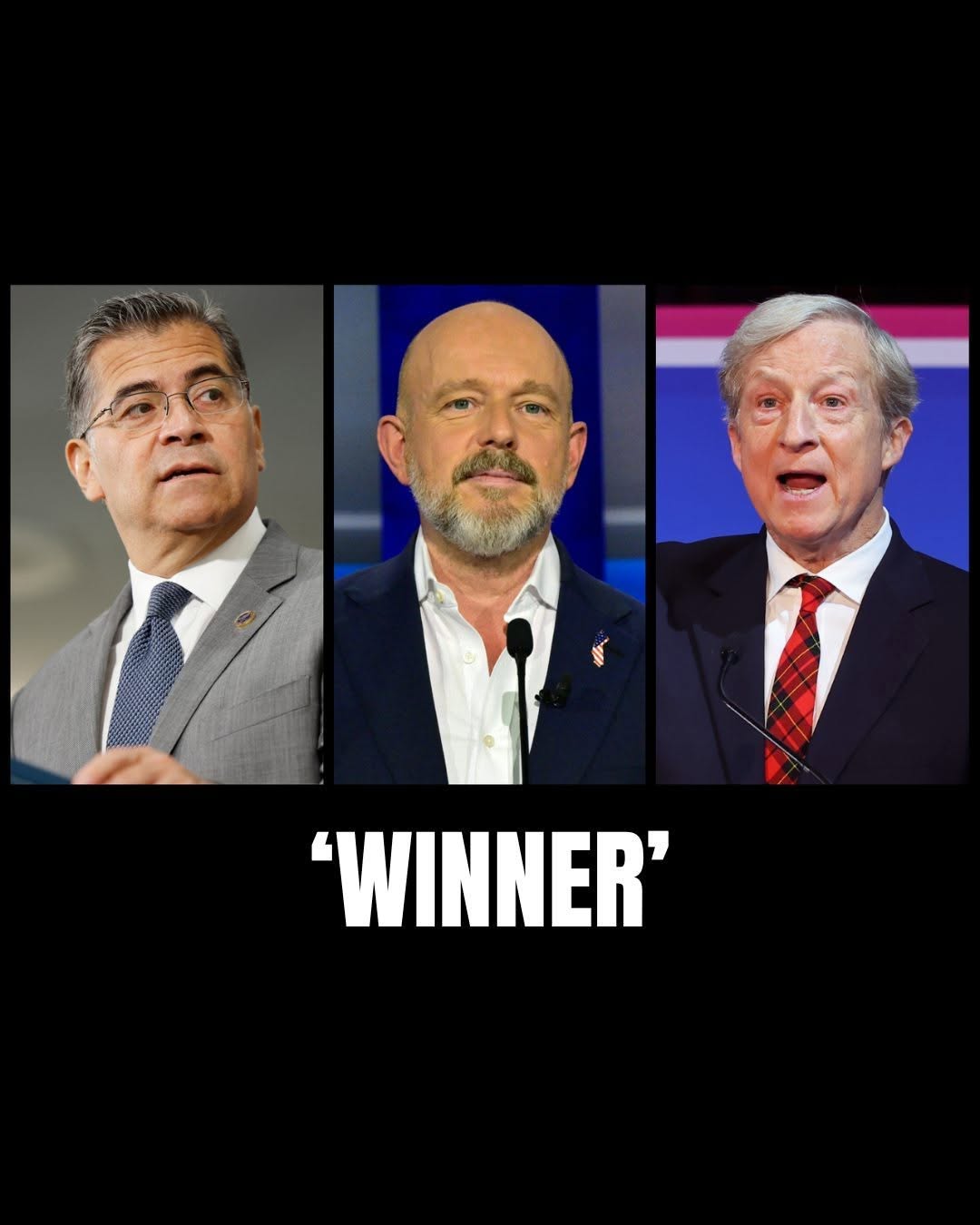
California’s governor’s race has entered a new phase, delivering a result that few political observers would have predicted just months ago.
After a turbulent campaign season marked by unexpected withdrawals, shifting alliances, and intense public scrutiny, Xavier Becerra emerged as the candidate moving forward to the general election, providing Democrats with a much-needed sense of stability after months of uncertainty.
For much of the year, California politics seemed defined by unpredictability. High-profile names considered potential contenders ultimately chose not to run. Several rising political figures who had once generated excitement among voters found themselves facing setbacks that weakened their campaigns. Meanwhile, frustration among portions of the electorate created an atmosphere in which traditional political assumptions no longer felt reliable.
Against that backdrop, Becerra’s success represents more than a simple electoral victory. It reflects the appeal of experience and familiarity during a period when many voters appear increasingly skeptical of political spectacle. While other candidates focused on generating headlines and building momentum through media attention, Becerra’s campaign emphasized steady leadership, government experience, and a long record of public service.
Supporters argue that those qualities ultimately resonated with voters seeking competence and predictability in uncertain times.
His path to this moment was far from effortless.
Throughout the campaign, analysts repeatedly questioned whether California voters were looking for a new political generation rather than an established figure. The state’s political landscape has been evolving rapidly, driven by demographic changes, economic pressures, housing challenges, and growing debates about the future direction of public policy.
In that environment, some observers believed a more unconventional candidate might capture the public’s imagination.
Instead, Becerra’s performance suggested that a significant portion of voters still values experience when faced with complex issues. His supporters describe him as a candidate who understands the machinery of government and possesses the practical knowledge required to navigate California’s enormous challenges.
The victory also carries broader implications for the Democratic Party.
For months, party leaders worried about the possibility of entering the general election season divided and uncertain. Internal disagreements, strategic miscalculations, and concerns about voter enthusiasm created anxiety among Democrats who feared a difficult campaign ahead.
Becerra’s emergence helps alleviate some of those concerns.
Rather than facing a fragmented political landscape with no clear standard-bearer, Democrats now have a nominee capable of uniting multiple factions within the party. His campaign has already begun emphasizing themes of continuity, experience, and effective governance, seeking to present him as a reliable choice in an era defined by political volatility.
Yet while Democrats may be celebrating, the broader battle is far from settled.
One of the most closely watched questions remains unresolved: who will secure the second position on the November ballot?
The contest between Steve Hilton and Tom Steyer has become one of the most fascinating storylines in California politics. Both candidates represent dramatically different visions for the state’s future, and the eventual outcome could fundamentally reshape the general election campaign.
Hilton, known for his alignment with Donald Trump and conservative political themes, has attracted support from voters seeking significant change in California’s political direction. His supporters argue that the state’s leadership has failed to address key concerns involving affordability, public safety, and government accountability.
Steyer, by contrast, brings a different kind of political profile.
The billionaire businessman and activist has invested heavily in political causes and environmental advocacy. His campaign has emphasized progressive priorities while also leveraging substantial financial resources to build visibility and support.
The difference between these two potential opponents is enormous.
If Hilton advances, November could become a traditional partisan battle between Democratic and Republican visions for California’s future. Such a race would likely focus on familiar political divisions involving taxation, regulation, public services, immigration, environmental policy, and economic development.
If Steyer secures the second position, however, the election could transform into something entirely different.
Instead of a conventional Democrat-versus-Republican contest, voters could witness an intense intraparty confrontation between two Democrats representing distinct approaches to governance. Such a scenario would likely spark debates over ideology, priorities, and the future direction of California’s dominant political party.
Political strategists on both sides recognize the significance of that distinction.
The identity of Becerra’s opponent may determine not only campaign strategy but also voter turnout, fundraising efforts, media coverage, and national attention.
Adding even more intrigue to California’s political landscape is the unexpected drama unfolding in Los Angeles.
The mayoral contest has produced one of the most surprising developments of the election season. Reality television personality Spencer Pratt remains locked in a closely watched battle for a runoff position, a development that many political insiders would have dismissed as impossible only a short time ago.
His continued presence near the top of the standings has become a symbol of broader voter dissatisfaction with traditional political structures.
Whether Pratt ultimately advances or falls short, his performance has already demonstrated that California’s political establishment can no longer assume automatic support from voters. Outsider candidates, unconventional campaigns, and unexpected coalitions have become increasingly influential forces in modern elections.
For established politicians, that reality presents both challenges and warnings.
Voters appear more willing than ever to consider alternatives to traditional political figures. Familiarity alone is no longer enough to guarantee success. Candidates must compete in an environment where celebrity, social media influence, and public frustration can dramatically alter electoral dynamics.
The result is a political climate that feels increasingly unpredictable.
While Becerra’s victory offers Democrats a sense of direction, it does not eliminate the uncertainty surrounding the months ahead. Campaigns are already preparing for a fiercely contested general election, one that could shape California’s political future for years to come.
Questions about housing affordability, economic growth, public safety, education, environmental policy, and government effectiveness will likely dominate the debate. Candidates will compete not only for votes but also for the broader narrative about what California should become in the years ahead.
For now, Becerra stands as the candidate who survived a chaotic and often unpredictable primary season. His victory reflects persistence, experience, and the ability to navigate a political environment filled with obstacles.
Yet the celebration may be brief.
The identity of his eventual opponent remains uncertain. The political forces reshaping California continue to evolve. Voter frustrations remain powerful. And as recent elections have repeatedly demonstrated, assumptions can collapse quickly in a rapidly changing political landscape.
Democrats may have secured their nominee, but they have not secured the future. The next chapter of California’s political story is only beginning, and the battle ahead promises to be every bit as dramatic as the race that brought them here.