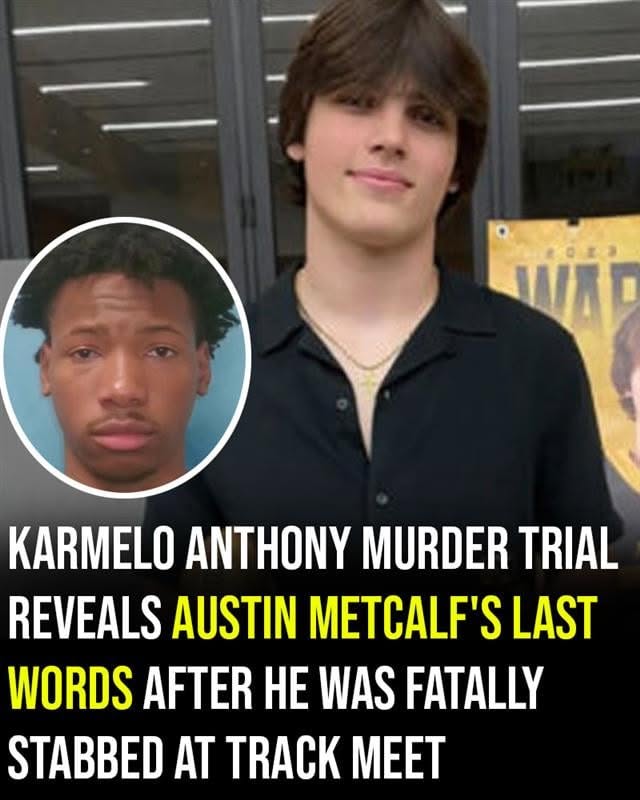
What should have been an ordinary day of competition and school spirit has become one of the most heartbreaking criminal cases in recent memory.
Months after 17-year-old Austin Metcalf lost his life during a confrontation at a high school track meet, a courtroom is now revisiting the tragic events that forever changed multiple families and an entire community.
As testimony unfolds, jurors are hearing emotional accounts of the final moments leading up to Austin’s death, including details about the last words he reportedly spoke before collapsing from a fatal stab wound.
The trial has drawn intense public attention, not only because of the devastating outcome but because of the ages of those involved. Both Austin Metcalf and Karmelo Anthony were teenagers with their futures ahead of them. Now one family is grieving an unimaginable loss while another watches a young man’s future hang in the balance as a jury determines what happened during a confrontation that lasted only seconds.
Inside the courtroom, emotions have remained high as witnesses describe the events that unfolded at the crowded track meet.
According to prosecutors, the incident began with what appeared to be a relatively minor disagreement involving seating arrangements beneath a team tent. What started as a verbal dispute quickly escalated into a physical confrontation, ending with a single stab wound to Austin’s chest.
That wound would prove fatal.
Emergency responders rushed to the scene, but despite efforts to save him, Austin died from his injuries.
The prosecution argues that the evidence clearly supports a murder charge. Prosecutors claim that Karmelo Anthony intentionally used a knife during the confrontation and then attempted to distance himself from the scene afterward.
They point to witness testimony, physical evidence, and the recovery of a knife allegedly connected to the incident.
According to their case, Austin’s death was not an unavoidable act of self-defense but rather the result of a deliberate decision made during an argument.
As the trial progresses, prosecutors have sought to paint a detailed picture of the moments before and after the stabbing.
More than 35 witnesses are expected to testify, including students, coaches, law enforcement officers, medical professionals, and family members.
Among the most emotional testimony comes from Austin’s identical twin brother, Hunter Metcalf.
The brothers shared an unusually close bond throughout their lives. Friends and family have described them as inseparable, often spending nearly every day together. That bond has made Hunter’s testimony particularly painful for those in attendance.
Jurors listened as he described the chaos that erupted following the confrontation.
He recalled seeing his brother injured and struggling to understand what had happened in the immediate aftermath. Witnesses in the courtroom reportedly became emotional as details emerged regarding Austin’s final moments and the desperate efforts made to help him.
For the Metcalf family, every day of the trial forces them to relive a nightmare that began at what should have been a routine school event.
Family members have attended proceedings hoping for answers and accountability. Their grief remains visible throughout the courtroom as testimony repeatedly returns to the final minutes of Austin’s life.
Yet across the courtroom sits another family experiencing a different kind of anguish.
Karmelo Anthony’s defense team argues that the prosecution’s version of events ignores critical context.
According to defense attorneys, Anthony was frightened, overwhelmed, and reacting to what he perceived as a threatening situation. They contend that he did not arrive at the event intending to harm anyone and that his actions were driven by fear rather than malice.
The defense maintains that the confrontation escalated rapidly and that Anthony believed he needed to protect himself.
Their strategy centers on convincing jurors that the stabbing occurred in a moment of panic rather than as an intentional act of murder.
Throughout the trial, defense attorneys have emphasized Anthony’s age and emotional state at the time of the incident. They argue that teenagers often react differently than adults under stressful circumstances and that split-second decisions made during moments of fear should be evaluated within that context.
Prosecutors strongly dispute that characterization.
They argue that the evidence demonstrates conscious choices made before, during, and after the stabbing. They point to witness accounts suggesting that Anthony discarded the weapon and left the area rather than remaining to assist or explain his actions.
Those details, prosecutors argue, are inconsistent with a claim of lawful self-defense.
As each side presents its case, jurors face the difficult task of separating emotion from evidence.
The challenge is particularly significant because the facts themselves are tragic regardless of the eventual verdict.
No outcome can reverse what happened that day.
Austin Metcalf’s life ended before he reached adulthood. His family must now navigate a future without a son, brother, and friend they loved deeply.
At the same time, the legal process will determine whether Karmelo Anthony spends years or potentially decades living with the consequences of what happened during those brief moments at the track meet.
The case has sparked wider conversations throughout the community about youth violence, conflict resolution, and how quickly seemingly minor disagreements can spiral into life-altering tragedies.
Many parents have expressed shock that an argument at a school sporting event could end with such devastating consequences.
Educators, coaches, and community leaders have also reflected on the pressures facing young people and the importance of teaching de-escalation, communication, and emotional control.
Still, those broader discussions remain secondary to the immediate question facing the jury.
Was this an act of murder?
Or was it a panicked response by a frightened teenager who believed he was in danger?
The answer will ultimately determine Anthony’s fate.
As testimony continues, courtroom observers remain captivated by a case that is as emotionally devastating as it is legally complex.
Every witness adds another piece to the puzzle.
Every statement brings new scrutiny to the seconds before the fatal encounter.
And every day of proceedings serves as a reminder of how quickly lives can change forever.
For Austin Metcalf’s loved ones, the trial is about seeking justice for a young man whose future was cut short in an instant.
For Karmelo Anthony and his family, it is about determining whether a terrible moment should define the rest of a young life.
As the courtroom waits for the final verdict, one painful truth remains undeniable: what began as a simple disagreement at a school track meet ended in a tragedy that neither family will ever escape.
Now twelve jurors must decide whether that tragedy was a criminal act, an act of self-defense, or something that falls somewhere in the difficult space between fear, judgment, and irreversible consequences.