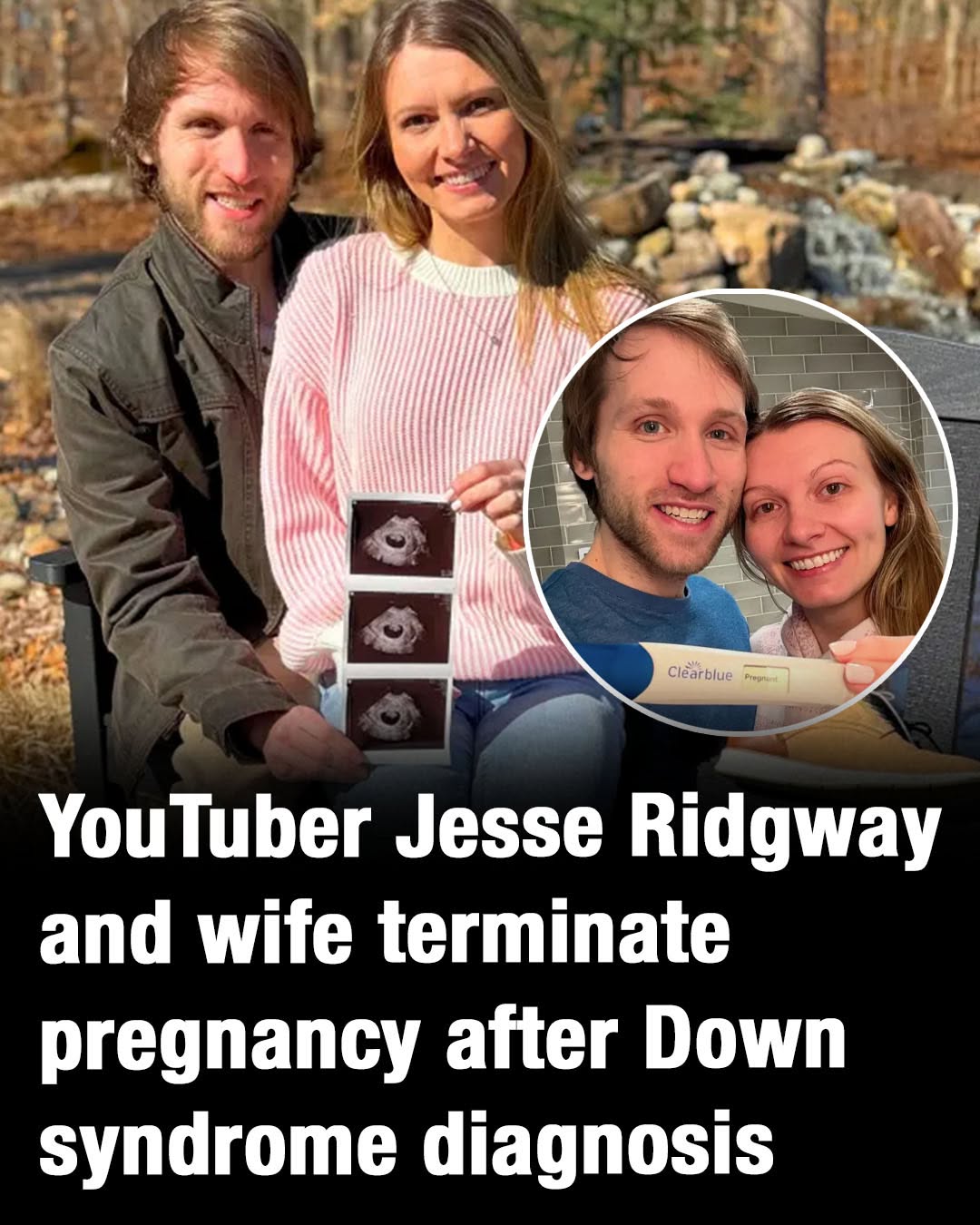
For months, popular YouTuber Jesse Ridgway and his wife Ashley were living through what they believed would be one of the happiest chapters of their lives.
They eagerly shared updates with their audience, talked about future plans, and looked forward to welcoming their child into the world. Like countless expectant parents, they imagined first smiles, family milestones, and the joy of building a future together.
Then everything changed.
What began as a routine stage of pregnancy soon became an emotional ordeal that neither of them could have anticipated. Medical testing revealed devastating news: their unborn baby had an estimated 95 percent chance of having Trisomy 21, commonly known as Down syndrome. The diagnosis forced the couple into a situation they never expected to face—a decision that would leave a lasting impact on their lives.
In a deeply personal video shared with his followers, Jesse spoke candidly about the emotional turmoil that followed the diagnosis. Rather than presenting a simple narrative, he described weeks of uncertainty, fear, research, and difficult conversations that tested both him and Ashley in ways they had never experienced before.
At first, Jesse admitted, he believed they could handle whatever challenges lay ahead.
His initial reaction was one many parents might recognize: a determination to adapt and find a way forward regardless of the circumstances. He recalled feeling hopeful that love, commitment, and preparation would be enough to overcome any obstacles that accompanied the diagnosis.
But as the couple learned more about the condition, they found themselves confronting realities that felt increasingly overwhelming.
They spent countless hours reading medical literature, speaking with healthcare professionals, examining statistics, and listening to the experiences of families raising children with Down syndrome. The more information they gathered, the more complex their decision became.
While many individuals with Down syndrome live meaningful and fulfilling lives, Jesse explained that the condition can also be associated with significant medical complications. Heart defects, developmental delays, immune system challenges, and lifelong support needs were among the concerns that weighed heavily on the couple’s minds.
For Jesse and Ashley, the issue extended beyond the diagnosis itself.
They found themselves asking difficult questions about quality of life, long-term care, financial responsibilities, and what the future might look like decades down the road. They considered not only their own ability to provide support but also the potential challenges their child might face throughout life.
As weeks passed, the emotional burden grew heavier.
The couple described feeling trapped between two heartbreaking realities. Every possible path seemed to involve pain. There was no option that felt easy, clear, or free of consequences.
Eventually, after extensive reflection and consultation with medical professionals, Jesse and Ashley made the decision to terminate the pregnancy.
The choice marked the end of months filled with anticipation and hope. Instead of preparing a nursery and celebrating an upcoming birth, they found themselves grieving a future they had already begun imagining.
Jesse later described the experience as the most traumatic event he and his wife had ever endured.
He spoke openly about the emotional aftermath, explaining that the loss continued to affect them long after the procedure. Feelings of sadness, doubt, grief, and guilt became part of their daily lives as they attempted to process what had happened.
What made the experience even more difficult, Jesse said, was the intense public reaction that followed.
As a public figure with millions of followers, he understood that sharing such a personal decision would invite strong opinions. Yet the volume of criticism and judgment still caught him off guard.
Some people accused the couple of making the wrong choice. Others questioned their motives or challenged their understanding of Down syndrome. Social media quickly became a battleground of competing viewpoints, with supporters and critics debating the deeply personal decision.
Jesse acknowledged that people are entitled to their beliefs, but he also argued that no outsider can fully understand what it feels like to sit in a doctor’s office and hear life-changing news about an unborn child.
According to him, many judgments are formed from a distance, without experiencing the fear, uncertainty, and emotional devastation that often accompany such situations.
He emphasized that every family faces different circumstances and that deeply personal medical decisions cannot be reduced to simple slogans or assumptions.
Despite the controversy, Jesse made it clear that his decision was never rooted in a lack of compassion toward people living with Down syndrome.
In fact, some of the most emotional moments in his statement came when he addressed individuals with Down syndrome and autism directly.
He spoke about the value and dignity of every human life, expressing admiration for people who overcome significant challenges and for families who dedicate themselves to supporting loved ones with special needs.
His words reflected a mixture of grief and respect.
He acknowledged that many families raising children with Down syndrome demonstrate extraordinary strength, patience, and love. He praised parents who navigate medical challenges, educational needs, and lifelong caregiving responsibilities while creating supportive environments for their children.
At the same time, he remained honest about his own limitations and fears.
Rather than claiming certainty, Jesse described himself as someone who made an agonizing decision while confronting circumstances he felt unprepared to manage. He admitted that the choice would likely remain with him forever and that he would continue wondering about the child he never got the chance to meet.
That sense of loss became one of the most powerful themes throughout his story.
Although the pregnancy ended, the emotional connection to the baby did not simply disappear. Jesse spoke about grieving not only a child but also an imagined future filled with birthdays, family memories, and milestones that would never occur.
For many viewers, the raw vulnerability of his account stood in stark contrast to the often simplistic way controversial topics are discussed online.
Instead of presenting himself as certain or unshaken, he revealed the emotional complexity behind a decision that continues to divide public opinion. His story highlighted how medical diagnoses, family planning, and personal values can intersect in ways that leave no easy answers.
The conversation surrounding his experience also reignited broader debates about prenatal testing, reproductive choices, disability awareness, and the support systems available to families facing difficult diagnoses.
While opinions remain sharply divided, Jesse’s story served as a reminder that behind every headline is a family grappling with circumstances that are often far more complicated than they appear.
Today, Jesse and Ashley continue to mourn the loss of their unborn child while attempting to move forward with their lives. The experience has left permanent emotional scars, but it has also deepened their understanding of grief, uncertainty, and the difficult realities some families face during pregnancy.
Their story is not one of simple conclusions or universal lessons. Instead, it is a deeply personal account of two people confronted with an impossible choice, forced to weigh hope against fear, love against uncertainty, and dreams against realities they never expected to face.
For Jesse, the pain remains profound. The questions have not disappeared. The memories still linger.
And somewhere between heartbreak, controversy, and reflection lies the story of a child who was loved long before birth and whose brief existence changed the lives of two parents forever.