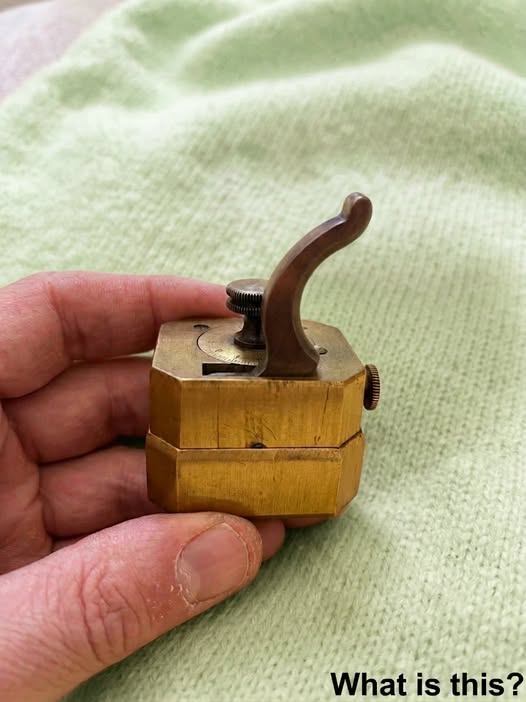
It started like countless flea market discoveries do: with a dusty object sitting quietly among forgotten treasures.
On a cool weekend morning, surrounded by tables piled high with old books, tarnished silverware, antique clocks, and mysterious gadgets from another era, I noticed a small metal device that immediately caught my attention. It wasn’t flashy or particularly decorative. In fact, it looked surprisingly plain. Yet something about its design suggested it had once served an important purpose.
The seller shrugged when I asked what it was.
“No idea,” he admitted. “Found it in an estate box.”
That answer only made it more intriguing.
The object fit comfortably in the palm of my hand. It was solid, surprisingly heavy for its size, and clearly made with precision. Tiny mechanical components hinted at a function far more sophisticated than an ordinary household tool. There were no labels, no instructions, and no obvious clues about its purpose.
Curiosity got the better of me.
I bought it and took it home.
At first, I assumed it might be some forgotten workshop instrument or a specialized tool used in a trade that no longer exists. I spent hours searching online, comparing photographs, and scrolling through antique collector forums.
The deeper I looked, the stranger the mystery became.
Then I found a photograph that stopped me cold.
The object in the image looked nearly identical to the one sitting on my desk.
The caption identified it as a medical scarificator.
Suddenly, the mystery transformed into something far more fascinating and unsettling.
For centuries, physicians practiced a procedure known as bloodletting, one of the most common medical treatments in human history. Today it sounds shocking, but for generations it was considered a legitimate and scientifically sound way to treat illness.
Doctors believed that many diseases resulted from imbalances within the body. By removing blood, they hoped to restore health and eliminate harmful conditions thought to be causing sickness.
Headaches.
Fevers.
Inflammation.
Digestive disorders.
Respiratory problems.
Even emotional distress.
All were sometimes treated through bloodletting.
The scarificator was one of the tools used to make that possible.
At first glance, the device appears harmless enough. But inside its compact metal body hides an ingenious mechanism designed to perform a very specific task.
With the press of a trigger, a spring-loaded system would release multiple tiny blades simultaneously.
The blades would emerge for only a fraction of a second before retracting again.
The result was a series of small, controlled cuts made across the skin.
These cuts were intended to draw blood quickly and efficiently.
Often, the procedure was combined with cupping, another common medical practice. Heated cups would be placed over the incisions, creating suction that encouraged blood flow from the treated area.
To physicians of the time, this represented advanced medical care.
To modern eyes, it can seem difficult to comprehend.
Yet understanding the scarificator requires understanding the world in which it existed.
Medicine during previous centuries operated with limited knowledge compared to today. Germ theory had not yet transformed healthcare. Microscopes revealed little about infection. Antibiotics did not exist. Many diseases remained mysterious and terrifying.
Doctors worked with the information available to them.
Patients placed enormous trust in their expertise.
When someone suffered from illness, families desperately sought relief wherever it could be found.
In that environment, bloodletting became one of the dominant forms of treatment.
The scarificator represented innovation rather than cruelty.
It was designed to improve consistency and precision compared with older methods involving knives or lancets.
To physicians of the era, it was a sophisticated instrument.
To patients, it often represented hope.
Holding the antique in my hand, I found myself imagining the countless people who may have encountered similar devices over the centuries.
A worried mother bringing in a sick child.
A farmer weakened by fever.
A merchant suffering from headaches.
A laborer desperate for relief after months of pain.
Each would have arrived seeking answers.
Each likely trusted the physician standing before them.
Each probably believed the treatment offered a genuine chance of recovery.
The scarificator became more than an antique object.
It became a connection to those forgotten moments.
Its polished metal surface seemed to carry echoes of human fear, determination, and faith in medical progress.
What fascinated me most was not the procedure itself but what it revealed about the history of knowledge.
Every generation believes it understands the world reasonably well.
People trust experts.
They follow accepted practices.
They build institutions around prevailing theories.
Yet history repeatedly demonstrates that certainty can be temporary.
Ideas once considered unquestionable sometimes become obsolete.
Treatments once regarded as breakthroughs can later appear misguided.
The scarificator serves as a powerful reminder of that reality.
The physicians who used it were not villains.
Most genuinely wanted to help their patients.
They applied the best knowledge available at the time.
Their mistakes were not born from malice but from incomplete understanding.
That distinction makes the object even more thought-provoking.
It represents both progress and limitation.
Wisdom and error.
Compassion and misunderstanding.
Looking closely at the craftsmanship, I couldn’t help but admire the engineering involved. The mechanism remains remarkably clever even by modern standards. The blades deploy and retract with astonishing speed. Every component was carefully designed to perform a specific function reliably.
The craftsmanship reflects the ingenuity of its creators.
Yet that ingenuity was directed toward a medical theory now largely abandoned.
That contradiction is what makes the artifact so captivating.
It embodies humanity’s endless quest to solve problems, even when the answers are imperfect.
Today, advances in medical science have transformed healthcare beyond anything those early practitioners could have imagined.
Modern physicians rely on evidence-based research, advanced imaging, genetic analysis, laboratory testing, and technologies that would have seemed miraculous centuries ago.
Diseases that once terrified entire populations can now be prevented, treated, or cured.
And yet the scarificator remains relevant.
Not because we would use it again.
But because it reminds us to remain humble.
Future generations may one day look back at some of our own practices with similar astonishment.
They may wonder how we could have believed certain things.
They may discover better treatments, deeper understanding, and more effective solutions than those available today.
That possibility is part of the story of human progress.
The small metal device I found at a flea market now sits on a shelf in my home.
Visitors often ask about it.
At first glance, most assume it is some kind of mechanical tool or unusual antique gadget.
When they learn what it actually is, the reaction is almost always the same.
Surprise.
Curiosity.
A little discomfort.
And a renewed appreciation for how far medicine has come.
What began as a simple flea market purchase became something much more meaningful.
It became a reminder that history is often hidden inside ordinary objects.
Sometimes the most fascinating discoveries are not valuable because of what they are worth.
They are valuable because of the stories they carry.
And few stories are more remarkable than humanity’s long, complicated journey from uncertainty to understanding.