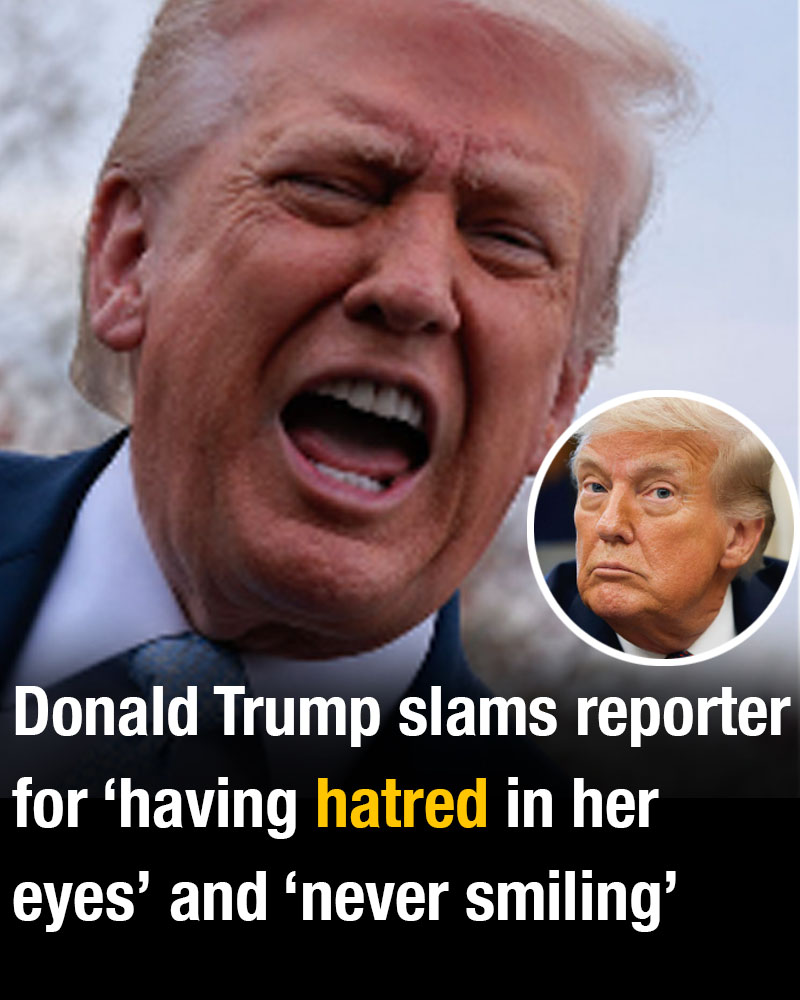
What began as a routine policy question inside the Oval Office quickly transformed into one of the most talked-about political exchanges of the week, reigniting debates about presidential accountability, media scrutiny, and the increasingly combative relationship between elected officials and journalists.
The confrontation unfolded during a press event when a reporter sought clarification regarding a controversial Justice Department fund reportedly worth $1.8 billion. Rather than focusing immediately on the substance of the question, the discussion took an unexpected turn that quickly captured attention across social media and cable news networks.
Observers described the moment as tense from the start. The question itself centered on public concerns about how the large fund would be administered, who might benefit from it, and whether adequate oversight measures would be in place. These are the kinds of questions reporters routinely ask public officials, particularly when taxpayer dollars and government programs are involved.
But instead of offering a direct explanation, the conversation shifted toward the reporter personally.
The exchange quickly became less about policy and more about personality.
Critics and supporters alike dissected every second of the encounter, debating whether it represented a legitimate challenge to the media or an effort to divert attention from the issue being raised.
At the center of the moment was CNN journalist Kaitlan Collins, a reporter who has frequently questioned political leaders from both parties and who has become a familiar presence at major White House press briefings and presidential events.
As the questioning continued, Collins remained focused on obtaining an answer regarding the fund and its intended use.
Those watching noticed a striking contrast between the two approaches unfolding in real time.
One side focused on the messenger.
The other continued returning to the message.
Rather than escalating the confrontation, Collins repeatedly attempted to steer the discussion back to the original topic. She did not interrupt aggressively, raise her voice, or engage in a personal argument. Instead, she returned to the same basic question that had prompted the exchange in the first place.
What would happen to the money?
Who would ultimately benefit?
What safeguards would be in place?
The simplicity of those questions became a central part of the story itself.
Political analysts later noted that some of the most memorable moments in modern press conferences are not created by dramatic confrontations but by persistence. Often, a reporter’s willingness to repeat a question can become more significant than any single answer.
For supporters of a free and independent press, the exchange served as an example of journalism’s core purpose: asking questions on behalf of the public and continuing to ask them when answers remain unclear.
For critics of mainstream media organizations, the incident became another chapter in a long-running conflict between political leaders and journalists whom they believe are unfairly adversarial.
The debate quickly spread online.
Videos of the interaction accumulated millions of views within hours. Commentators from across the political spectrum weighed in with sharply different interpretations of what had occurred.
Some argued that the reporter had done exactly what journalists are supposed to do.
Others insisted the questioning was politically motivated.
Yet beyond the partisan arguments, many observers focused on a broader issue: the growing tendency for political discourse to become personal rather than substantive.
Instead of discussing policy details, budgets, legal authority, or government oversight, public conversations increasingly revolve around individual personalities, perceived motives, and emotional reactions.
That dynamic was evident throughout the Oval Office exchange.
The original issue involved government spending and public accountability. Yet much of the subsequent coverage centered on the confrontation itself rather than the policy question that sparked it.
Media historians point out that clashes between presidents and reporters are hardly new.
From Franklin Roosevelt to Richard Nixon, from Ronald Reagan to Barack Obama, presidents have often expressed frustration with journalists who ask difficult or uncomfortable questions.
The relationship between the White House and the press has always involved tension because their roles are fundamentally different.
Political leaders seek to advance agendas, communicate priorities, and maintain public support.
Journalists seek information, clarification, and transparency.
These goals sometimes align, but often they collide.
What made this particular exchange stand out was the extent to which attention shifted away from the policy issue and toward personal commentary.
For many viewers, that shift raised larger questions about how public officials respond when faced with scrutiny.
Should leaders focus exclusively on answering questions?
Should reporters adapt their approach when dealing with confrontational figures?
And how can the public separate political theater from meaningful discussion about government decisions?
The answers depend largely on individual perspectives.
Yet regardless of political affiliation, many observers agreed on one point: the public benefits most when substantive questions receive substantive answers.
The controversy surrounding the Justice Department fund remains a topic of discussion, with lawmakers, legal analysts, and watchdog organizations continuing to examine how the money may be allocated and monitored.
Meanwhile, the Oval Office confrontation has taken on a life of its own.
The video continues circulating online.
Supporters of both sides continue sharing clips and commentary.
Political strategists continue analyzing what the moment reveals about communication in modern American politics.
For some, the story is about media accountability.
For others, it is about government accountability.
For many, it is about both.
What remains undeniable is that the exchange highlighted a growing reality of contemporary politics: the battle over information often becomes as significant as the information itself.
Questions, answers, narratives, and perceptions now travel instantly across digital platforms, where millions of people form opinions based on brief clips rather than lengthy explanations.
In that environment, even a single question can become a national conversation.
Whether remembered as a clash over transparency, a dispute between a president and a reporter, or simply another chapter in the ongoing struggle between power and scrutiny, the moment resonated because it touched on a fundamental democratic principle.
Public officials hold authority.
Journalists ask questions.
Citizens watch both.
And in those brief but revealing exchanges, people often learn as much from what is avoided as from what is actually said.