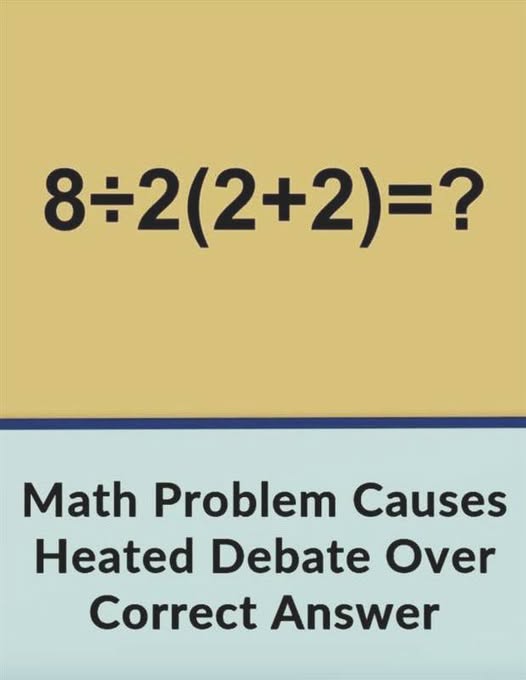
It looked like the kind of math problem a student could solve in less than a minute.
Just a few numbers.
A division sign.
A set of parentheses.
Nothing complicated at first glance.
Yet one mathematical expression managed to ignite a debate so intense that millions of people around the world found themselves arguing over what should have been a straightforward calculation.
The equation was simple:
8 ÷ 2(2 + 2)
Despite containing only elementary arithmetic, the problem spread across social media platforms, online forums, classrooms, and even news websites. Friends challenged one another. Families debated at dinner tables. Teachers weighed in. Engineers, scientists, and mathematicians were suddenly being asked to settle an argument that seemed impossible to end.
The strange part was that many people were completely convinced they were correct.
And depending on how they interpreted the expression, they arrived at two entirely different answers.
Some insisted the answer was 16.
Others passionately argued that the answer was 1.
Neither side appeared willing to back down.
What started as a simple puzzle quickly became one of the internet’s most famous mathematical controversies.
The reason for the disagreement wasn’t that people had forgotten basic arithmetic.
Instead, it exposed something far more interesting: how mathematical notation can sometimes create confusion when it isn’t written clearly.
To understand why the debate became so heated, it helps to walk through the expression step by step.
Most students learn a set of rules known as the order of operations. Depending on where someone attended school, they may know these rules as PEMDAS, BODMAS, BEDMAS, or another similar acronym.
While the names vary slightly, the principle remains the same.
Parentheses are solved first.
Exponents come next.
Multiplication and division follow.
Addition and subtraction are completed last.
These rules exist for a simple reason.
Without them, every mathematical expression could produce multiple answers depending on who was solving it.
Standardized rules ensure that everyone follows the same process and arrives at the same result.
Applying those rules to the viral expression begins with the parentheses.
The portion inside the brackets is:
2 + 2
That simplifies to:
4
The equation then becomes:
8 ÷ 2 × 4
At this point, many people immediately reach the answer of 16.
Why?
Because multiplication and division share equal priority within the order of operations. When operations have equal priority, they are evaluated from left to right.
Following that rule:
8 ÷ 2 = 4
Then:
4 × 4 = 16
The final answer becomes 16.
For countless educators and mathematics instructors, this interpretation follows standard arithmetic convention.
Case closed.
Except it wasn’t.
Because a large group of people saw the expression differently.
They focused on the way the multiplication was written.
Instead of viewing the equation as 8 ÷ 2 × 4, they viewed the adjacent notation 2(4) as a tightly connected mathematical unit.
In their minds, the expression became:
8 ÷ (2 × 4)
Performing the multiplication first gives:
8 ÷ 8
Which equals:
1
From this perspective, the answer appeared equally obvious.
And so the battle lines were drawn.
One side confidently defended 16.
The other passionately supported 1.
The internet exploded.
Social media users shared screenshots of calculators producing different answers. Comment sections filled with arguments stretching thousands of replies deep. YouTube creators produced lengthy breakdowns. Teachers recorded educational videos explaining their positions.
People who hadn’t thought about algebra in years suddenly found themselves passionately debating arithmetic notation.
The fascination extended beyond mathematics itself.
The equation became a social phenomenon.
Why?
Because it tapped into something people love: being right.
Everyone could understand the problem.
Everyone could attempt to solve it.
And everyone believed their reasoning made perfect sense.
Unlike highly specialized scientific debates, this was a puzzle accessible to nearly anyone.
That accessibility fueled its popularity.
The controversy also revealed an important truth about communication.
Mathematics is often described as a universal language.
Yet even languages depend on clarity.
When expressions are written ambiguously, misunderstandings become possible.
Professional mathematicians rarely write equations in ways that invite multiple interpretations.
In textbooks, research papers, engineering documents, and scientific publications, clarity is prioritized above all else.
Additional parentheses are frequently used to eliminate uncertainty.
For example, if someone intended the answer to be 16, they could write:
(8 ÷ 2)(2 + 2)
Or:
(8 ÷ 2) × (2 + 2)
If someone intended the answer to be 1, they could write:
8 ÷ [2(2 + 2)]
In both cases, the ambiguity disappears instantly.
Nobody needs to argue.
Nobody needs to guess.
The intended meaning becomes obvious.
That is one reason many mathematics professionals were less interested in the answer itself than in the notation.
To them, the viral expression demonstrated poor mathematical communication rather than a flaw in arithmetic.
The rules were not broken.
The writing was simply unclear enough to encourage competing interpretations.
As discussions continued online, experts pointed out that implied multiplication—the kind created when a number is placed directly next to parentheses—has historically been treated differently in various contexts.
Different textbooks.
Different calculators.
Different software programs.
Different educational systems.
Each has occasionally applied slightly different conventions.
This historical inconsistency added fuel to the debate.
People could often find examples supporting whichever answer they preferred.
As a result, both sides felt justified.
The situation resembled other famous internet disagreements.
Much like optical illusions that cause people to see different colors or hear different sounds, the equation revealed how individuals can interpret the same information differently while sincerely believing their perspective is correct.
The debate became less about arithmetic and more about human perception.
It highlighted how assumptions influence understanding.
It demonstrated how people often rely on familiar patterns rather than explicit instructions.
And perhaps most importantly, it showed how quickly online conversations can transform small ambiguities into massive controversies.
Years after first going viral, the equation continues resurfacing across social media.
New generations encounter it.
Fresh debates begin.
The arguments repeat almost exactly as before.
One group confidently writes 16.
Another immediately responds with 1.
Thousands of comments follow.
The cycle continues.
For educators, the expression has become a valuable teaching tool.
Rather than focusing solely on calculation, teachers use it to emphasize the importance of mathematical communication.
Students learn that solving a problem correctly is only part of the process.
Writing it clearly matters just as much.
After all, mathematics is ultimately a language designed to communicate ideas precisely.
When notation becomes unclear, confusion follows.
The famous equation serves as a reminder that precision is often more important than complexity.
A highly advanced equation written clearly can be easier to understand than a simple equation written poorly.
That lesson extends far beyond mathematics.
Whether communicating through language, science, business, or everyday conversation, clarity matters.
Small ambiguities can create surprisingly large misunderstandings.
In the end, the viral equation wasn’t really about whether the answer was 16 or 1.
It was about interpretation.
It was about communication.
And it was about how millions of people can look at the exact same information and walk away with completely different conclusions.
Perhaps that is why the problem remains so fascinating.
Years later, it continues sparking debates, attracting attention, and dividing opinions around the world.
Not because the arithmetic is difficult.
But because the expression reminds us that even the simplest things can become complicated when clarity disappears.
And sometimes, a few numbers on a screen are all it takes to start an argument that refuses to die.