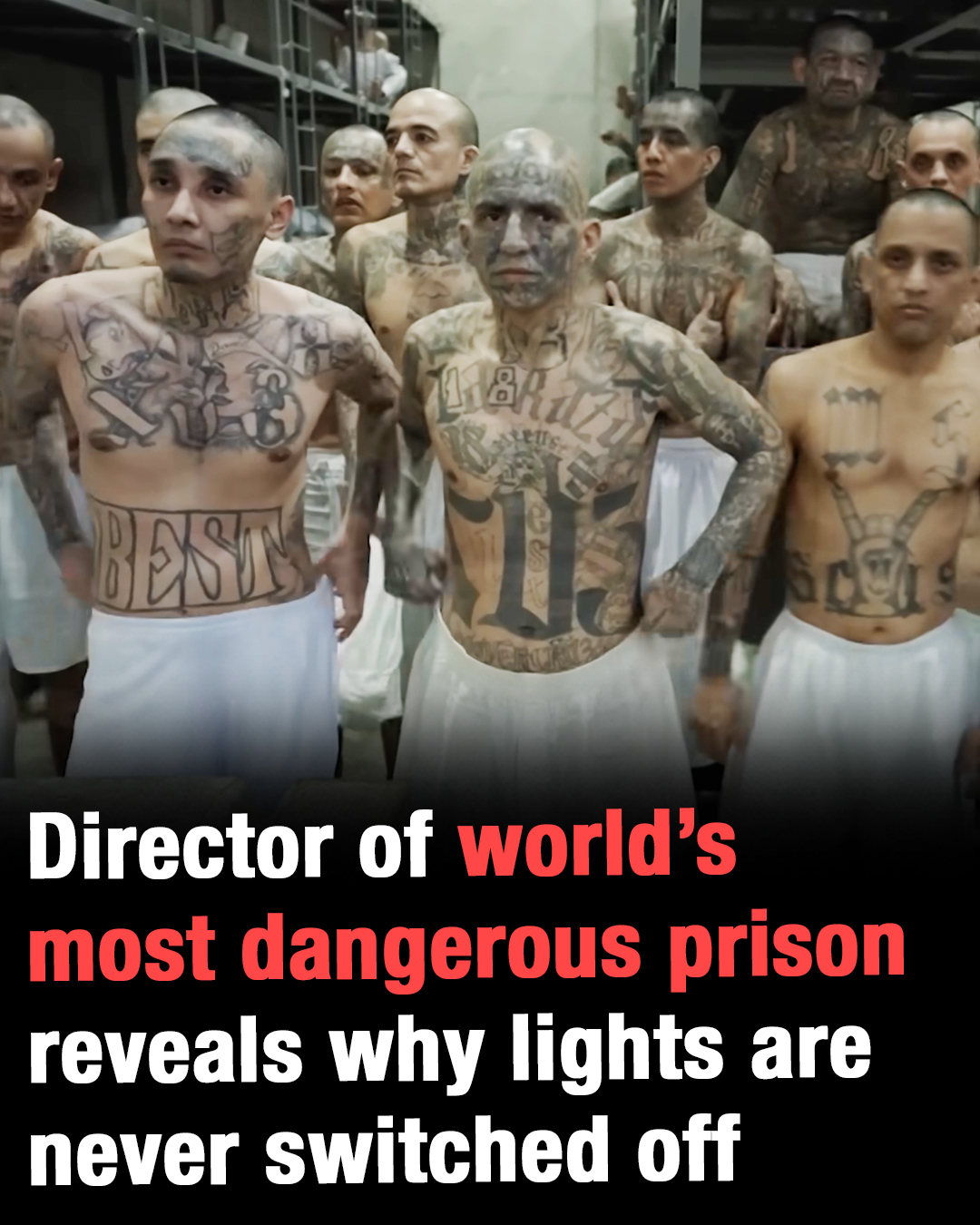
Deep in El Salvador, behind layers of concrete, steel, surveillance systems, and armed security, stands one of the most controversial correctional facilities ever constructed.
Known as the Terrorism Confinement Center, or CECOT, the massive complex has attracted worldwide attention for its unprecedented scale, strict operating procedures, and the government’s promise to crack down on organized crime. Yet among all the details that have captured global fascination, one particular rule continues to spark debate: the lights inside never go off.
Day and night, every hour of the year, the facility remains illuminated.
For many observers, the idea seems difficult to comprehend. In most prisons around the world, inmates follow a structured schedule that includes designated sleeping hours and periods of darkness. At CECOT, however, permanent illumination has become part of the institution’s identity, symbolizing a system designed to prioritize control, monitoring, and security above all else.
The prison was built as part of El Salvador’s aggressive campaign against gang violence, a strategy that dramatically reshaped public safety discussions both inside and outside the country. Designed to hold tens of thousands of inmates, the complex quickly became one of the largest prisons in the world. Massive walls, electronic surveillance systems, and heavily guarded checkpoints surround the facility, creating an environment intended to prevent escapes and limit communication with the outside world.
Visitors who have been allowed limited access often describe the facility as unlike any prison they have ever seen. Rows of metal bunks stretch across enormous housing units. Living spaces are highly structured and uniform, with few personal possessions and minimal opportunities for privacy. Every aspect of daily life is regulated according to strict schedules and procedures.
Yet it is the lighting system that often leaves the strongest impression.
According to prison officials, the decision to keep the lights on continuously is directly connected to security concerns. Permanent visibility allows guards to monitor activity at all times and reduces the possibility of hidden movements, confrontations, or attempts to damage infrastructure. In a facility housing individuals considered high-risk by authorities, constant observation is viewed as a critical component of prison management.
Director Belarmino García has publicly explained that maintaining uninterrupted visibility helps staff oversee large populations of inmates more effectively. In an institution operating on such a massive scale, administrators argue that even small lapses in observation could create significant challenges.
For inmates, however, the experience of living under constant illumination creates an environment unlike ordinary life. The natural distinction between day and night becomes blurred. There are no darkened rooms, no private corners, and few opportunities to escape the watchful eyes of cameras and security personnel.
Some human rights organizations and prison reform advocates have expressed concerns about the psychological effects of such conditions. Researchers have long studied the importance of natural light cycles and sleep patterns for mental and physical well-being. Disruptions to these rhythms can affect mood, concentration, stress levels, and overall health.
Supporters of the prison’s policies counter that the facility was never intended to provide comfort. They argue that its purpose is to maintain order, protect society, and prevent criminal organizations from operating behind bars. For many citizens who endured years of insecurity and violence, the prison represents a decisive response to problems that once seemed impossible to control.
The debate reflects a broader question that extends beyond El Salvador itself: how should societies balance security with human dignity?
Around the world, prison systems vary dramatically in their philosophies. Some emphasize rehabilitation, education, and reintegration into society. Others prioritize deterrence and strict confinement. CECOT has become a focal point in that conversation because it represents one of the most extreme examples of the latter approach.
Inside the facility, daily routines are carefully structured. Inmates spend most of their time within designated housing areas under constant supervision. Movements are coordinated according to strict procedures, and activities are conducted under close monitoring. Every aspect of the environment is designed to minimize uncertainty and maximize control.
The prison’s architecture reinforces that objective. Wide corridors, reinforced barriers, extensive surveillance networks, and centralized observation points create a system where visibility is considered a central security tool. The lighting policy fits directly into that philosophy.
For prison administrators, darkness represents an opportunity for concealment. Light represents awareness.
Critics, however, argue that continuous illumination can have consequences beyond security. They point to research suggesting that prolonged exposure to artificial light may affect sleep quality and overall well-being. While opinions differ regarding the severity of those effects, the discussion has become part of a larger international debate about prison conditions and correctional practices.
Regardless of perspective, few people dispute the extraordinary nature of the facility itself. Images and reports emerging from CECOT have circulated across social media, documentaries, news programs, and political discussions worldwide. Some view it as a model of decisive action. Others see it as a warning about the risks of prioritizing control above all other considerations.
What makes the prison particularly fascinating is how it reflects larger societal tensions. Citizens want safety and stability. Governments seek effective tools to address crime. Human rights advocates emphasize the importance of humane treatment. These goals do not always align perfectly, creating difficult questions with no easy answers.
The permanently illuminated cells have therefore become more than a prison feature. They have evolved into a symbol. To supporters, the lights represent vigilance, order, and accountability. To critics, they symbolize an environment where surveillance never ends and personal space disappears completely.
Perhaps that is why the policy continues to attract so much attention. It is not simply about electricity or architecture. It is about competing visions of justice, security, and human rights.
For those living inside the prison, the lights remain a constant presence. Every hour looks much the same. Every movement is visible. Every day unfolds beneath the same unwavering brightness.
Outside the prison walls, the discussion continues. Some see a necessary response to a difficult problem. Others worry about the long-term implications of such an approach. But regardless of where opinions fall, one thing is undeniable: the prison where the lights never go out has become one of the most talked-about correctional facilities on Earth.
And as debates over crime, punishment, and public safety continue around the world, the glow from those never-ending lights remains a powerful symbol of a nation determined to maintain control, no matter how unconventional the methods may appear.