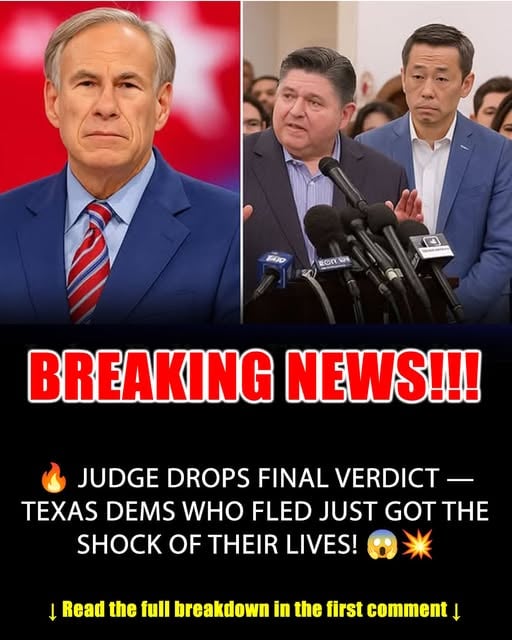
What started as a dramatic political walkout inside the Texas Capitol has now transformed into one of the most explosive power struggles the state has seen in years.
The clash is no longer simply about legislation or parliamentary procedure. It has become a battle over authority, punishment, protest, and the true cost of defiance in modern American politics.
At the center of the storm are Democratic lawmakers who left Texas in an effort to block legislation they believed would fundamentally reshape voting laws and political representation in the state. By leaving, they denied the legislature the quorum required to move forward. Supporters called it an act of principle. Critics called it political theater. But regardless of perspective, the consequences arrived quickly and with unmistakable force.
Texas leaders responded with a message that could not have been clearer: elected officials who abandon their duties would face penalties, and those penalties would hit where it hurts most. Salaries were threatened. Daily fines stacked up. Public condemnation intensified. Suddenly, what had looked like a symbolic protest became something far more personal and financially devastating.
For many Texans watching from home, the confrontation felt bigger than one vote or one legislative session. It touched on a deeper question that has haunted American politics for years: what happens when both sides become convinced democracy itself is under attack?
Republican leaders argued that lawmakers are elected to show up, debate, and vote—not flee the state when they dislike the outcome. They framed the walkout as an abuse of office and a betrayal of voters who sent representatives to Austin to do their jobs. In their eyes, consequences were not retaliation. They were accountability.
Democratic lawmakers saw the situation entirely differently. To them, leaving the state was not abandoning democracy but defending it. They argued that extraordinary measures were necessary because the legislation being proposed would permanently alter political power and make voting more difficult for certain communities. In interviews and public statements, many described the walkout as a last resort after exhausting traditional avenues of opposition.
What made the conflict especially striking was how quickly it moved beyond politics and into ordinary life. Every withheld paycheck represented groceries not bought, mortgages not easily paid, savings drained, and families forced to absorb the stress of a national political spectacle. The headlines focused on strategy and ideology, but behind those headlines were real people calculating bills, arguing with spouses, and wondering how long they could afford to stand firm.
Inside the Capitol, the atmosphere reportedly became increasingly tense. Lawmakers traded accusations of cowardice and authoritarianism. Press conferences grew sharper. Television cameras captured empty desks that became symbols for completely opposite narratives depending on who was speaking. To some Americans, those empty chairs represented courage. To others, they represented dereliction.
The standoff also revealed how modern political warfare has changed. Punishment today is not always about arrest or imprisonment. Often, it is economic pressure, public humiliation, or institutional isolation. The threat is subtler but deeply effective. If political resistance becomes financially impossible, many wonder how long dissent can truly survive.
Critics of the penalties warned that tying income to political obedience sets a dangerous precedent. They argued that democracy depends not only on majority rule but also on the ability of minorities to resist, protest, and delay when they believe something fundamental is at stake. Once punishment becomes severe enough, they say, lawmakers may comply not because they agree, but because they cannot afford not to.
Supporters of the measures dismissed those concerns as exaggerated. They insisted that no ordinary worker can simply abandon responsibilities without consequences, and elected officials should not be treated differently. In their view, allowing lawmakers to flee without penalty would encourage chaos and undermine the functioning of government itself.
As the conflict dragged on, the national political world began paying close attention. Commentators framed the showdown as a preview of the future of American governance: increasingly polarized, increasingly personal, and increasingly unforgiving. What once might have been resolved through negotiation now unfolded like open political warfare, each side believing compromise would equal surrender.
The emotional toll became harder to ignore as weeks passed. Some lawmakers reportedly struggled with exhaustion and uncertainty. Families found themselves pulled into the spotlight. Children watched parents become targets of national outrage online. Political allies demanded unwavering strength, while opponents mocked and condemned them relentlessly.
What made the situation especially painful was the realization that both sides believed they were acting in defense of democracy itself. That is what turned the conflict from a procedural dispute into something existential. Each camp saw the other not merely as wrong, but as dangerous.
For older Texans who remembered less combative political eras, the moment felt deeply unsettling. There was a time when legislative battles were fierce but temporary, when lawmakers argued during the day and still managed to maintain personal relationships afterward. Increasingly, that culture seems to be disappearing. Politics now often demands total loyalty, and public compromise can look like weakness rather than leadership.
The media frenzy only intensified the divide. Social media transformed complex legislative procedures into viral slogans and emotional outrage. Clips were edited into heroes and villains within minutes. Nuance disappeared beneath waves of anger and applause. Millions formed opinions before understanding the actual details of the legislation or the procedural rules involved.
Yet beneath all the noise lies a quieter and more uncomfortable truth. Democracy has always depended on something fragile: the willingness of people who deeply disagree to still recognize each other as legitimate participants in the same system. Once that recognition collapses, every action begins to feel like an attack, and every response begins to feel justified.
The Texas standoff exposed how thin that line has become.
For some Americans, the fleeing lawmakers symbolize courage in the face of overwhelming political power. For others, they symbolize a refusal to accept democratic outcomes. The same event produces completely opposite emotional reactions depending on who is watching.
That divide may be the most important part of the story.
Because long after the fines are paid, the salaries restored, and the legislative session ends, the deeper damage may remain. Trust in institutions erodes slowly but rebuilds painfully. Every escalation teaches politicians that punishment works and teaches voters to expect conflict instead of cooperation.
The tragedy is that many of the people caught in the middle are ordinary citizens who simply want functioning schools, affordable healthcare, safe communities, and fair elections. Instead, they watch leaders locked in battles so bitter that every disagreement begins to resemble a constitutional crisis.
In the end, the Texas showdown is about far more than one walkout or one piece of legislation. It is about how power responds to resistance, how dissent survives under pressure, and how fragile democratic culture becomes when compromise disappears entirely.
The lawmakers who fled may eventually return to the Capitol. The fines may stop. The headlines will eventually move on.
But the message delivered during this confrontation will linger far beyond Texas: in modern politics, resistance can carry a price so high that only the most determined are willing to pay it.