I only meant to spend a few minutes cleaning my son’s room.
That was the plan, at least.
The room had reached the point where ignoring it was no longer possible. Clothes were piled across the chair in the corner, empty snack wrappers had somehow migrated under the bed, and the desk had disappeared beneath random school papers, tangled charging cables, and half-finished projects that looked important enough that I didn’t dare throw them away. Sunlight slipped weakly through the curtains, catching floating dust in the air and giving the whole room that dull, late-afternoon stillness every parent recognizes.
At first, nothing seemed unusual.
I moved slowly through the mess, picking things up one by one, trying to decide what belonged in the trash and what might somehow still matter. Then, near the edge of the room beside a storage bin, I noticed something lying quietly on the floor.
And instantly, every instinct in my body tightened.
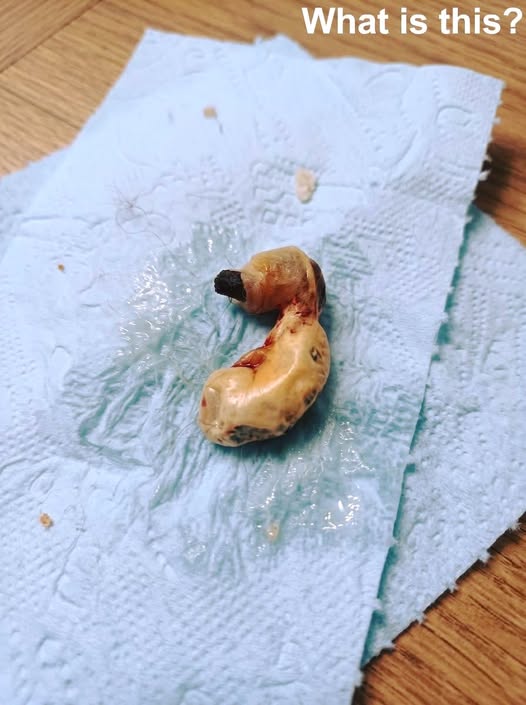
It was pale, curved, and partially hidden in shadow. The light from the nearby window barely touched it, making the shape difficult to fully understand. It rested there in a strangely deliberate way, almost as if it had intentionally settled into that exact corner to avoid being noticed.
The longer I stared at it, the stranger it looked.
At first glance, it seemed soft. Then suddenly it looked leathery. One end appeared darker than the other, slightly bent, with an uneven texture that immediately pushed my imagination toward uncomfortable possibilities. Something about it felt organic, almost alive in a way I couldn’t explain logically.
I stopped moving completely.
The silence in the room suddenly felt heavier.
It’s strange how quickly ordinary moments can transform into something tense. Only seconds earlier, I had been annoyed about dirty laundry. Now my brain was racing through every unpleasant possibility it could invent.
A dead animal.
Something rotting.
An insect shell.
Some kind of strange growth.
I hated how quickly fear took over my thoughts, but once uncertainty appears, the mind begins filling gaps automatically. Every shadow starts looking intentional. Every small detail feels threatening. The object itself hadn’t changed, but my perception of it had completely transformed.
My son appeared quietly in the doorway behind me.
“What are you looking at?” he asked.
I didn’t answer immediately.
He leaned slightly to the side to see past me, and the moment his eyes landed on the object, his expression changed too. Not panic exactly, but confusion mixed with caution.
“What is that?” he asked softly.
That somehow made it worse.
If neither of us recognized it, then the mystery instantly felt more serious. Usually there’s comfort in someone else having an explanation, but now we were both standing there staring at the same strange shape without understanding what we were seeing.
For several long seconds, nobody moved.
The room felt frozen.
The object remained perfectly still on the dusty floor, silent and unchanged, yet somehow full of presence. The longer we looked at it, the more unsettling it became. It felt ridiculous and frightening at the same time.
Part of me wanted to leave the room entirely and pretend I had never noticed it.
Another part needed answers.
That’s the strange thing about human curiosity. Even when fear tells us to back away, uncertainty pulls us closer. The unknown demands attention.
Eventually, I decided I had to do something.
I grabbed a tissue from the desk nearby and wrapped it carefully around my fingers, as though a thin layer of paper could somehow protect me from whatever I was about to touch. My movements became overly cautious, slow and deliberate. Behind me, my son stopped breathing for a moment, watching carefully to see what would happen next.
As I leaned closer, my imagination became even more dramatic.
The object still hadn’t moved, but my brain kept expecting it to. I found myself bracing for something impossible a twitch, a sudden movement, some horrifying explanation that would instantly justify all the fear building inside me.
I almost pulled my hand back.
But curiosity won.
Slowly, I reached down and picked it up.
The sensation immediately confused me.
It wasn’t soft in the way I expected something living to feel, but it wasn’t completely solid either. It bent slightly under the pressure of the tissue, revealing a strange combination of firmness and fragility. Even holding it in my hand, I still couldn’t identify it immediately.
For one unsettling second, my mind continued searching for terrible explanations.
Then the truth hit me all at once.
It wasn’t alive.
It wasn’t dangerous.
It wasn’t even remotely unusual.
It was old chewing gum.
Just a forgotten piece of gum that had somehow collected dust, hair, lint, and dirt over time until it no longer resembled anything recognizable. The darker tip wasn’t decay or something sinister at all it was simply grime that had gathered over weeks or months of being ignored beneath furniture.
For a moment, neither of us said anything.
Then I laughed.
Not a calm laugh either the shaky kind that arrives after tension suddenly collapses. My son laughed too, partly from relief and partly from disbelief that we had both worked ourselves into such silent panic over a piece of gum.
“I seriously thought that was something dead,” he admitted.
“So did I,” I replied.
And honestly, I probably thought worse than that.
The entire room instantly felt lighter again. The strange heaviness disappeared almost immediately once the mystery was solved. What had felt threatening only moments earlier now looked completely harmless and almost absurd.
Yet the experience stayed with me long afterward.
It reminded me how powerfully the mind reacts to uncertainty. Human beings are wired to search for danger, especially when something doesn’t immediately make sense. When information is incomplete, imagination rushes to finish the story and it rarely chooses the most comforting explanation first.
Psychologists often describe fear of the unknown as one of the most basic human instincts. The brain constantly tries to identify threats in order to protect us, even when no real danger exists. Shadows become figures. Sounds become warnings. Ordinary objects become frightening simply because we cannot identify them right away.
That tiny piece of gum became proof of how quickly perception can distort reality.
What changed wasn’t the object itself.
It stayed exactly the same the entire time.
The only thing changing was our interpretation of it.
Once we understood what we were looking at, the fear vanished instantly, leaving only relief and embarrassment behind. The mystery disappeared the moment clarity arrived.
My son went back to what he had been doing, still amused by the situation, while I stood there a little longer thinking about how strange the human mind can be. Minutes earlier, that room had felt tense and unsettling. Now it looked ordinary again just another messy bedroom needing to be cleaned.
In the end, there was no creature hiding in the corner.
No danger.
No horror story.
Only an old forgotten piece of chewing gum that time and neglect had transformed into something unrecognizable.
And somehow, for a few unforgettable moments, it had completely convinced us otherwise.