At first glance, it looked almost laughably simple.
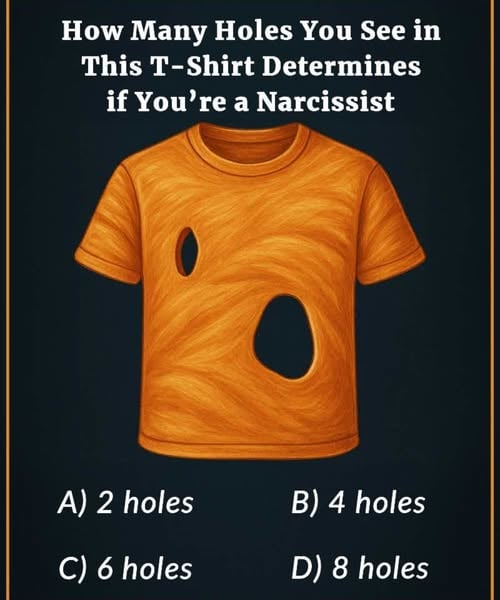
A picture of a torn T-shirt appeared online with a single question attached: “How many holes are in this shirt?”
Most people answered immediately, barely pausing before typing their response with total confidence. Some counted the obvious tears and proudly declared the answer was two. Others quickly said four. A few argued passionately for eight.
Within hours, the harmless little image had exploded into arguments across comment sections, family group chats, classrooms, and social media feeds around the world.
What shocked people was not the puzzle itself.
It was how fiercely everyone defended their answer.
Friends mocked each other’s logic. Strangers accused one another of overthinking. Some insisted the puzzle was designed to trick people. Others argued the “wrong” answers revealed a failure of basic reasoning. What began as a casual visual riddle suddenly transformed into something far more revealing: a glimpse into how human perception, assumptions, and certainty shape the way people see reality.
Because the image itself never changed.
Only the interpretation did.
That was enough to divide thousands of minds instantly.
The T-shirt puzzle appears deceptively ordinary. A shirt lies flat with several visible tears in the fabric. The challenge sounds simple enough: count the holes. Yet the moment people begin answering, they unknowingly expose the mental shortcuts their brains rely on every single day.
Most people initially focus only on the damage.
They see the tears because the tears demand attention. Human brains are naturally trained to notice abnormalities first stains, cracks, missing pieces, danger, movement, mistakes. The obvious rips jump forward visually, while the ordinary structure of the shirt fades into the background because it feels familiar and automatic.
That instinct explains why many confidently answer “two.”
To them, the puzzle is about the visible damage and nothing else.
But then someone points out the neck opening.
Another mentions the sleeves.
Another adds the bottom opening of the shirt itself.
Suddenly the entire question changes.
The puzzle no longer depends on eyesight alone. It depends on definitions.
What actually counts as a hole?
That tiny shift in perspective completely rearranges the answer.
People who originally felt completely certain suddenly begin second-guessing themselves. Some become defensive. Others laugh and change their minds instantly. A few stubbornly refuse to reconsider at all, insisting the question was “obviously” referring only to tears in the fabric.
And that reaction may be the most fascinating part of the entire puzzle.
Because the riddle quietly exposes how deeply humans depend on assumptions without realizing it.
Most people do not carefully analyze every word of a question before answering. The brain prefers speed over precision. It fills gaps automatically using context, habit, and expectation. In daily life, this mental efficiency helps people function quickly without overanalyzing every tiny decision.
But puzzles like this interrupt that autopilot.
They force people to confront the hidden assumptions guiding their thinking.
Some participants eventually settle on six holes as the most logically consistent answer: two tears in the shirt plus the four structural openings everyone normally ignores the neck hole, two sleeves, and the bottom opening.
Others continue debating because they notice something additional.
If the shirt is lying flat and the tears go completely through both sides of the fabric, do those count as double holes instead of single holes? Suddenly the answer expands again depending on how literally one interprets the image.
What looked simple now becomes strangely philosophical.
The puzzle stops being about fabric entirely.
It becomes about perception itself.
Why do some people immediately question hidden assumptions while others accept the first interpretation that feels obvious? Why do certain minds naturally step back and reconsider definitions while others focus only on surface details? Why do people become emotionally attached to being correct even during meaningless visual games?
Psychologists have long studied these patterns because they reveal important truths about human cognition. The brain constantly simplifies information to reduce mental strain. It creates shortcuts called heuristics — fast ways of interpreting situations without deep analysis. Most of the time, these shortcuts work remarkably well.
But they also create blind spots.
People often confuse familiarity with correctness. Once the brain forms an initial interpretation, it resists changing it because certainty feels emotionally comfortable. Admitting uncertainty, even over something trivial, creates subtle psychological discomfort.
That is why arguments over simple riddles sometimes become surprisingly intense.
The disagreement is never just about the answer.
It becomes about identity, intelligence, pride, and the fear of being fooled.
Social media amplifies this effect dramatically. Online platforms reward quick reactions and confident opinions far more than careful reflection. People rush to answer before thinking deeply because speed creates engagement. Once they publicly commit to an interpretation, changing their minds can feel embarrassing.
As a result, even harmless puzzles become miniature battlegrounds of ego and perception.
Yet beneath the arguments lies something oddly beautiful.
The T-shirt puzzle reminds people that reality is often shaped not only by what they see, but by what they unconsciously ignore. Every person enters the image carrying slightly different assumptions about language, objects, and logic itself.
Some see damage.
Some see structure.
Some see trickery.
Some see creativity.
Some see overthinking.
Some see insight.
The image functions almost like a psychological mirror reflecting how different minds organize the world around them.
And perhaps that is why the puzzle resonates so deeply with so many people.
In modern life, individuals constantly encounter situations where two people can look at the exact same event yet interpret it completely differently. Politics, relationships, social conflicts, media debates, and cultural arguments all operate through similar mechanisms. Facts matter, but interpretation matters too. Definitions matter. Assumptions matter.
The T-shirt puzzle condenses that larger truth into one deceptively tiny image.
It demonstrates how quickly certainty forms and how reluctant people often become to revisit first impressions. It also reveals how valuable it can be to pause, step back, and reconsider perspectives that initially seem unnecessary or wrong.
Sometimes intelligence is not about answering fastest.
Sometimes it is about noticing what everyone else overlooked.
The most thoughtful participants eventually realize the puzzle was never truly designed to measure mathematical ability at all. It measures attention, flexibility, and willingness to challenge automatic thinking.
And in that sense, there may not even be one perfect answer.
Because the real lesson hides beneath the debate itself.
A torn T-shirt managed to expose how humans build meaning from assumptions, defend those meanings emotionally, and struggle to separate observation from interpretation. It revealed how perception shapes certainty and how certainty shapes behavior.
All from a single image most people believed they understood within seconds.
That may be the most surprising part of all.
The shirt never changed once.
Only the minds looking at it did.