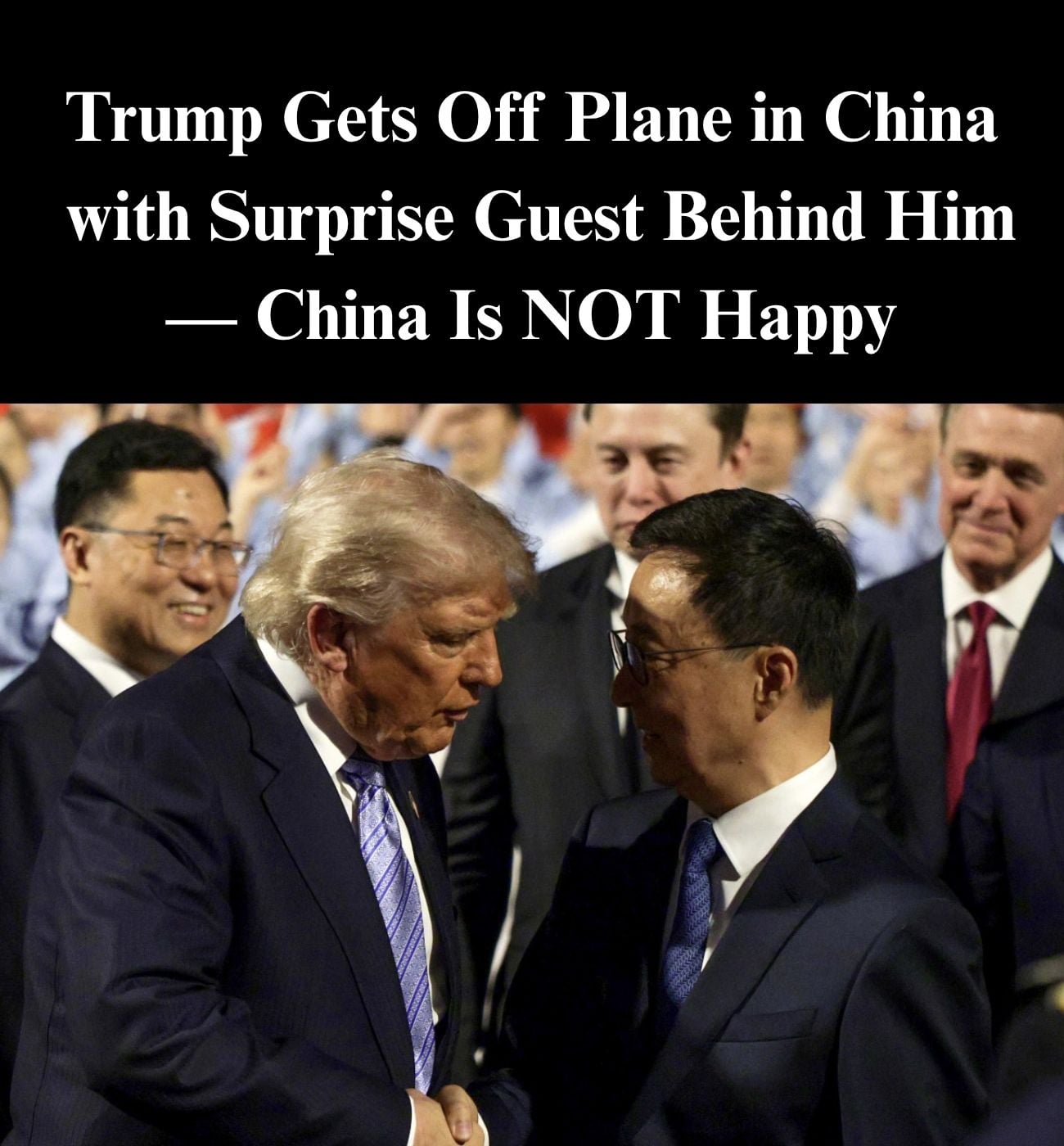
When Donald Trump stepped off the plane in China, the scene looked less like a traditional diplomatic visit and more like the arrival of a traveling empire of money, technology, and geopolitical influence.
Walking behind him was an extraordinary lineup of corporate powerhouses and financial titans whose presence immediately transformed the trip into something much larger than a ceremonial state appearance.
Among the figures reportedly accompanying the delegation were Elon Musk, Jensen Huang, Tim Cook, Larry Fink, Jane Fraser, and David Solomon, alongside other influential executives and advisers whose companies collectively shape enormous portions of the global economy.
The visual impact alone stunned observers.
As Chinese officials welcomed the delegation with military formality, ceremonial music, and rows of waving schoolchildren, cameras captured what many described as a mobile boardroom of American capitalism arriving directly inside the territory of the United States’ most powerful strategic rival.
The symbolism could hardly have been more dramatic.
For years, relations between Washington and Beijing have been defined by escalating suspicion, economic rivalry, technological competition, and growing military tension surrounding Taiwan and the Indo-Pacific region. Yet here stood some of America’s richest and most influential business leaders walking beside a former president who has repeatedly promised to confront China aggressively on trade, manufacturing, technology, and geopolitical influence.
That contradiction became the defining image of the visit.
On one hand, Trump has built much of his political identity around challenging China economically and rhetorically. He has accused Beijing of exploiting American manufacturing, manipulating trade systems, stealing intellectual property, and expanding global influence at America’s expense. His supporters often frame him as one of the few major political figures willing to confront China openly.
On the other hand, the delegation surrounding him reflected how deeply interconnected the American and Chinese economies remain despite years of political hostility.
Technology companies rely heavily on Chinese manufacturing.
Financial institutions seek access to Chinese markets.
Global supply chains remain intertwined across borders in ways neither country can easily untangle without enormous economic consequences.
That tension hovered over every moment of the visit.
Trump reportedly framed the trip publicly as an effort to “open up” China economically while strengthening America’s negotiating position globally. But behind the speeches and ceremonial handshakes lay a much broader and more fragile geopolitical reality.
Trade disputes remain unresolved.
Competition over artificial intelligence continues accelerating.
Semiconductor restrictions have intensified tensions between both nations.
Military concerns surrounding Taiwan remain dangerously sensitive.
Meanwhile, global instability in regions like the Middle East continues influencing energy markets, shipping routes, defense alliances, and diplomatic calculations involving both Washington and Beijing.
In that context, this was never simply a business trip.
Nor was it purely diplomatic theater.
It was a high-stakes intersection of politics, money, military power, and technological competition unfolding in full public view.
Observers noted that the presence of executives tied to AI, finance, and global manufacturing was especially significant. Companies connected to advanced semiconductor technology, artificial intelligence infrastructure, and digital communications increasingly sit at the center of strategic competition between the United States and China.
The modern geopolitical battlefield is no longer limited to tanks, missiles, and aircraft carriers alone.
It now includes microchips, data centers, rare earth minerals, AI systems, shipping routes, financial leverage, and control over emerging technologies capable of reshaping entire economies.
That reality explains why figures like Jensen Huang and Elon Musk attracted enormous attention during the visit.
Artificial intelligence has become one of the defining power struggles of the 21st century. Both China and the United States view AI dominance not only as an economic advantage, but as a matter of national security and future global influence. The race now extends into military systems, surveillance technologies, cyber capabilities, and economic infrastructure.
Every conversation surrounding AI therefore carries geopolitical consequences far beyond business profits alone.
At the same time, financial leaders accompanying the delegation signaled another major priority: stability.
Global markets remain highly sensitive to worsening tensions between the world’s two largest economies. Investors fear disruptions involving Taiwan, trade sanctions, cyber conflict, or supply chain collapses capable of triggering worldwide economic consequences. For many financial institutions, maintaining at least some degree of predictability between Washington and Beijing has become critically important.
That urgency reportedly shaped much of the behind-the-scenes diplomacy surrounding the visit.
While cameras focused on ceremonies and carefully staged photo opportunities, months of quiet negotiations had already been unfolding privately between officials, advisers, and economic representatives from both sides. Beijing reportedly sought clearer signals regarding Taiwan and future American intentions in the region. Washington, meanwhile, pushed for leverage involving shipping routes, technology restrictions, industrial access, and strategic influence.
The smiling public images concealed enormous pressure beneath the surface.
Chinese officials presented the visit with polished precision. Children waved flags. Military bands performed. Red carpets stretched beneath bright lights as the delegation arrived. State-controlled media emphasized cooperation, dialogue, and mutual respect.
But few observers believed the atmosphere was truly relaxed.
Too many unresolved tensions remain hanging between the two powers.
Taiwan alone continues representing one of the most dangerous geopolitical flashpoints in the world. China views the island as part of its territory and has repeatedly warned against foreign interference. The United States, while officially maintaining strategic ambiguity, continues supporting Taiwan militarily and politically.
Any escalation surrounding Taiwan could rapidly destabilize the global economy and potentially trigger military confrontation involving multiple nations.
That possibility lingers constantly beneath U.S.-China diplomacy.
Trade disputes add another layer of instability. Tariffs, sanctions, export controls, and restrictions on advanced technology have already reshaped portions of the global market. Companies operating internationally increasingly find themselves trapped between competing political pressures from both governments.
Business leaders now navigate an environment where economics and national security are becoming impossible to separate fully.
That is partly why the image of billionaire executives accompanying Trump felt so striking to many observers.
It symbolized how modern power no longer belongs solely to governments.
Corporations, technology giants, financial institutions, and private industry leaders now influence geopolitics directly in ways once reserved almost entirely for states themselves. Decisions made inside corporate boardrooms increasingly affect military competition, international diplomacy, labor markets, technological dominance, and even national security strategies.
The delegation arriving in China embodied that transformation perfectly.
It was not merely politicians meeting politicians.
It was an alliance of political influence and corporate power walking together into one of the most delicate geopolitical relationships on earth.
As closed-door meetings continue behind carefully controlled public appearances, the stakes surrounding the visit remain enormous. The outcome may influence trade policy, technology competition, military positioning, financial markets, and diplomatic stability for years to come.
For now, the carefully choreographed images show smiles, handshakes, and ceremonial welcomes.
But behind every photograph lies a deeper reality.
The world’s two greatest powers are attempting to manage rivalry, dependence, mistrust, and ambition all at once while billionaires, politicians, military planners, and diplomats quietly negotiate the future of the global order itself.