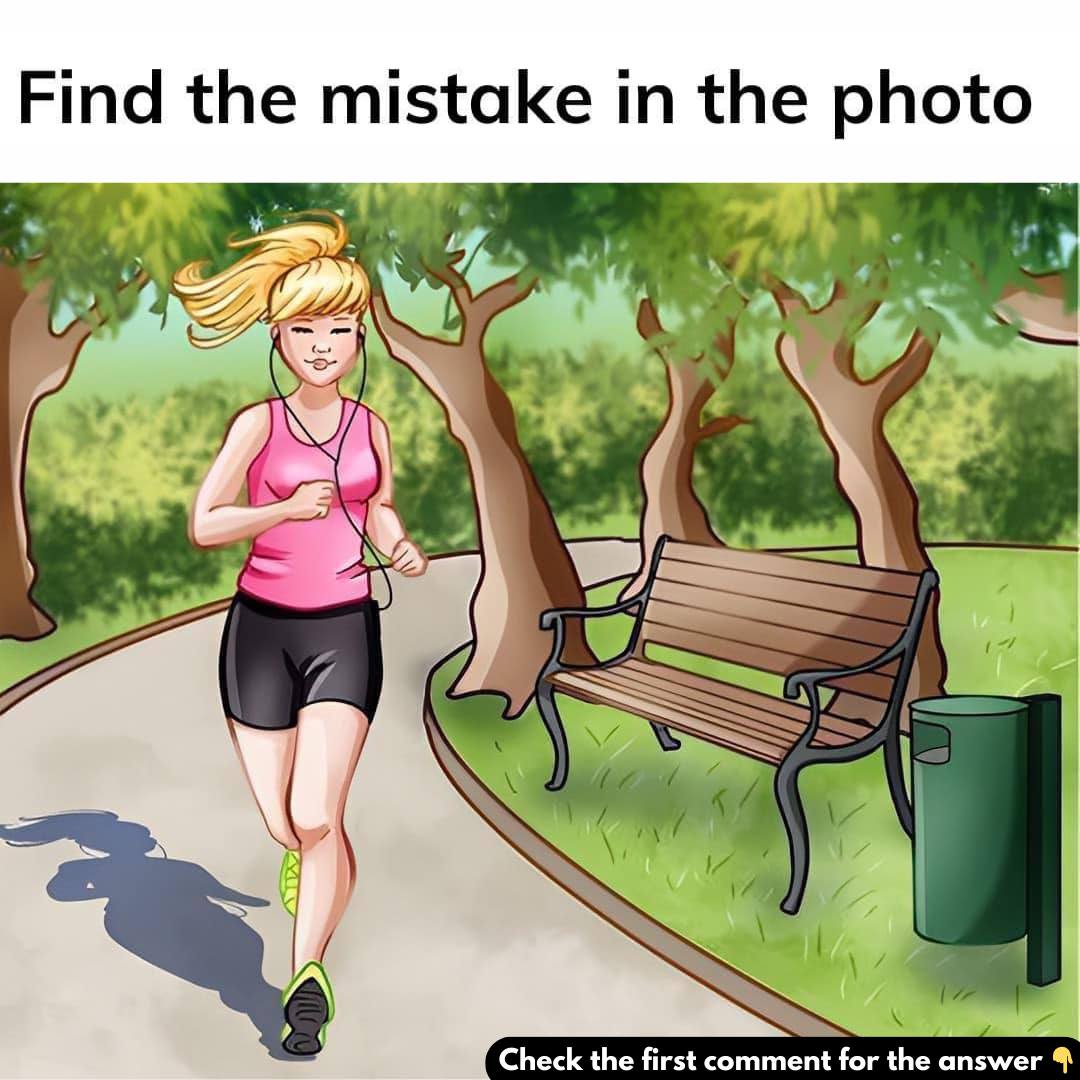
At first glance, the image looks completely ordinary. A young woman jogs peacefully through a quiet park as sunlight stretches across the path beneath her feet.
Trees sway gently in the background, a bench rests beside the walkway, and a trash bin stands nearby. Everything about the scene feels calm, balanced, and realistic. Most people glance at it for only a second or two before assuming there is nothing unusual hidden inside.
But there is a mistake.
And once you notice it, you can never unsee it again.
This deceptively simple brain teaser has frustrated thousands of people online because the error hides in plain sight. The puzzle does not rely on impossible objects, distorted faces, or dramatic visual tricks. Instead, it takes advantage of something far more powerful: the way the human brain automatically fills in missing information without us realizing it.
That is exactly what makes puzzles like this so fascinating. They expose how often we trust assumptions instead of observation.
When most people first examine the image, their attention immediately locks onto the runner herself. The movement, posture, and central placement naturally pull the eye toward her. The brain quickly processes the setting as familiar: a sunny park scene with a jogger enjoying a morning run. Because the situation feels normal, the mind stops questioning it almost immediately.
This is one of the brain’s most efficient survival tools. Human beings constantly filter visual information to avoid becoming overwhelmed by details. Instead of carefully analyzing every object we see, the brain builds shortcuts based on expectation and experience. Most of the time, those shortcuts help us navigate the world quickly and effectively.
But puzzles like this exploit those shortcuts perfectly.
The hidden mistake only becomes obvious when you deliberately slow down and begin questioning details that your brain initially ignored.
Start with the scene as a whole. Everything appears realistic. The lighting feels natural. The jogger’s posture makes sense. The environment looks peaceful and balanced. Nothing immediately seems broken or impossible. That false sense of normalcy is precisely what allows the error to stay hidden.
Next, focus on the sunlight.
The image clearly suggests a bright day. The runner casts a visible shadow across the ground, and the angle of the light appears consistent with the position of the sun. At first, this detail reassures the brain that the image follows real-world physics.
But now look closer.
Examine the bench.
Look at the trees.
Check the trash bin.
Notice something strange?
None of them cast shadows.
Suddenly the entire image changes. What once looked realistic now feels subtly unsettling. The jogger has a perfectly defined shadow, yet every stationary object in the environment appears untouched by sunlight. The laws of light and perspective are completely broken, but because the brain focused primarily on the moving subject, most people never noticed the inconsistency at first.
That hidden contradiction is the true genius of the puzzle.
The mistake is not dramatic. It is quiet. Subtle. Almost invisible unless you consciously force yourself to examine the background instead of the obvious focal point. And that is exactly why so many people miss it.
Psychologists often explain this phenomenon through something called selective attention. Human beings naturally prioritize information that seems emotionally important or visually dominant. In this image, the runner becomes the brain’s primary subject, while background details fade into passive scenery. Once the brain labels the environment as “normal,” it stops actively verifying whether every element actually makes sense.
The result is a fascinating illusion where people see what they expect to see rather than what is truly present.
This is also why many viewers become shocked after discovering the answer. The missing shadows were visible the entire time. Nothing was hidden. The brain simply chose not to notice them because it trusted the scene automatically.
These types of observation puzzles have become incredibly popular because they reveal something deeper than visual perception alone. They expose how human thinking works under everyday conditions. Most of life operates through assumptions, patterns, and mental shortcuts. We rarely examine every detail carefully unless something forces us to pause.
That tendency extends far beyond puzzles.
People overlook contradictions in conversations, relationships, social situations, and even personal habits for the same reason they miss missing shadows in an image. The brain values efficiency over perfection. It prefers coherent stories over constant analysis. Sometimes that helps us function smoothly. Other times, it blinds us to important details hiding directly in front of us.
Observation puzzles train the mind to slow down.
They encourage patience in a culture built around speed. Instead of rushing toward answers, they reward careful attention, curiosity, and critical thinking. The more people practice these skills, the sharper their awareness becomes not only in puzzles but in daily life.
There is also something deeply satisfying about the moment the mistake finally clicks into place. One second the image feels ordinary. The next, the flaw becomes impossible to ignore. That sudden shift creates a powerful psychological effect because it reveals how unreliable first impressions can sometimes be.
Many people who solve the puzzle immediately return to study the image again, amazed that they overlooked something so obvious. Others begin searching for additional hidden inconsistencies, questioning every object more carefully than before. Once the brain realizes it has been tricked, trust disappears, and observation becomes far more deliberate.
This reaction highlights an important truth about human perception: seeing is not the same as noticing.
The eyes may capture information constantly, but the brain decides what deserves attention. That filtering process shapes how people experience the world every single day. In many ways, puzzles like this act as tiny reminders that reality is often more complicated than our first glance suggests.
The running girl puzzle may seem simple, but its power comes from exposing a hidden weakness shared by almost everyone. We assume familiarity equals accuracy. We believe normal-looking scenes must obey normal rules. And because of that confidence, we often overlook the smallest contradictions hiding right in front of us.
Yet those tiny contradictions are often where the most interesting discoveries live.
That is why visual puzzles remain endlessly addictive. They challenge pride, sharpen awareness, and reward patience in ways few other games can. Every solved puzzle feels like a small victory over the brain’s own automatic habits.
And sometimes, all it takes to fool thousands of people is a sunny park, a jogger, and a few shadows that were never there at all.