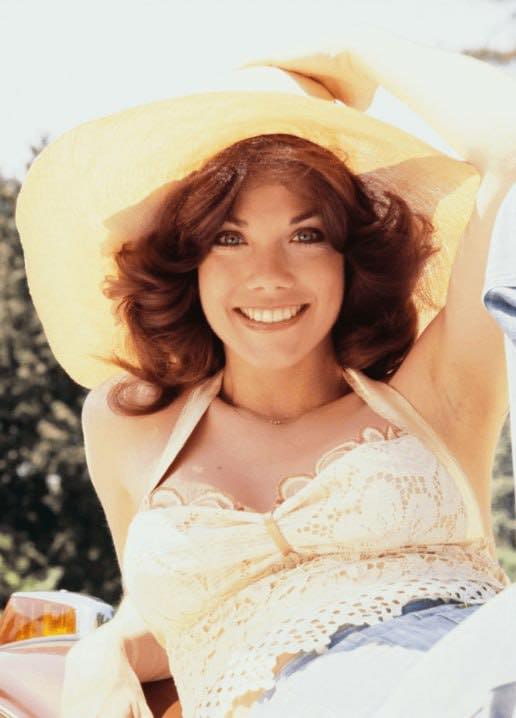
Long before today’s era of viral fame and carefully curated online personas, a select group of entertainers defined what it meant to be a true multimedia star.
Among them was Barbi Benton, a woman whose presence in the 1970s seemed to follow no single script, yet somehow fit perfectly into the cultural rhythm of the time. Born Barbara Lynn Klein in 1950 in New York City and raised in California, her story is one of reinvention, ambition, and an instinctive understanding of how to move with the changing tides of entertainment.
Her early years gave little indication of just how recognizable she would become. Like many young women drawn to the spotlight, she began in modeling, learning quickly how to command attention without saying a word. That early exposure helped her develop not only confidence but also a keen awareness of image and presentation. It wasn’t long before she began transitioning beyond still photography and into television, where her natural charisma proved impossible to ignore.
The 1970s entertainment landscape was unlike anything that came before it. Television was rapidly expanding, variety shows were at their peak, and audiences were eager for personalities who could do a bit of everything. Benton fit that mold almost effortlessly. She didn’t limit herself to one lane; instead, she moved fluidly between modeling assignments, television appearances, and musical experiments, creating a career that felt both spontaneous and carefully constructed.
Her association with Playboy during the early stages of her career brought her widespread attention, placing her firmly within the era’s evolving conversation around glamour, independence, and public identity. Yet what made her stand out was her ability to move beyond that initial image. While many might have remained confined to a single label, Benton used that exposure as a launching point, not a destination.
Television soon became the space where her personality truly came alive. Her long-running role on Hee Haw introduced her to millions of viewers across America. The show, known for its blend of country music, humor, and rural-themed sketches, offered Benton a platform to showcase more than just appearance. She displayed comedic timing, adaptability, and a warmth that resonated with audiences week after week. At a time when performers were often typecast, she managed to maintain a sense of versatility that kept her from being boxed into a single identity.
What made her presence on television particularly compelling was the balance she struck between glamour and relatability. She could deliver a joke in one moment and embody classic elegance in the next, a combination that helped solidify her status as a recognizable figure in American pop culture. For many viewers, she became a familiar face someone who felt both aspirational and approachable.
At the same time, Benton explored another creative avenue: music. The 1970s saw many television personalities crossing over into recording careers, and she was no exception. Leaning into country and pop influences, she released several singles that reflected the musical trends of the era. Her song “Brass Buckles” stood out in particular, achieving notable success on the country charts and proving that her talents extended beyond the screen.
While she never positioned herself as a full-time recording artist, her willingness to step into the music world demonstrated a broader creative curiosity. It also mirrored a time when the boundaries between entertainment fields were more fluid, allowing performers to experiment and expand their reach without rigid expectations.
Of course, Benton’s personal life also drew public attention, particularly her relationship with Hugh Hefner. Their connection became a widely discussed topic, adding another layer to her public image. Yet even within that context, she worked to establish her own identity, separate from any association. Over time, it became clear that her ambitions extended far beyond being defined by a single relationship or role.
As the years passed, her focus gradually shifted. Rather than remaining constantly in the public eye, she began to step back, choosing a quieter and more private path. This transition was not a retreat but a redirection. Benton turned her attention toward personal projects, family life, and creative pursuits that existed outside the traditional boundaries of entertainment.
One of the most fascinating chapters of her later life unfolded in Aspen, Colorado. Alongside her husband, real estate developer George Gradow, she became deeply involved in the design and construction of a remarkable residence often referred to as the “Copper Palace.” This project reflected a different kind of creativity one rooted in architecture, design, and long-term vision.
The home itself became a symbol of her evolution. With its distinctive style and intricate details, it represented more than just a place to live; it was an expression of her aesthetic sensibilities and her ability to channel artistic energy into new forms. This phase of her life revealed a side of Benton that many had not previously seen, one that emphasized craftsmanship, innovation, and independence.
Her journey mirrors a broader shift in how celebrity can be defined. In the 1970s and 1980s, public figures often had to navigate multiple roles without the support of modern branding tools or social media platforms. Benton did this with a level of adaptability that allowed her to remain relevant across different stages of her life. She embraced change rather than resisting it, moving from one chapter to the next with a sense of purpose.
Unlike many of her contemporaries, she chose not to maintain a constant presence in mainstream media. Instead, she allowed her legacy to speak for itself, stepping away from the spotlight while still capturing public curiosity. This decision has contributed to the enduring fascination with her story. She represents a time when fame was both more mysterious and, in some ways, more enduring.
Today, Benton is often remembered as a defining figure of 1970s pop culture, a woman who embodied the spirit of an era marked by experimentation and transformation. Her career serves as a reminder that success in entertainment does not always follow a straight path. It can be shaped by reinvention, by the willingness to explore new opportunities, and by the courage to step away when the time feels right.
Her legacy is not confined to a single role or achievement. It lives in the variety of her work, the shifts in her identity, and the choices she made along the way. From magazine covers to television screens, from music charts to architectural design, she carved out a life that reflects both the possibilities and complexities of fame.
In the end, Barbi Benton’s story is less about a single moment of recognition and more about a lifetime of evolution. She remains a symbol of an era when entertainers were expected to do it all, and she did so with a style and confidence that continues to resonate decades later.