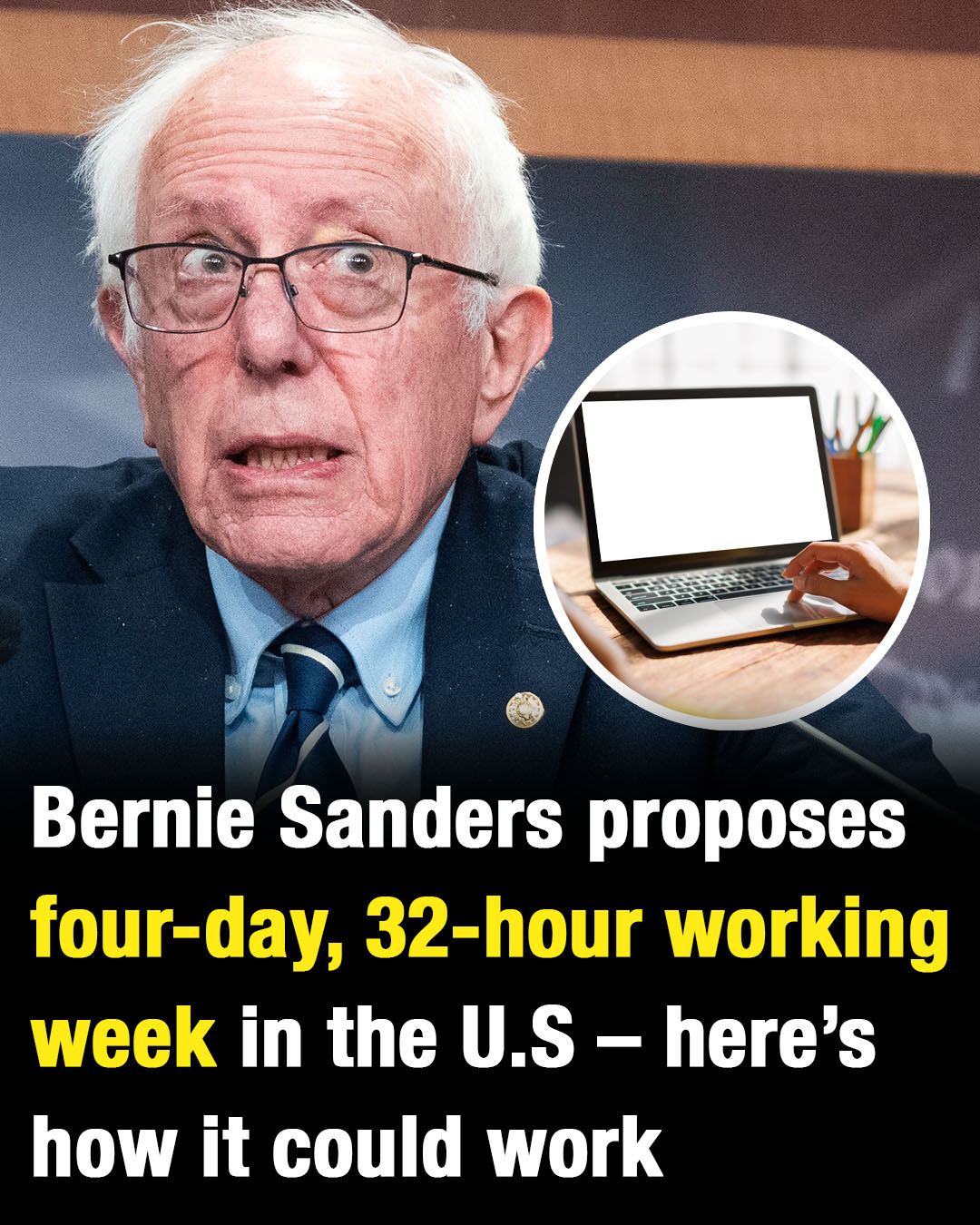
When Bernie Sanders speaks about a shorter workweek, he is not simply proposing a technical adjustment to labor policy.
He is making a broader argument about the direction of modern society and the distribution of its gains. At the center of his proposal is a simple but provocative question: as technology makes work more efficient, who should benefit from that efficiency?
For decades, productivity in the United States has steadily increased, driven by automation, digital systems, and now the rapid rise of artificial intelligence. Businesses are able to produce more with fewer resources, streamline operations, and expand output at a pace that would have been unimaginable in earlier eras. Yet Sanders argues that while corporations have reaped enormous rewards from these advancements, the everyday worker has not experienced a corresponding improvement in quality of life.
His proposed legislation, often referred to as the Thirty-Two Hour Workweek Act, seeks to address that imbalance directly. The core idea is straightforward: redefine the standard workweek from 40 hours to 32 hours, spread across four days, without reducing pay. Any work beyond that threshold would qualify for overtime compensation, creating a financial incentive for employers to adjust schedules rather than extend hours.
The concept challenges long-standing assumptions about work in American culture. For generations, the 40-hour week has been treated as a fixed standard, a baseline that defines full-time employment. Sanders’ proposal invites a reevaluation of that norm, suggesting that it was never meant to be permanent but rather a product of its time. In the early 20th century, labor movements fought to reduce grueling work schedules, eventually establishing the 40-hour week as a major victory. From Sanders’ perspective, the next logical step is to continue that trajectory in response to new technological realities.
A central pillar of his argument is the role of artificial intelligence. As AI systems become more capable, they are increasingly able to perform tasks that once required human labor, from data analysis to customer service and even creative work. This transformation has the potential to dramatically increase productivity, but it also raises concerns about job displacement and economic inequality.
Sanders frames this moment as a crossroads. On one path, the benefits of AI could be concentrated among a small group of corporations and investors, widening the gap between those at the top and everyone else. On the other path, those same gains could be used to improve the lives of workers, reducing hours while maintaining income and allowing people more time for personal pursuits.
In his vision, a shorter workweek is not just about rest; it is about reclaiming time. Time to spend with family, to pursue education, to engage in community life, or simply to recover from the demands of modern work. He often emphasizes that economic progress should translate into human progress, not just higher profits.
The proposal also reflects a growing global conversation about work-life balance. Several countries and companies have experimented with four-day workweeks, reporting mixed but often promising results. In some cases, employees have maintained or even increased productivity while experiencing lower stress and higher job satisfaction. These experiments have fueled interest in whether similar models could be implemented more broadly.
However, the transition to a 32-hour workweek would not be without challenges. Businesses would need to adapt their operations, potentially hiring additional staff or restructuring workflows to maintain output. Certain industries, particularly those that rely on continuous coverage such as healthcare or manufacturing, might face more complex adjustments. Critics argue that the costs and logistical hurdles could outweigh the benefits, especially for small businesses operating with limited margins.
Supporters counter that similar concerns were raised during past labor reforms, including the introduction of the 40-hour week itself. Over time, those changes became normalized, and the economy adapted. They argue that with careful planning and phased implementation, a shorter workweek could follow a similar path.
Beyond economics, Sanders also connects the issue to broader questions about the future of society. He has warned that technological advancements, including AI, are not inherently beneficial or harmful. Their impact depends on how they are used and who controls them. In some of his remarks, he has pointed to the potential for technology to reshape not only work but also global security, raising concerns about the development of autonomous weapons and the changing nature of conflict.
These warnings add a layer of urgency to his proposal. If technology can transform industries and influence geopolitics, then decisions about its use cannot be left solely to market forces. They require deliberate policy choices that reflect societal values.
In this context, the 32-hour workweek becomes part of a larger vision. It is not just a labor reform but a statement about priorities about whether economic systems should serve human needs or the other way around. Sanders’ argument suggests that the measure of progress should not be how much people can produce, but how well they can live.
Public reaction to the idea has been varied, reflecting the broader political and cultural divisions within the country. Some see it as a necessary evolution, a way to align work structures with modern capabilities. Others view it as unrealistic or potentially disruptive, questioning whether it can be implemented without unintended consequences.
Despite these debates, the proposal has succeeded in bringing the conversation into the mainstream. It has prompted discussions about productivity, fairness, and the purpose of work in a rapidly changing world. Whether or not the legislation advances, the ideas behind it are likely to continue influencing how people think about employment and time.
At its core, Sanders’ push for a shorter workweek is rooted in a belief that technological progress should lead to a better quality of life for everyone, not just increased efficiency or profit. It challenges the assumption that longer hours are inherently more valuable, suggesting instead that balance, well-being, and opportunity are equally important measures of success.
As automation and artificial intelligence continue to evolve, the question he raises becomes increasingly relevant. The tools exist to reshape how work is organized and experienced. The outcome will depend on the choices made by policymakers, businesses, and society as a whole.
In that sense, the debate over a 32-hour workweek is not just about schedules or paychecks. It is about defining what progress looks like in the modern era and deciding who gets to share in its benefits.