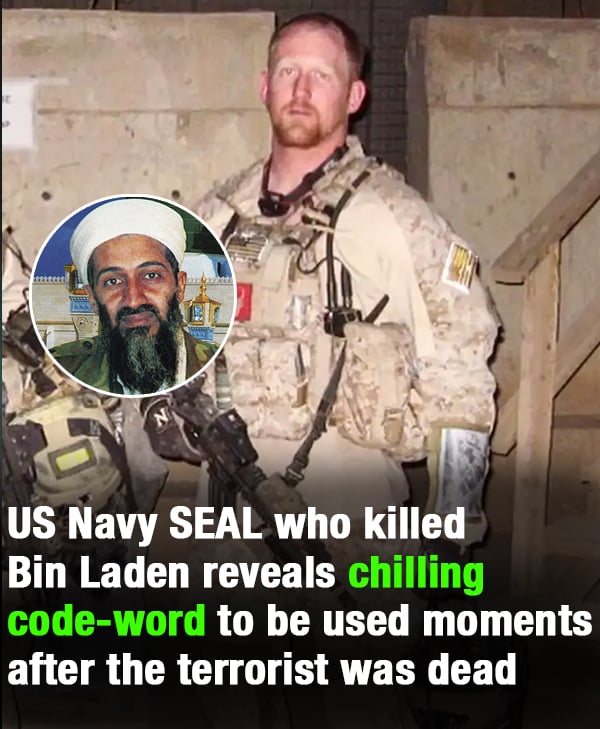
More than a decade after the covert operation in Abbottabad, the memory of that night remains vivid for Robert O’Neill, one of the U.S. Navy SEALs involved in the mission that brought an end to the long pursuit of Osama bin Laden.
What unfolded in those final minutes was the culmination of years of intelligence work, relentless searching, and a mission defined by precision, risk, and secrecy.
The operation, carried out by members of the elite SEAL Team Six, had already encountered unexpected complications before reaching its ultimate objective. A helicopter crash during the initial phase forced the team to adapt instantly, recalibrating their plan in real time while maintaining focus on the primary goal. In missions of this magnitude, there is little room for hesitation. Every second carries weight, and every decision can alter the outcome.
According to O’Neill’s recollections, the movement through the compound was methodical but urgent. Each room was cleared with calculated speed, every corner assessed for threats. The team advanced floor by floor, navigating the unfamiliar structure with a blend of training and instinct. By the time they approached the upper level, the tension had reached its peak. The final objective was within reach, but so too were the risks.
The moment itself, as described in later accounts, was brief yet decisive. In a narrow space where visibility and reaction time were limited, the confrontation occurred in an instant. The years-long manhunt, driven by the aftermath of the September 11 attacks, came to a sudden conclusion in a matter of seconds. For those involved, it was not a cinematic climax but a controlled, focused execution of a mission that had been meticulously planned.
While the events inside the compound unfolded at high speed, an entirely different kind of tension existed thousands of miles away in Washington, D.C. Inside the White House Situation Room, senior officials monitored the operation in real time. Among them was Barack Obama, whose administration had authorized the mission after careful deliberation.
In that room, the stakes extended far beyond the immediate outcome. The success or failure of the operation carried profound political, strategic, and human consequences. A successful mission would mark a defining moment in counterterrorism efforts. A failure, however, could have led to severe repercussions, both domestically and internationally. The weight of that uncertainty hung over every second of silence between updates.
Communication between the team on the ground and leadership in Washington was intentionally concise. In operations of this nature, clarity and brevity are essential. The code name assigned to the target was “Geronimo,” a designation used to confirm the identification and status of the individual at the center of the mission. When the critical moment arrived, the message transmitted was precise and devoid of emotion: “Geronimo EKIA,” meaning enemy killed in action.
Those few words carried immense significance. They signaled not only the end of a specific operation but also the conclusion of a chapter that had shaped global politics for years. In the Situation Room, the response from President Obama was reportedly understated, reflecting the gravity of the moment rather than triumph. The acknowledgment was simple, measured, and final.
For O’Neill, however, the mission did not end with that transmission. In the years that followed, he made the controversial decision to speak publicly about his role in the operation. This choice placed him at odds with the traditional culture of silence within the special operations community, where anonymity and discretion are deeply ingrained values.
His decision sparked debate among military personnel and the public alike. Some viewed his account as an important personal perspective on a historic event, while others criticized it as a departure from the collective ethos that defines elite units like SEAL Team Six. The discussion highlighted the tension between individual recognition and institutional tradition, a balance that is not easily maintained.
O’Neill has described his choice to come forward as a personal necessity rather than a pursuit of recognition. Carrying the details of such a significant moment, he has suggested, became a burden over time. By sharing his experience, he sought to provide clarity about what happened while also processing the weight of his involvement.
The broader story of the Abbottabad raid extends beyond any single individual. It represents the coordinated effort of intelligence agencies, military planners, and political leadership working toward a common objective. From the initial gathering of intelligence to the execution of the mission, every stage required precision, trust, and a willingness to operate under extraordinary pressure.
It also underscores the complexity of modern warfare and counterterrorism. The operation was not simply a military action but a carefully calibrated response shaped by legal, ethical, and strategic considerations. Decisions were made with an awareness of their potential impact on global relations, public perception, and future policy.
The legacy of that night continues to resonate. For many, it stands as a moment of closure following years of uncertainty and loss. For others, it serves as a reminder of the ongoing challenges associated with global security and the pursuit of justice in a complex world.
O’Neill’s account adds a human dimension to this broader narrative. It provides insight into the mindset of those who operate in high-stakes environments, where training and instinct must align perfectly under pressure. His recollections emphasize not only the intensity of the mission but also the discipline required to carry it out.
At the same time, his story reflects the personal cost of such experiences. Even after the mission’s success, the memories remain vivid, the decisions still replayed, and the significance of the moment unchanged. For those directly involved, the operation is not just a historical event but a defining chapter of their lives.
The phrase “Geronimo EKIA” has since become one of the most recognizable elements of the operation, symbolizing the precise moment when years of effort converged into a single outcome. It encapsulates the clinical efficiency of military communication while also marking a turning point in a larger global narrative.
In the end, the raid on Abbottabad was not defined by a single action or individual but by the collective effort that made it possible. It was a moment shaped by preparation, decision-making, and execution under pressure, culminating in a result that would be remembered around the world.
For those who were there, including Robert O’Neill, the memory of that night remains immediate and unfiltered. It is a story of action and consequence, of silence and revelation, and of a mission that continues to shape how one of the most significant operations of the modern era is understood.