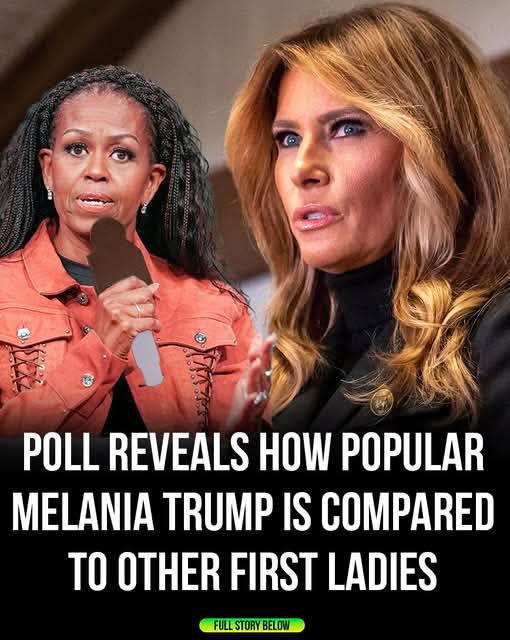
From the runways of Europe to the halls of the White House, Melania Trump has lived a life that continues to fascinate supporters and critics alike.
Known for her poised public image and carefully curated presence, she remains one of the most talked-about modern First Ladies. But a new national poll has reignited a deeper question how does she truly compare to the women who came before her?
To understand the answer, it helps to start at the beginning. Born Melanija Knavs in Novo Mesto, Slovenia, Melania’s early life was far removed from American politics. She grew up in a modest environment and initially pursued studies in architecture at the University of Ljubljana. However, her path quickly shifted. Drawn to the world of fashion, she left university to pursue modeling a decision that would ultimately reshape her future.
Within a year, she secured a contract in Milan, one of the fashion capitals of the world. Her striking appearance and disciplined work ethic opened doors to international opportunities, leading to appearances in major publications like Vogue, Harper’s Bazaar, and GQ. It was during this period that she met Italian businessman Paolo Zampolli, who helped her secure a visa to the United States. That move would mark the beginning of a new chapter one that would eventually lead her to the global stage.
Melania met Donald Trump in 1998 at a New York Fashion Week event. Their relationship quickly became the subject of media attention, and the couple married in 2005 in a high-profile ceremony in Palm Beach, Florida. A year later, Melania became a U.S. citizen, emphasizing throughout her public life that her immigration process followed legal channels.
As First Lady, she carved out a distinct identity. Unlike some of her predecessors, Melania maintained a relatively private profile, choosing her appearances carefully and often avoiding the constant spotlight. Her “Be Best” initiative, launched in 2018, focused on children’s well-being, online behavior, and the challenges of opioid addiction. She also became the first Catholic First Lady since Jacqueline Kennedy Onassis, a detail that added another historical layer to her role.
Her personal life has also drawn attention, particularly her role as a mother to Barron Trump. Those close to her have often highlighted her hands-on approach to parenting and her efforts to keep her son largely shielded from public scrutiny during his formative years. In many ways, this balance between public duty and private life has defined her time in Washington.
Yet despite her carefully managed image, public opinion about Melania Trump remains deeply divided. A recent survey conducted by YouGov, involving more than 2,200 Americans, offers a revealing snapshot of how she is perceived today. According to the poll, Melania holds a net approval rating of -16. This places her behind Jill Biden, who scored -9, but not at the very bottom of the rankings.
That position belongs to Hillary Clinton, whose approval rating came in slightly lower at -17. The data highlights a broader trend in modern politics: negative approval ratings are increasingly common, reflecting a climate where public figures are often viewed through sharply partisan lenses.
What makes Melania’s ranking particularly interesting is the contrast with earlier First Ladies, many of whom continue to enjoy strong bipartisan support years after leaving the White House. Figures like Nancy Reagan, Rosalynn Carter, Lady Bird Johnson, Barbara Bush, Michelle Obama, and Laura Bush all received positive approval scores, ranging from the high teens to over thirty points.
Towering above them all, however, is Jacqueline Kennedy Onassis, whose legacy continues to resonate decades later. With an approval rating of +56, she remains the most admired First Lady in the survey, a testament to her enduring influence on American culture, style, and public life.
The poll also underscores a familiar pattern in Melania Trump’s public perception. Her support is significantly stronger among Republicans than Democrats, mirroring the broader political divide associated with her husband’s presidency. For some, she represents elegance, restraint, and a departure from traditional political engagement. For others, she is inseparable from the controversies and polarization of the Trump era.
Interestingly, the survey didn’t stop with First Ladies. It also evaluated former U.S. presidents, revealing equally stark divisions. Donald Trump ranked last among the twenty presidents included, with a net approval rating of -20. Close behind was Joe Biden, who also received a negative score, highlighting the extent to which contemporary political figures face intense scrutiny from the public.
Beyond the numbers, Melania Trump’s story continues to evolve. A recent documentary about her life has attracted significant attention, reportedly generating millions in its opening weekend and securing substantial investment for distribution and promotion. This renewed interest suggests that, regardless of polling data, public curiosity about her remains strong.
In the end, Melania Trump occupies a unique place in the history of American First Ladies. Her journey from a small Slovenian town to one of the most visible roles in the world is undeniably remarkable. Yet her legacy is still being written, shaped not only by her actions but by the deeply divided landscape in which she served.
The latest poll doesn’t offer a final verdict it reflects a moment in time. It captures a country still grappling with its political identity, where admiration and criticism often coexist. And in that complex picture, Melania Trump remains exactly what she has always been: a figure impossible to ignore, and one whose place in history continues to spark debate.