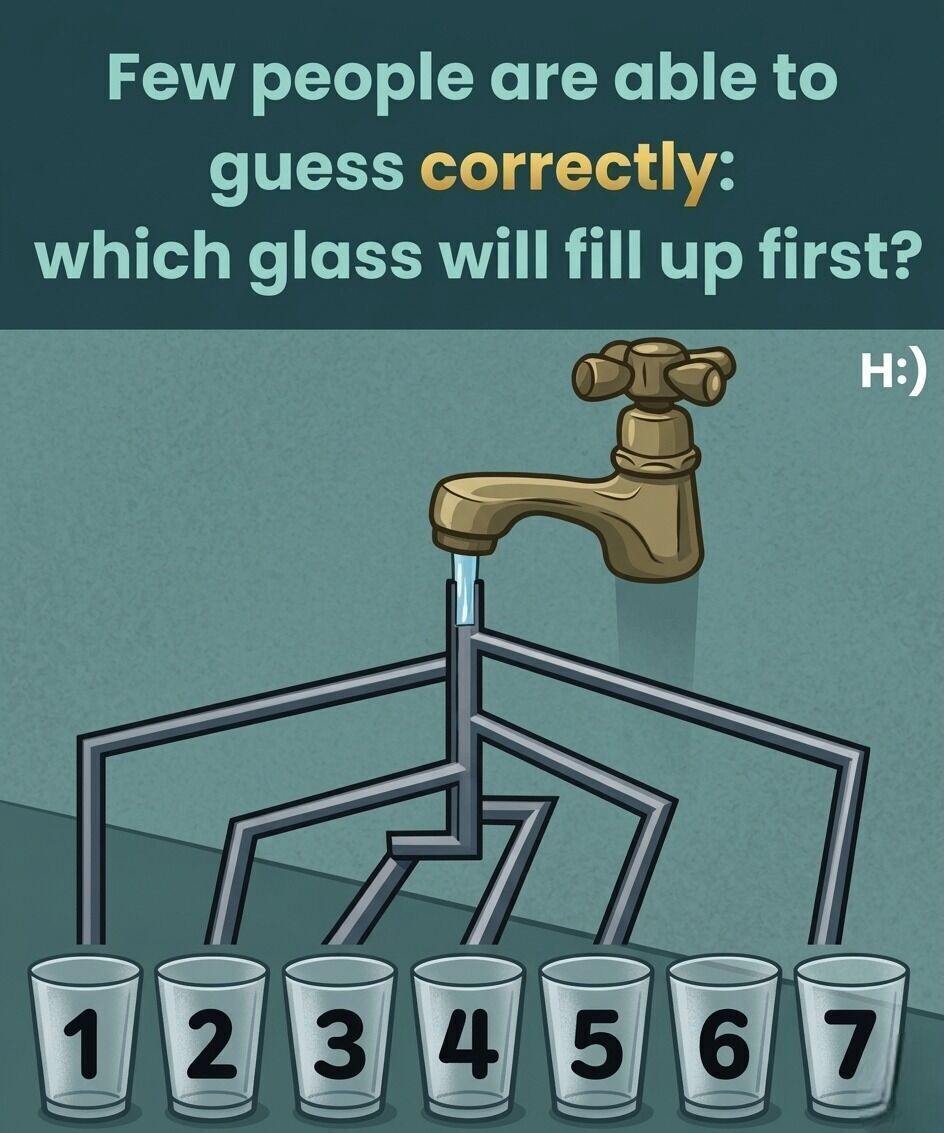
At first glance, the puzzle feels simple, almost inviting. A container pours water into a network of pipes, each branching off toward a series of glasses waiting below.
The challenge seems straightforward: follow the path, trace the flow, and decide which glass will fill first. It’s the kind of problem that sparks instant confidence. You look, you pick a route, and you settle on an answer within seconds.
And that’s exactly where the puzzle begins to outsmart you.
What makes this visual challenge so compelling isn’t its complexity, but its subtle manipulation of how we think. The drawing appears organized, logical, even predictable. Pipes connect, angles align, and everything seems to guide your eye naturally from the source to the destination. Your brain, eager to make sense of it quickly, fills in the gaps. It assumes continuity where there may be none. It trusts that lines which appear connected must actually carry flow. It prioritizes speed over verification.
In that first quick glance, most people don’t analyze the diagram they interpret it. They follow what looks like the most obvious path, often choosing the glass that appears closest to the main flow or the one that seems to receive the most direct stream. It feels right. It feels efficient. And it feels correct.
But the truth hides in what you don’t immediately question.
This puzzle isn’t about tracing water. It’s about challenging the assumptions you make while doing so. Each pipe, each junction, each turn is carefully designed to encourage a specific conclusion while quietly undermining it. What appears to be a clear route is often interrupted by a subtle blockage. What looks like a connection may not actually meet. Some paths that seem open are, on closer inspection, sealed off. Others lead nowhere at all, ending just short of where they appear to continue.
The illusion is not in the artwork itself, but in the way your mind completes it.
When you slow down really slow down the entire image begins to change. Instead of scanning, you start verifying. You follow each pipe deliberately, checking where it begins, where it turns, and whether it truly connects to the next segment. You stop assuming and start confirming. And one by one, the possibilities begin to collapse.
A pipe that seemed promising suddenly reveals a hidden block. Another that looked like a clear route turns out to be disconnected by a tiny gap. A third leads confidently downward, only to end abruptly before reaching any glass. Each discovery feels small on its own, but together they dismantle the entire premise of the puzzle.
You move from glass to glass, testing each path with careful attention. At first, it feels like you must have missed something. Surely one of them works. Surely the puzzle wouldn’t present options without a solution among them. That expectation keeps you searching, keeps you trying to force a path where none exists.
But the deeper you look, the clearer it becomes. Every route is compromised. Every apparent solution is an illusion. There is no hidden path you overlooked, no clever shortcut waiting to be found. The system is closed. The flow is blocked. The water has nowhere to go.
And that’s when the realization lands.
No glass will fill.
It’s a conclusion that feels almost uncomfortable. After all the effort, after all the scanning and second-guessing, the answer isn’t one of the options you were choosing between. It’s the rejection of all of them. The puzzle doesn’t reward speed or intuition it rewards patience and skepticism.
What makes this so powerful is how it exposes a deeper truth about how we think. In everyday life, we rely heavily on quick judgments. We recognize patterns, make assumptions, and move forward without examining every detail. Most of the time, this works. It helps us navigate a complex world efficiently. But in situations like this, that same instinct becomes a weakness.
The puzzle is a perfect demonstration of how easily perception can override logic. It shows how quickly we accept something as true simply because it appears consistent with our expectations. We see a path, so we believe it must function as one. We see a connection, so we assume it carries meaning. We trust the image before we test it.
And yet, the moment we slow down, everything shifts.
Careful observation replaces assumption. Verification replaces intuition. And in that shift, the illusion falls apart. What once seemed obvious becomes questionable. What once felt certain becomes fragile. The puzzle doesn’t change but your approach does, and that makes all the difference.
There’s a quiet lesson hidden in that experience. It’s not just about pipes or glasses or visual tricks. It’s about attention. About the value of pausing before deciding. About recognizing that what feels right isn’t always what is right. In a world that constantly pushes for faster answers and quicker conclusions, this puzzle asks you to do the opposite.
It asks you to look again.
It reminds you that clarity often lies just beyond that first impression, waiting for you to question it. And sometimes, the most accurate answer isn’t the one that stands out it’s the one that remains after everything else has been ruled out.
So while the image may appear simple, its impact lingers. Not because it was difficult, but because it revealed something fundamental. That even in the most straightforward situations, our minds can lead us astray. And that the real skill isn’t just seeing but seeing carefully.
In the end, the pipes never carried water. But they carried something else entirely: a lesson in perception, patience, and the quiet power of looking twice.