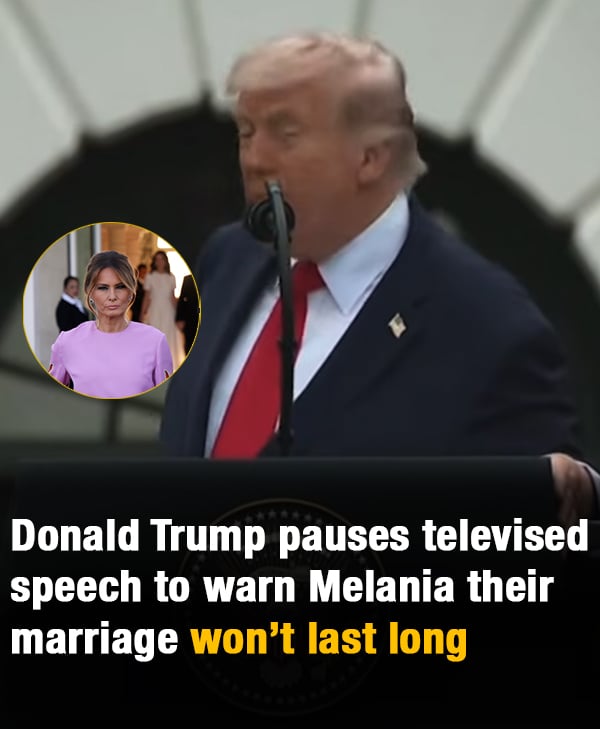
It was supposed to be a routine address, the kind that follows a familiar script. Lights, cameras, a measured cadence, and a message carefully constructed to project control. Yet in the middle of that polished setting, something unscripted slipped through.
It wasn’t loud or dramatic, not a headline-grabbing declaration or a sudden outburst. Instead, it came wrapped in humor, delivered casually, almost as if it were an aside meant only for the person standing closest to him. But because that person was Melania Trump, and the speaker was Donald Trump, the moment didn’t stay small for long.
As he spoke about legacy, about endurance, about the kind of long-lasting partnerships that define both public and private life, he turned briefly toward her. The line he delivered framed as a light joke comparing their marriage to that of his parents drew laughter from the audience. On the surface, it landed as self-deprecating humor, the kind that softens a speech and makes it feel more human. Yet there was something in the phrasing, something in the timing, that lingered beyond the initial reaction.
Moments like this often exist in two realities at once. Inside the room, they are fleeting, absorbed quickly into the rhythm of the event. Laughter fills the space, the speech continues, and the audience moves on. But outside the room, where clips are replayed and words are examined without the cushioning effect of context, those same moments take on a different weight. The line that earned a laugh becomes a subject of analysis, its meaning stretched and reshaped by those who watch it again and again.
For some, the remark felt harmless, even relatable. Public figures, after all, often use humor to bridge the gap between themselves and their audience. A joke about marriage especially one that acknowledges imperfection can be seen as an attempt to appear grounded, to show that even those in the highest offices are not immune to the complexities of personal life. In that reading, Donald Trump was simply leaning into a familiar tactic, using a light touch to humanize himself in front of the cameras.
But others heard something else beneath the humor. They pointed to the timing, coming after weeks in which the couple had already been under intense public scrutiny. The attempted shooting at the White House Correspondents’ Dinner had shaken the political world, bringing with it a wave of commentary, speculation, and renewed attention on the lives of those closest to power. In the aftermath, every gesture, every expression, every interaction between Donald Trump and Melania Trump seemed to carry additional significance.
That context matters, because humor does not exist in isolation. A joke told in a vacuum is one thing; the same joke delivered in the middle of ongoing tension can feel very different. For those already attuned to signs of strain, the remark sounded less like a throwaway line and more like a glimpse into something unspoken. It was not that the words themselves were overtly revealing, but that they opened the door to interpretation in a moment when many were already looking for meaning.
Melania Trump, known for her reserved public presence, did not respond in a way that altered the immediate flow of the event. There was no visible reaction that disrupted the moment, no indication that the comment had landed heavily in real time. And yet, her silence or rather, her composure became part of the story. In the absence of a clear response, observers filled in the gaps, projecting their own readings onto what they saw.
This is the paradox of public life at that level. The smallest interactions become amplified, not because of what they definitively reveal, but because of what they might suggest. A glance, a pause, a line delivered in passing each can be transformed into evidence supporting a narrative that may or may not reflect reality. The people at the center of these moments rarely have the ability to control how they are interpreted once they leave the room.
The remark also intersected with another thread that had been circulating in public discourse: the role of humor in a political environment already charged with tension. Comedians like Jimmy Kimmel had recently drawn criticism for jokes that some viewed as crossing a line, particularly in light of real-world threats and incidents. In that context, the boundary between humor and insensitivity felt more fragile than usual. When Donald Trump made his own joke this time about his marriage it inevitably became part of that broader conversation.
What makes moments like this resonate is not just the content of the words, but the questions they raise. Was it simply a calculated attempt to connect with the audience? A spontaneous comment that carried more weight than intended? Or something closer to a reflection of private thoughts slipping into a public setting? The truth may lie somewhere in between, but in the absence of clarity, speculation fills the space.
For the audience watching from afar, the moment offered a rare glimpse into the intersection of the personal and the political. Leaders are often presented as symbols of strength, stability, continuity. Yet they are also individuals, navigating relationships that exist outside the formal structures of power. When those two dimensions overlap, even briefly, the result can feel revealing, even if it is not meant to be.
In the end, the line itself remains unchanged, a few words spoken in the middle of a longer speech. But what it came to represent is far more complex. For some, it is a reminder that humor can misfire, especially in moments when sensitivity is heightened. For others, it is evidence of a deeper dynamic, one that occasionally surfaces despite efforts to keep it private.
What is certain is that the moment did not pass unnoticed. It joined a growing collection of instances in which the boundary between public image and private reality becomes blurred, leaving observers to interpret what they see without ever having access to the full picture. And in that space between what is said and what is understood, the story continues to evolve, shaped as much by perception as by fact.