What should have been a carefully choreographed display of diplomacy and tradition turned into something far more charged in a matter of seconds.
The state visit hosted by King Charles III and Queen Camilla was meant to reflect continuity, respect, and the quiet power of ritual. Every movement, every greeting, every step along the receiving line carried meaning shaped by centuries of protocol. But in a moment that would soon be replayed across the world, that sense of order fractured, replaced by a brief but striking departure from expectation.
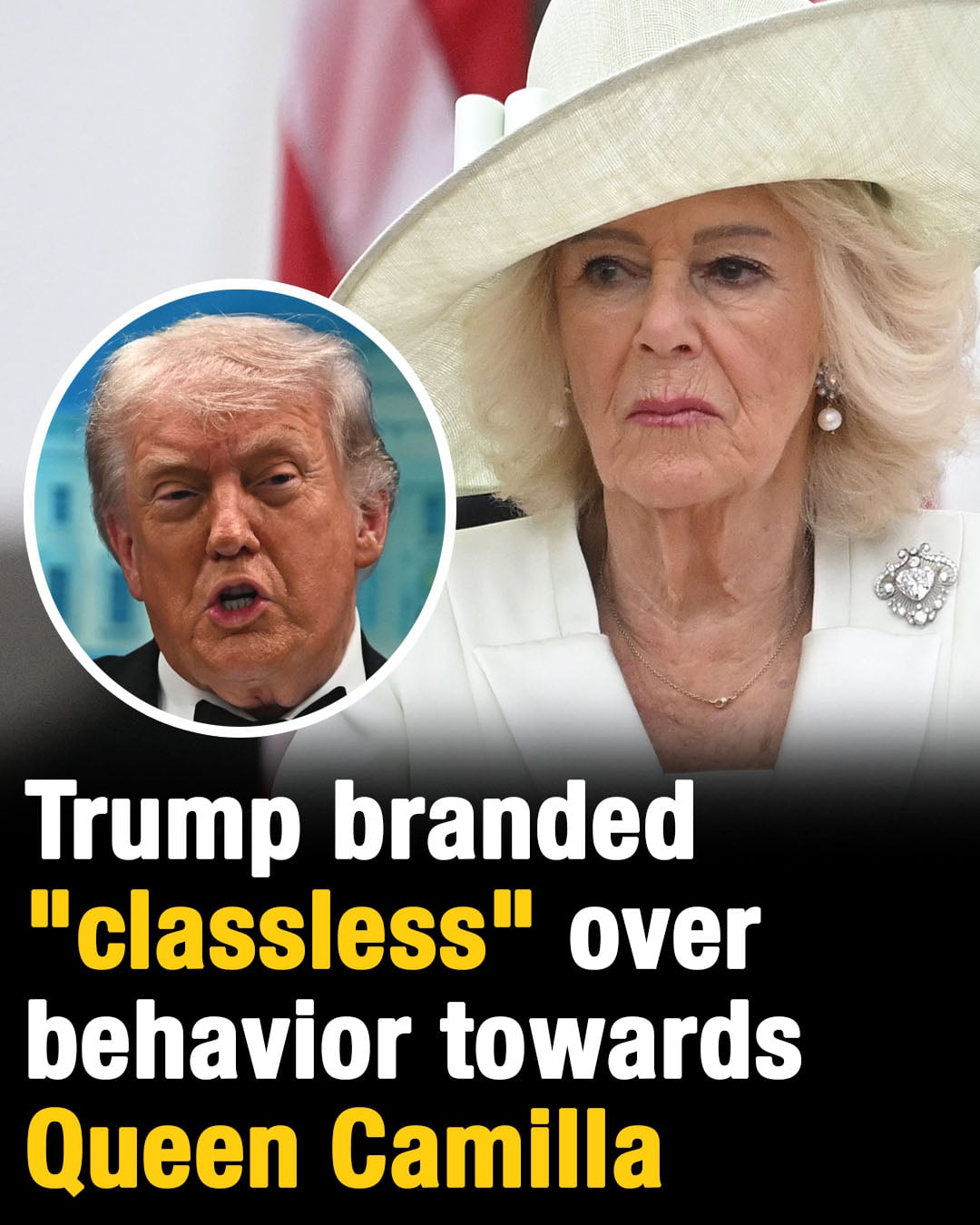
As guests gathered and cameras captured every angle, Queen Camilla moved with the composed ease expected of her role. Dressed in a vivid lime-green coat that stood out against the muted tones around her, she greeted dignitaries with calm precision, each interaction measured and deliberate. The setting demanded a certain rhythm, a choreography in which the host and guest moved in sync, reinforcing the symbolism of mutual respect. It was in the middle of this sequence that Donald Trump stepped forward and in doing so, disrupted more than just the line.
Rather than allowing the moment to unfold according to protocol, he moved ahead, placing himself directly in front of her. It was not a dramatic shove or an overt gesture, but the kind of subtle interruption that carries disproportionate weight in a setting defined by formality. For a brief instant, Queen Camilla was left behind him, her presence visually and symbolically diminished in a space where she was meant to stand at the forefront.
To some observers in the room, it may have passed as an awkward misstep, a lapse in timing or awareness. But in an era where every public interaction is captured, clipped, and circulated within seconds, that moment did not remain contained. The footage spread rapidly across social media, detached from its immediate context and placed under the scrutiny of millions. What might once have been forgotten became something to be analyzed, interpreted, and judged from every possible angle.
The reaction was immediate and deeply divided. Critics saw the incident as more than a simple breach of etiquette. To them, it reflected a pattern an extension of previous moments in which Donald Trump had appeared to disregard established norms during encounters with British royalty. Comparisons quickly surfaced to his earlier visit with Queen Elizabeth II, where similar accusations of protocol violations had been widely discussed. In this new context, the latest incident did not feel isolated, but cumulative, reinforcing a narrative that had already taken shape in the public imagination.
For those critics, the issue was not about monarchy or tradition in a narrow sense. It became a question of respect, of understanding the symbolic weight carried by these interactions. In environments where roles are clearly defined, even small deviations can be interpreted as statements. Stepping ahead, in that moment, was seen not just as a physical action, but as a reflection of priorities who leads, who follows, and who is given space to be seen.
Supporters, however, pushed back against what they viewed as an exaggerated response. They argued that the reaction said more about the audience than the act itself, suggesting that the incident was being inflated to fit existing criticisms. From this perspective, it was a fleeting, inconsequential misstep, one that did not warrant the level of attention it received. They pointed to the complexity of such events, where timing, movement, and positioning can easily go awry without intent or meaning.
Yet the intensity of the debate revealed something deeper than disagreement over a single moment. It highlighted how public figures are interpreted not just through their actions, but through the lens already applied to them. For some, the image of Donald Trump stepping in front of Queen Camilla confirmed long-held beliefs about his approach to decorum and authority. For others, it underscored what they see as a tendency to scrutinize and criticize his behavior beyond reasonable limits.
The power of the moment lay in its simplicity. There were no words exchanged that could be quoted or clarified, no official statement that could fully reshape its meaning. It was a visual event, open to interpretation, shaped by context and perception. In that sense, it became a kind of symbol one that people could project their own views onto, whether those views were rooted in admiration, skepticism, or outright opposition.
For Queen Camilla, the response within the moment remained composed, almost understated. There was no visible reaction that acknowledged the disruption, no outward sign of discomfort beyond the brief shift in positioning. That restraint, in itself, became part of the narrative, reinforcing the contrast between adherence to tradition and deviation from it. In settings like this, composure is not just expected; it is essential, a way of maintaining continuity even when circumstances shift unexpectedly.
As the footage continued to circulate, it became clear that the discussion was no longer confined to the specifics of that day. It expanded into broader conversations about leadership, behavior, and the expectations placed on those in positions of power. The incident served as a focal point for debates that had been ongoing, offering a new example through which those debates could be expressed.
What made the moment resonate was not its scale, but its visibility. In a world saturated with information, it is often the smallest, most human actions that capture attention. A step taken at the wrong time, a shift in position, a break in rhythm these are the details that linger, precisely because they are so easy to grasp and interpret.
In the end, the significance of what happened rests less in the action itself and more in what it came to represent. For some, it stands as evidence of disregard for tradition and respect. For others, it is a reminder of how quickly narratives can form around even the briefest of moments. Either way, it demonstrates how public perception is shaped not just by what is done, but by how it is seen, shared, and understood.
Long after the event itself has passed, the image remains: a receiving line, a sudden step forward, and a shift that transformed a routine moment into a subject of global attention. In that single movement, an entire conversation unfolded, revealing as much about the observers as it did about the act they were watching.