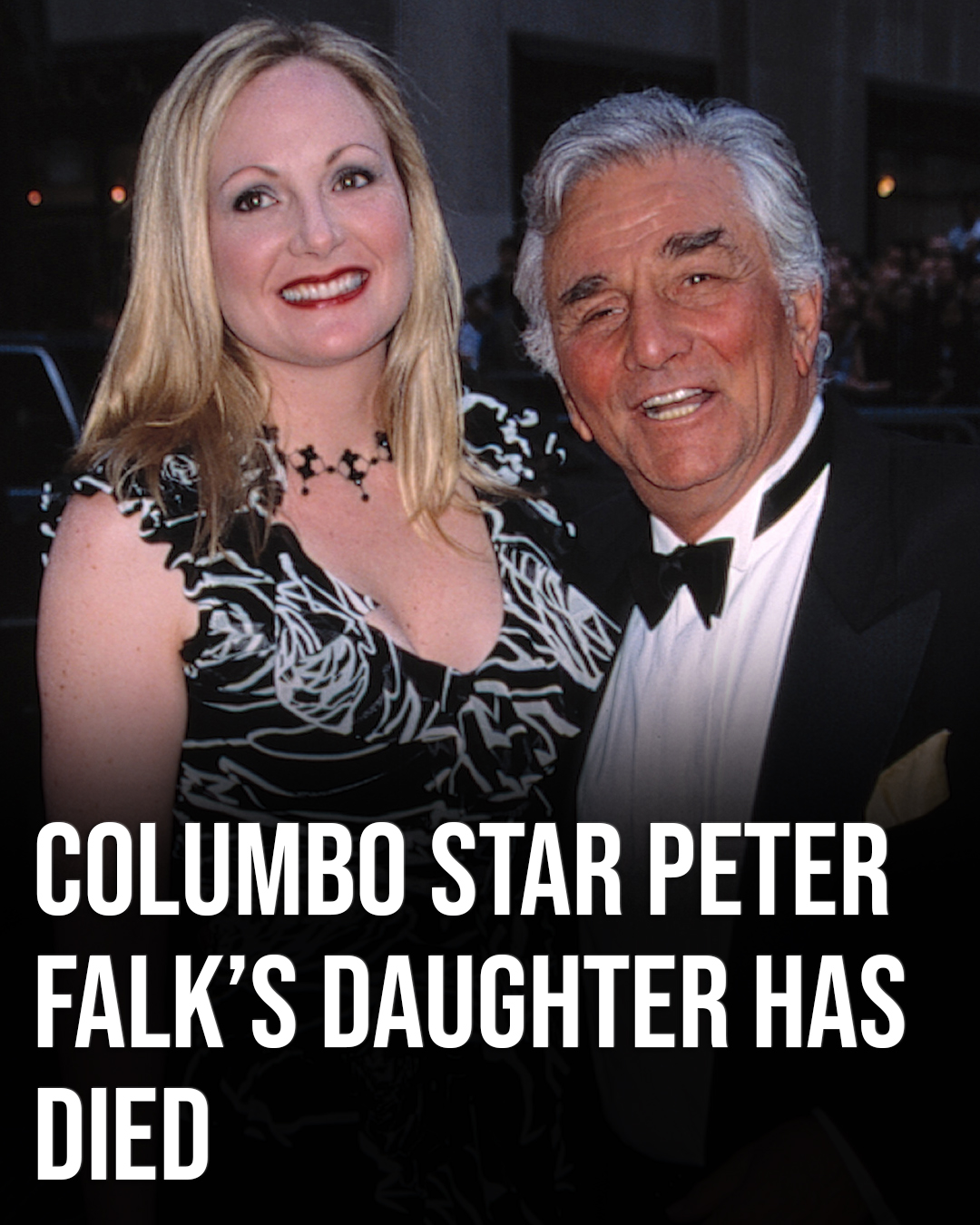
She grew up in a home that millions of people thought they understood, shaped by the presence of a man whose rumpled trench coat and quiet brilliance had become part of television history.
To the world, her father was a genius of subtle performance, a character who could disarm suspects with a single raised eyebrow and a deceptively simple question. But inside that household, far from studio lights and scripted mysteries, life unfolded in ways far more complex and far less predictable.
Jacqueline was one of two daughters adopted into a family that, at least from the outside, seemed touched by something special. Her father’s success brought admiration, stability, and a kind of cultural immortality. Yet even in those early years, there were fractures that fame could not seal. Her parents’ marriage eventually ended in the mid-1970s, closing one chapter while opening another that would quietly shape the emotional landscape of everyone involved.
Despite the separation, the bonds within the family did not simply vanish. They lingered, complicated and layered, tied together by shared history and the weight of a public identity that never quite faded. Growing up in the orbit of such a recognizable figure meant that Jacqueline’s life was never entirely her own. There was always an echo of expectation, a reflection cast by a father who had become something larger than life to strangers.
As time passed, that shadow only grew heavier. Her father’s later years were marked by a slow, devastating decline brought on by Alzheimer’s disease, a condition that gradually stripped away the very essence of the man audiences believed they knew so well. Memories faded, connections blurred, and the sharp, inquisitive mind that had once defined him began to dissolve. For those closest to him, it was not just an illness it was a prolonged goodbye.
Jacqueline lived through that unraveling, witnessing the transformation of someone who had once seemed indestructible. It is one thing to lose a parent suddenly, but something entirely different to watch them disappear piece by piece, long before their body follows. When he passed away in 2011, it marked the end of an era not only for fans but for a family that had already endured years of quiet grief.
Her mother’s death several years later added another layer to that loss. With both parents gone, Jacqueline found herself holding the remnants of a shared past alone. The stories, the memories, the unresolved tensions everything that once connected them now rested with her. It is a burden that can feel invisible from the outside, yet incredibly heavy for the person carrying it.
From a distance, her life might have seemed defined by proximity to fame, but proximity is not the same as protection. Being close to something admired does not shield a person from pain, nor does it guarantee clarity or peace. In many ways, it can deepen the sense of isolation, especially when the world assumes your life has been touched by privilege and meaning simply because of who you are connected to.
When news of her death emerged, it came with the stark finality that often follows lives lived quietly in the background of public narratives. At the age of 60, her story came to an end in a way that left more questions than answers. The official ruling provided a conclusion, but not an understanding. Those who learn of it are left grappling with the same haunting uncertainty: what weight had she been carrying, and how long had it been there?
There is something particularly unsettling about loss that unfolds this way. It resists easy explanation. It challenges the comforting idea that suffering always announces itself, that pain can be seen, measured, or intervened upon before it becomes overwhelming. Instead, it reminds us that some struggles exist beneath the surface, hidden even from those who believe they are paying attention.
Her life, like many others connected to public figures, existed in a strange in-between space. Not entirely private, yet not truly visible either. Known, but not understood. That kind of existence can blur identity over time, making it difficult to separate who you are from who people assume you must be. It can also make it harder for others to recognize when something is wrong, because the narrative they believe in feels too complete to question.
What remains now is not a neatly resolved story, but a complicated legacy woven from both light and shadow. There is the enduring impact of a father who helped shape television history, whose work continues to resonate with audiences decades later. And there is the quieter, more fragile reality of a daughter whose life unfolded alongside that legacy, shaped by it in ways that cannot be fully captured from the outside.
Her passing invites reflection not only on her own journey but on the broader truth it reveals. That even lives connected to admiration and success can carry unseen burdens. That being part of something celebrated does not erase vulnerability. And that sometimes, the people closest to what we admire are the ones whose struggles remain the least understood.
In the end, her story does not resolve into a simple lesson or a clear conclusion. It lingers instead as a reminder quiet, sobering, and difficult to ignore that behind every familiar name or celebrated figure, there are lives unfolding in parallel, shaped by forces that rarely make headlines. Lives that deserve to be seen not as extensions of someone else’s legacy, but as complete, complex stories in their own right.
And perhaps that is what remains most important now: not just remembering the legacy she was connected to, but acknowledging the life she lived within it, with all its unseen weight, its unanswered questions, and its deeply human complexity.