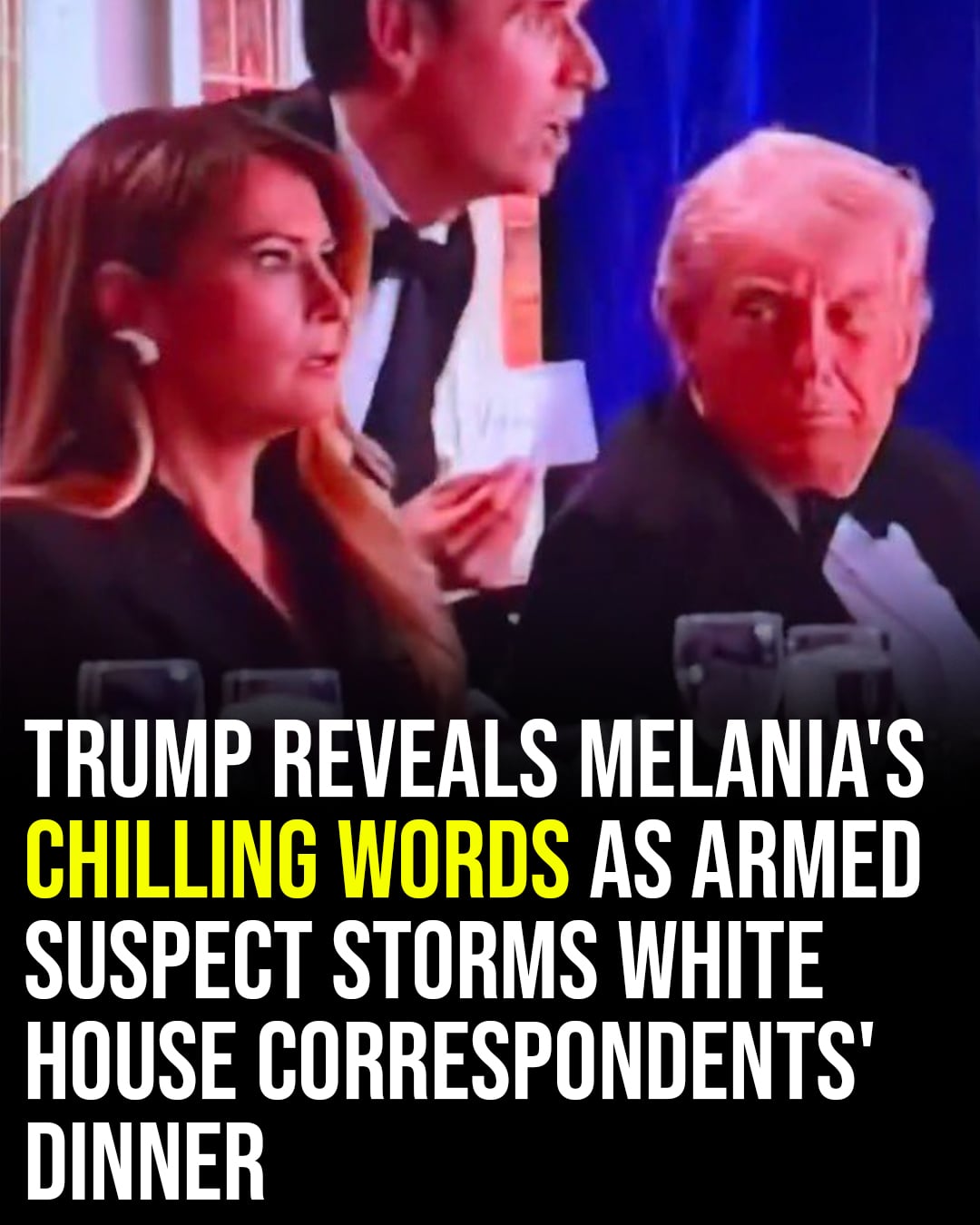
The evening had all the markings of a familiar Washington ritual formal attire, practiced humor, and a room filled with people who understood the choreography of power.
Inside the Washington Hilton ballroom, the White House Correspondents’ Dinner was unfolding as expected, a blend of satire and ceremony where politicians and journalists briefly shared the same stage. Conversations overlapped with laughter, glasses caught the light, and the atmosphere carried that delicate balance between rivalry and performance.
At one table, Donald Trump sat alongside Melania Trump and senior officials, preparing for what was meant to be another evening of carefully delivered remarks and public spectacle. Nothing in the room suggested what was about to happen. The sense of control felt complete, reinforced by layers of security and routine that had been repeated year after year.
Then the sound came.
At first, it was subtle enough to be dismissed. A sharp noise, easily mistaken for something ordinary in a large, crowded space. Some guests paused, turning their heads slightly, their expressions shifting from engagement to mild curiosity. For a brief moment, uncertainty hovered over the room, not yet fully formed into alarm.
According to accounts shared later, it was Melania who reacted first at their table. She reportedly leaned in and described it as “a bad noise,” a simple phrase that carried more intuition than explanation. It was not a declaration of danger, but it marked the moment when instinct began to replace assumption.
Seconds later, the ambiguity vanished.
The noise repeated, louder and unmistakable. The realization spread quickly, moving through the room not as a single wave but as a series of reactions one person dropping to the floor, another pulling someone close, others frozen in place as they tried to understand what was happening. The transformation was immediate. The event was no longer a performance. It was something else entirely.
Secret Service agents moved with precision. Training took over, compressing time into action. The President and First Lady were surrounded and escorted out with speed that left little room for hesitation. For many in the room, their departure was almost invisible, noticed only after it had already happened.
Around them, the ballroom fractured into motion. Chairs overturned, table settings were abandoned mid-meal, and the low hum of conversation gave way to urgent whispers and shouted instructions. Some guests crawled beneath tables, using whatever cover they could find. Others moved toward exits, guided by security personnel whose focus had narrowed to a single objective: containment.
Amid the confusion, a single fact would later stand out. One of the responding officers had been struck by a round. The impact, absorbed by a bullet-resistant vest, prevented what could have been a far more devastating outcome. The difference between tragedy and survival, in that moment, came down to preparation and seconds.
Outside the ballroom, the situation was already unfolding in parallel. The suspect, later identified as Cole Tomas Allen of Torrance, California, had reportedly approached the area with multiple weapons. His actions triggered a rapid response from law enforcement and protective services, who engaged and subdued him before he could reach deeper into the secured space.
Inside, however, the experience was less defined by resolution and more by uncertainty. Guests remained in place, unsure whether the threat had fully passed. Phones appeared in trembling hands as people reached out to family and friends, trying to communicate a situation that was still unclear even to those living through it.
Time stretched in a way that often happens during moments of crisis. Minutes felt longer, filled with questions that had no immediate answers. Slowly, information began to filter back into the room. The suspect was in custody. The President was safe. The immediate danger had been contained.
Even with that reassurance, the atmosphere did not return to what it had been. The room felt altered, as if something fundamental had shifted beneath the surface. The remnants of the evening told the story half-finished drinks, scattered programs, chairs left askew. The performance had been interrupted, and there was no easy way to resume it.
In the hours that followed, the focus moved from reaction to investigation. The bright, carefully controlled lighting of the ballroom gave way to the stark clarity of emergency response sirens, security perimeters, and the methodical work of gathering evidence. What had been a social event became a crime scene, its meaning redefined by what had taken place.
Details about the suspect began to emerge, adding complexity to an already unsettling narrative. Reports described a man with an academic background and professional achievements, someone who, on paper, appeared to have followed a disciplined and structured path. That contrast between expectation and allegation only deepened the questions surrounding the incident.
Investigators began examining every available piece of information. Digital activity, personal writings, and any material that might clarify motive were brought into focus. References to grievances, beliefs, and possible targets became part of a broader effort to understand not just what happened, but why.
For the President, the incident served as a stark reminder of the realities that exist beneath the surface of public life. Even in environments designed for maximum security, the possibility of disruption remains. The distance between routine and crisis, between ceremony and danger, can collapse in an instant.
Yet beyond the immediate political and security implications, the event left a different kind of mark on those who were present. It exposed the fragility of moments often taken for granted. It revealed how quickly familiarity can give way to uncertainty, and how instinct takes over when structure falls away.
Melania’s brief remark “a bad noise” lingers as a quiet detail within the larger narrative. It was not dramatic, not amplified, but it captured the exact point where perception began to shift. Before the room understood what was happening, before the full weight of the situation became clear, there was a moment of recognition that something was not right.
That moment, small as it may seem, reflects the human side of an event defined by speed and precision. It is a reminder that even in highly controlled environments, awareness begins with something simple a sound, a feeling, an instinct that interrupts the ordinary.
As the investigation continues and more details emerge, the night will be analyzed from multiple angles security, psychology, politics. Protocols will be reviewed, responses evaluated, and conclusions drawn. But for those who were there, the experience will likely remain more immediate, less abstract.
It will be remembered as the moment when laughter stopped. When the familiar rhythm of the evening broke. When a single sound changed everything.
And long after the formal reports are completed and the event is rescheduled, that memory will persist not just as a disruption, but as a reminder of how quickly the world can shift, even in the places where it feels most controlled.