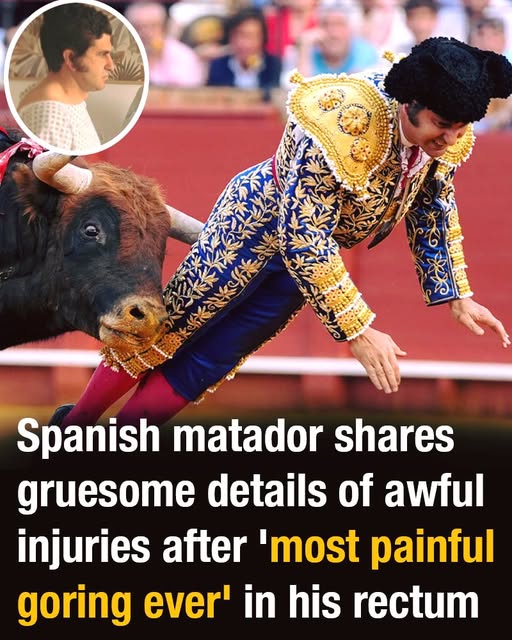
Veteran Spanish matador Morante de la Puebla is now recovering after suffering one of the most serious and painful injuries of his long career during a dramatic incident in Seville.
The event unfolded at the iconic Plaza de Toros de la Maestranza, a historic arena that has hosted generations of bullfighters and remains one of the most prestigious stages in Spain’s bullfighting tradition. What began as a routine performance quickly turned into a moment of danger that stunned both spectators and fellow participants.
At 46 years old, Morante de la Puebla is considered one of the most respected figures in modern bullfighting. Known for his distinctive style and deep connection to the art form, he has spent decades performing in major arenas across Spain. On the day of the incident, everything initially appeared to be going according to plan. Reports indicate that he had already completed several successful passes earlier in the event, demonstrating the confidence and precision that have defined his career.
Bullfighting, deeply rooted in Spanish culture, is a carefully choreographed yet inherently unpredictable spectacle. The matador faces the bull in a sequence of movements that require timing, composure, and complete control under pressure. Despite the ritualized nature of the performance, the risk is always present. Even the most experienced matadors remain vulnerable to sudden changes in the animal’s behavior.
That unpredictability became reality in a matter of seconds. During one of the later stages of the performance, the bull reportedly charged in an unexpected way, catching Morante de la Puebla off guard. Witnesses described the moment as abrupt and chaotic, leaving little opportunity for him to react or evade the attack. The force of the impact resulted in a serious injury that immediately shifted the atmosphere inside the arena.
Fellow bullfighters in the ring responded without hesitation. Their quick actions helped prevent the situation from escalating further, as they intervened to distract the bull and assist the injured matador. Within moments, he was carefully removed from the ring and taken to receive urgent medical attention. The speed of that response is often critical in such situations, where seconds can make a significant difference in the outcome.
Medical personnel on site began emergency treatment immediately before transferring him for further care. According to reports, the injury required an extensive surgical procedure, with doctors working for several hours to stabilize his condition. While specific medical details have been shared cautiously, the situation was serious enough to require close monitoring and continued supervision during recovery.
In the days following the incident, Morante de la Puebla spoke publicly about his experience, offering a rare and personal glimpse into what he endured. He described the moment of impact as disorienting and frightening, explaining that his first reaction was uncertainty about the severity of his injuries. In the confusion of the moment, he feared the worst, unsure of how much damage had been done.
As he was attended to by medical professionals, he began to understand that while the injury was serious, it was not as catastrophic as he had initially believed. That realization brought some relief, but it did not lessen the physical pain he experienced. He openly acknowledged the intensity of the discomfort, describing it as immediate and overwhelming in the aftermath of the incident.
Recovery from such injuries is rarely straightforward. It often involves a combination of rest, medical care, and gradual rehabilitation. In his case, reports indicate that the early stages of recovery have been particularly challenging. Basic daily activities have required effort, and he has needed medical assistance for nutrition and ongoing monitoring while under hospital care. These are common measures in cases involving significant trauma, ensuring that the body has the support it needs to heal properly.
Medical experts familiar with injuries sustained in bullfighting emphasize that outcomes can vary widely. The severity depends on multiple factors, including the angle of impact, the force of the bull, and the area of the body affected. Even with protective techniques and experience, matadors operate in an environment where complete control is never guaranteed.
The incident has also reignited broader conversations about bullfighting in Spain. For some, the practice remains an important cultural tradition, deeply tied to history and identity. For others, it raises ongoing concerns about ethics, safety, and its place in modern society. Events like this tend to bring those discussions back into focus, highlighting both the risks faced by performers and the controversial nature of the spectacle itself.
Public opinion on bullfighting continues to evolve, with different regions of Spain taking varying approaches to regulation and acceptance. While some areas maintain strong support for the tradition, others have introduced restrictions or bans. The debate reflects a wider shift in societal values, where long-standing customs are increasingly examined through contemporary perspectives.
For Morante de la Puebla, however, the immediate concern is recovery. His condition is being closely monitored, and while there is cautious optimism about his progress, no official timeline has been set for a potential return to the ring. Decisions about his future will depend on medical evaluations and his ability to regain full strength and mobility.
Throughout his career, he has built a reputation not only for his skill but also for his resilience. This latest incident adds another chapter to that story, one defined by both vulnerability and determination. It serves as a powerful reminder of the physical demands of bullfighting, where moments of artistry can quickly give way to moments of danger.
As updates continue to emerge, attention remains focused on his healing process. Supporters within the bullfighting community and beyond are watching closely, hoping for his full recovery. Whether or not he chooses to return to the arena, the incident has already left a lasting impression, underscoring the reality that behind the tradition lies a profession shaped by courage, risk, and the constant possibility of the unexpected.