What began as an evening defined by elegance, routine, and carefully managed appearances shifted in an instant into something raw, unpredictable, and deeply human.
The White House Correspondents’ Dinner, long known for its blend of politics, media, and spectacle, was moving along as expected measured laughter, formal introductions, the subtle choreography of power sharing a room with scrutiny. For many in attendance, it was just another high-profile night. For Erika Kirk, it would become something else entirely.
Seated near President Donald Trump and other senior officials inside the Washington Hilton ballroom, Kirk was part of the inner circle of guests who often find themselves closest to both influence and risk. As chairwoman and CEO of Turning Point USA, she had grown accustomed to public attention, to navigating rooms where conversations carried weight and visibility came with responsibility. But nothing in that experience prepared her for the sudden rupture that followed.
It started with a sound sharp, unclear, but wrong. At first, it didn’t register as danger. In a room filled with clinking glasses and amplified voices, unexpected noises can blur into the background. But then came another, and another, each one cutting through the atmosphere with increasing urgency. Confusion spread quickly, and within seconds, the tone of the room shifted from composed to unsettled.
Security responded before most guests could fully process what was happening. Secret Service agents moved with practiced speed, their presence instantly transforming the environment. Weapons were drawn, commands were issued, and the illusion of a controlled setting dissolved into something far more instinctive. People ducked, some dropped beneath tables, others froze, caught between disbelief and fear.
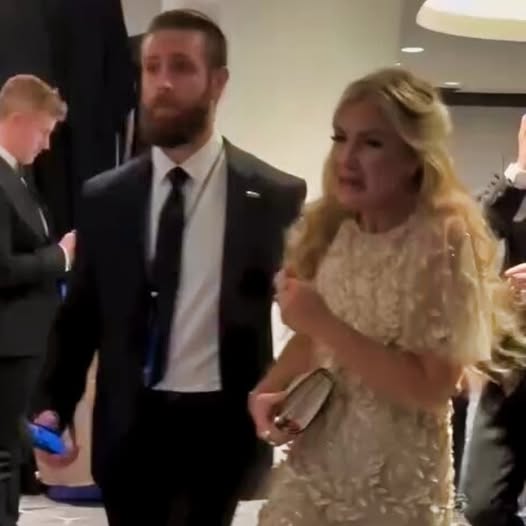
In the middle of that unfolding chaos, cameras captured a moment that would soon ripple across social media. Erika Kirk, visibly shaken, was being escorted out of the ballroom by security personnel. The footage shows her moving quickly through crowded hallways, her composure fractured in a way rarely seen in public figures. Dressed in a formal gown that moments earlier had symbolized the evening’s polished tone, she now appeared overwhelmed, her expression marked by fear and urgency.
Her voice, caught clearly amid the noise, repeated the same four words over and over: I want to go. It was a simple phrase, but in that moment, it carried everything shock, vulnerability, and a deeply human reaction to a situation spiraling out of control. There was no performance in it, no calculation. Just instinct.
Witnesses described her as visibly distraught, tears streaming down her face as she clutched her purse tightly, guided firmly but carefully by security through the corridors. Around her, others were being moved with equal urgency officials, staff, guests all caught in the same sudden shift from ceremony to survival.
The evacuation itself unfolded rapidly. President Trump, First Lady Melania Trump, Vice President JD Vance, and other dignitaries were ushered out under heavy protection. Agents created moving barriers, scanning constantly, their focus locked on removing key figures from potential danger. The ballroom, once filled with structured conversation, became a space of uncertainty, where every second seemed to stretch.
Outside the immediate scene, law enforcement quickly engaged with the source of the disturbance. Reports indicated that a suspected gunman had been taken down near the venue’s metal detectors. The confrontation, though brief, added another layer of intensity to an already volatile situation. Despite the severity of the moment, officials later confirmed that no attendees or protected individuals were injured, a fact that underscored the speed and effectiveness of the response.
Still, for those who experienced it firsthand, the absence of physical harm did little to erase the emotional impact. The event was abruptly canceled, its purpose overshadowed entirely by what had unfolded. Guests left not with memories of speeches or conversations, but with a shared sense of having witnessed something deeply unsettling.
For Erika Kirk, the experience carried additional weight. Her public life in recent months had already been shaped by personal tragedy and heightened security concerns. Following the loss of her husband, conservative activist Charlie Kirk, in September 2025, she had stepped into a leadership role while navigating grief and the demands of raising young children. The pressures of that transition had not been abstract—they had been immediate and ongoing.
In that context, the events of the dinner were not just another security scare. They intersected with an already fragile emotional landscape. Those close to her noted that the incident was particularly difficult, a moment that seemed to reopen fears that had never fully settled. In recent months, she had already faced threats serious enough to cancel a planned event, decisions made out of caution rather than convenience.
The video of her evacuation, shared widely online, quickly became more than just footage of a chaotic night. It became a focal point for public reaction, drawing attention to the human side of political life that is often obscured by rhetoric and roles. Viewers responded not to policy or affiliation, but to the visible reality of fear something immediate, recognizable, and impossible to dismiss.
Comments across platforms reflected a mix of sympathy and reflection. Many pointed to the vulnerability captured in those few seconds, noting how quickly the distance between public figures and private individuals can collapse. In moments like that, titles and positions lose their meaning, replaced by something more fundamental.
As investigations continue into the incident, authorities remain focused on understanding how the breach occurred and what factors allowed it to unfold. Questions about security protocols, access points, and response times are already shaping the next phase of analysis. But alongside those discussions, the emotional aftermath lingers in quieter ways.
For those who were there, the memory is not just of what happened, but of how it felt the sudden shift, the uncertainty, the instinct to escape. For Erika Kirk, those four words captured on camera now stand as a lasting echo of that moment, a reminder that even in the most controlled environments, unpredictability can break through without warning.
The dinner will be remembered not for its speeches or its symbolism, but for the night it transformed into something else entirely. And in the center of it, one brief, unguarded moment revealed a truth often overlooked: that behind every public figure is a person, and in the face of fear, that is what the world sees first.