The evening had been unfolding exactly as expected, polished and predictable, a carefully choreographed blend of humor, tradition, and political theater.
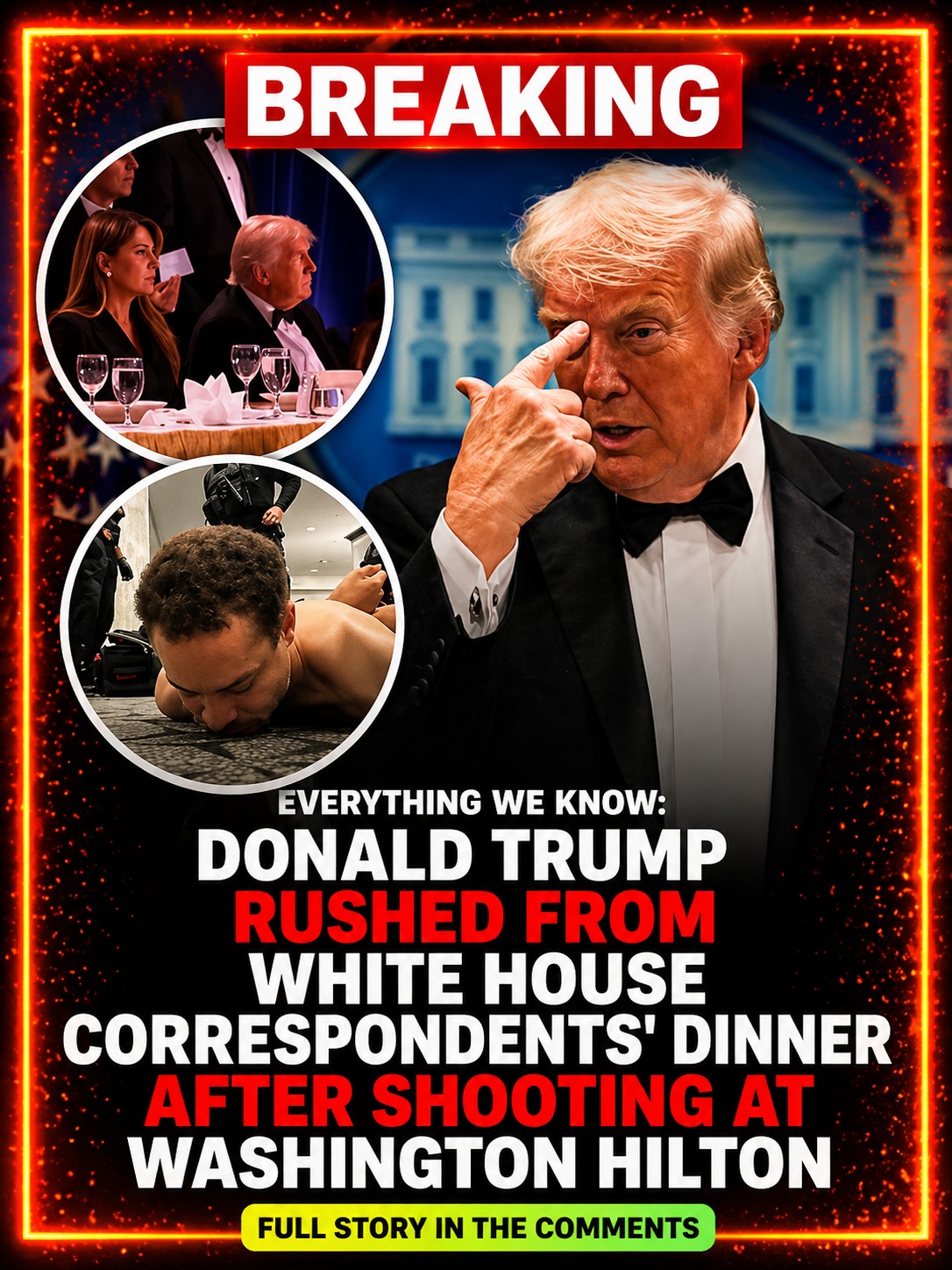
Inside the grand ballroom of the Washington Hilton, journalists, public officials, and celebrities sat shoulder to shoulder beneath soft lighting, clinking glasses and exchanging knowing smiles at familiar jokes. The White House Correspondents’ Dinner has always thrived on that delicate balance between satire and ceremony, a night where power relaxes just enough to laugh at itself. For a while, everything followed the script.
Then, in an instant, the script shattered.
What began as a faint, confusing noise quickly escalated into something unmistakable. Sharp cracks echoed through the building, cutting through laughter and conversation with a force that silenced the room before panic could even take shape. For a split second, there was disbelief, the human instinct to search for a harmless explanation. But as the sound repeated louder, closer, undeniable the illusion collapsed.
“Shots fired.”
Those two words, relayed through security channels and whispered from table to table, spread faster than comprehension. Chairs scraped violently against the floor as people stood up or ducked down without fully knowing why. Some froze, caught between instinct and confusion, while others moved immediately, abandoning heels, phones, and handbags in a desperate attempt to get low or get out. Beneath the elegant linens of banquet tables, seasoned reporters people accustomed to documenting chaos, not living it—huddled together, some crying, others gripping their colleagues’ arms in stunned silence.
On stage, the transformation was even more abrupt. Donald Trump and the First Lady had been part of the spectacle moments earlier, framed by cameras and applause. Then, almost as if pulled by an invisible force, they were gone. Secret Service agents moved with practiced precision, their actions swift and absolute. Black suits closed in, weapons drawn, forming a moving barrier as they escorted the President out of sight. For those watching, the image lingered: a figure of authority disappearing behind a wall of urgency, leaving behind a room that no longer felt secure.
Outside the ballroom, the situation was already unfolding in a different register faster, louder, more violent. Within minutes, a suspect had been confronted and subdued following a brief but intense exchange. The man, identified as 31-year-old Cole Tomas Allen, was taken into custody in handcuffs, his presence raising immediate and unsettling questions. A Secret Service agent had been struck during the encounter, saved only by a ballistic vest that turned what could have been a fatal injury into a narrow escape.
As emergency responders secured the area and investigators began their work, the focus shifted rapidly from survival to understanding. Who was this man, and how had he come so close?
The early details only deepened the mystery. Allen was not someone who fit the expected profile of a threat. He was described as highly educated, a graduate of California Institute of Technology with a master’s degree in computer science. Those who knew him spoke of intelligence, discipline, and a quiet demeanor. There was no criminal record, no documented history of violence, no obvious warning signs that might have drawn attention before that night. In Torrance, where he had lived, neighbors watched in disbelief as federal agents descended on his home, their quiet streets suddenly filled with the presence of an unfolding national investigation.
Back in Washington, D.C., the emotional aftershock was still rippling through those who had been inside the ballroom. For many, the experience defied easy description. It wasn’t just fear it was the abrupt collapse of certainty. The dinner, built on ritual and control, had been exposed as fragile, vulnerable to disruption in a matter of seconds. Conversations in the hours that followed were marked by a kind of disorientation, as attendees tried to process how quickly normalcy had given way to chaos.
As the night progressed, historical echoes began to surface. Commentators and officials alike drew comparisons to the Attempted assassination of Ronald Reagan, a moment that had also unfolded at the same hotel decades earlier. The parallels were impossible to ignore: a high-profile gathering, a heavily protected environment, and yet, somehow, a breach that brought danger uncomfortably close to the presidency. The question that lingered then and lingers now was the same: how did it happen again?
By the time Donald Trump reappeared at the White House later that night, still dressed in formal attire, the narrative had already begun to take shape. He addressed the incident with a tone that blended reassurance and resolve, praising the agent whose protective gear had prevented a tragedy from becoming something far worse. Footage of the suspect’s arrest circulated quickly, adding a visual dimension to an event that already felt surreal.
Behind the scenes, investigators worked through the night. Shell casings were collected, surveillance footage reviewed, and digital devices seized in an effort to uncover any indication of motive or planning. Authorities urged the public to come forward with information, while local officials emphasized that there was no indication of a broader, coordinated threat. Yet for those who had heard the gunfire those five to eight deafening shots that shattered the evening such assurances felt distant, almost abstract.
What they had experienced was immediate and personal. It was the sound of something breaking, not just physically, but psychologically. A reminder that even in spaces defined by security and ceremony, unpredictability can still force its way in.
For the United States Secret Service, the incident is likely to become a defining moment of scrutiny and reassessment. Each near-miss carries weight, not only because of what happened, but because of what might have happened. The margin between safety and catastrophe is measured in seconds, in inches, in decisions made under pressure.
For the country, the event resonates beyond the specifics of that night. It underscores a broader reality about the nature of public life and leadership. The rituals of power the dinners, the speeches, the carefully managed appearances are designed to project stability and control. But beneath that surface lies a more fragile truth: that safety is never absolute, and that even the most guarded environments can be tested by a single moment of disruption.
In the end, what remains is not just the memory of panic or the details of an investigation still unfolding. It is the awareness, sharpened and undeniable, that the line between order and chaos is thinner than it appears. And for those who were in that room, who heard those shots and felt the world shift beneath them, that understanding is something that will not easily fade.