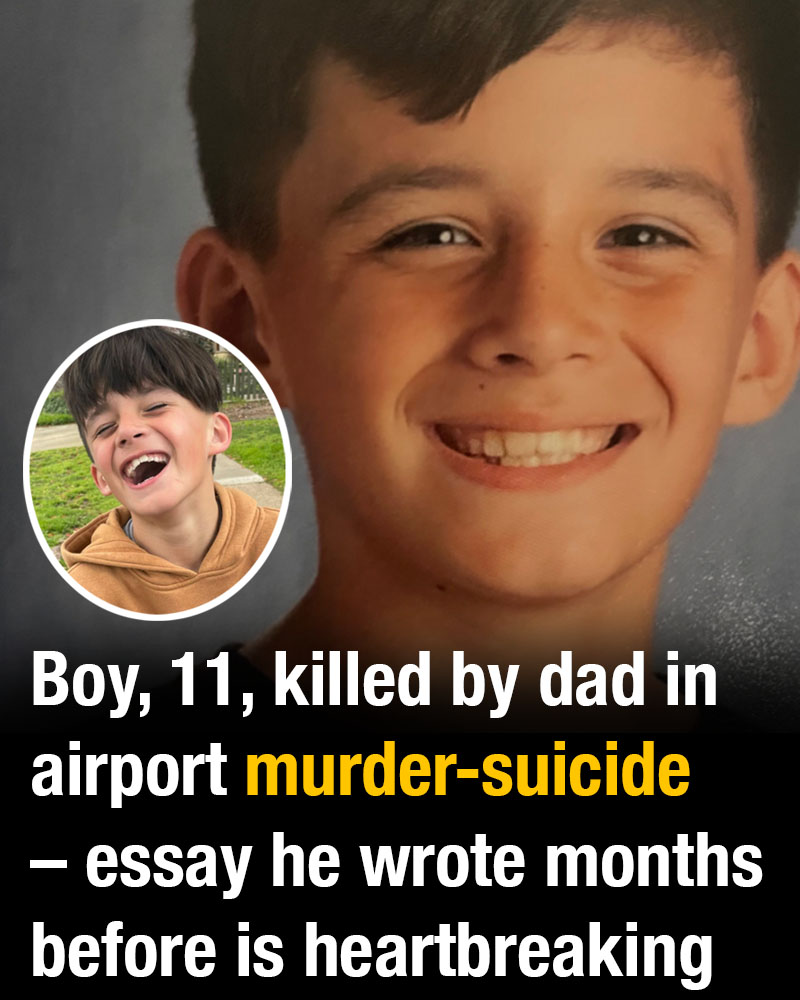
In the aftermath of a devastating incident at Elko Regional Airport, a family is left navigating a reality that feels impossible to comprehend.
The loss of 11-year-old Callan West Perez has shaken not only those closest to him but also a wider community struggling to make sense of what happened. What remains now are memories fragments of a life that once held promise, warmth, and innocence.
Those who knew Callan describe him in simple but powerful terms: bright, kind-hearted, and full of energy. He was the kind of child who could bring light into a room without trying, whose laughter came easily, and whose presence left a lasting impression. For his family, these memories are now all they have to hold onto, each one carrying both comfort and an unbearable sense of loss.
Among the many details that have surfaced since the tragedy, one stands out in a particularly painful way. Months before the incident, Callan had written an essay for a “Father of the Year” contest. In it, he expressed admiration and love for his father, describing him with the kind of sincerity only a child can offer. The words, written without hesitation or doubt, now carry a weight that no one could have anticipated. They reflect a bond that, at the time, seemed secure and unquestioned.
Today, that same essay has become a symbol of heartbreak. It represents not only the innocence of a child’s perspective but also the cruel contrast between expectation and reality. For the family, reading those words again is both a tribute to who Callan was and a reminder of how deeply their world has been altered.
As investigators piece together the events that unfolded, the emotional impact continues to ripple outward. Loved ones are left grappling with a mix of shock, anger, and confusion. The idea that someone meant to provide care and protection could be involved in such a tragedy is something that is difficult to reconcile. It challenges assumptions, disrupts understanding, and leaves behind questions that may never be fully answered.
In the days following the incident, the family has found themselves surrounded by both support and sorrow. Friends, neighbors, and even strangers have reached out, offering condolences and sharing in the grief. A fundraising effort has been established in Callan’s name, aimed at helping the family manage immediate needs while also creating a lasting tribute to his memory. Contributions have come not only from those who knew him personally but also from people moved by the story and its emotional weight.
Yet beyond the public gestures, the most profound experiences are unfolding in private. Inside the family home, the absence is constant and deeply felt. Everyday routines have been disrupted, and spaces once filled with life now carry a quiet stillness. The small details the things that might go unnoticed in ordinary times have taken on new significance. A favorite object, a familiar sound, a routine that no longer has a place all of these serve as reminders of what has been lost.
Grief, in this context, is not a single emotion but a complex and evolving process. It includes moments of reflection, bursts of anger, periods of silence, and attempts to find meaning in something that feels senseless. For Callan’s family, the journey ahead is uncertain, shaped by both the need to remember and the challenge of moving forward.
At the same time, the story has prompted broader conversations about family, trust, and the hidden struggles that can exist behind closed doors. While details continue to emerge, the situation highlights how appearances can differ from reality and how difficult it can be to fully understand the dynamics within any household. These reflections, while important, do little to ease the immediate pain experienced by those closest to the tragedy.
What remains most significant is the memory of Callan himself. Beyond the circumstances of his passing, he is remembered for who he was a child with a future, a personality, and a presence that touched those around him. His story is not defined solely by the events that ended his life but also by the moments that made it meaningful.
The essay he wrote now serves as a poignant reminder of that meaning. It captures a moment in time when his world felt stable, when his understanding of love and family was clear and uncomplicated. Preserving that perspective, even in the face of what has happened, is one way his family continues to honor him.
As time moves forward, the focus may shift, investigations may conclude, and public attention may fade. But for those who loved him, the impact will remain. The questions, the memories, and the emotional weight of the experience will continue to shape their lives in ways that are difficult to predict.
In the end, the story is one of profound loss, but also of enduring love. Even in the face of unimaginable circumstances, the connection between Callan and his family does not disappear. It lives on in memory, in shared stories, and in the quiet determination to keep his spirit present in their lives.
While answers may never fully satisfy the need for understanding, the commitment to remember him to speak his name, to honor his life, and to carry forward what he represented offers a path through the darkness. It is not a resolution, but it is a way to ensure that his story, and the love at its center, is never forgotten.