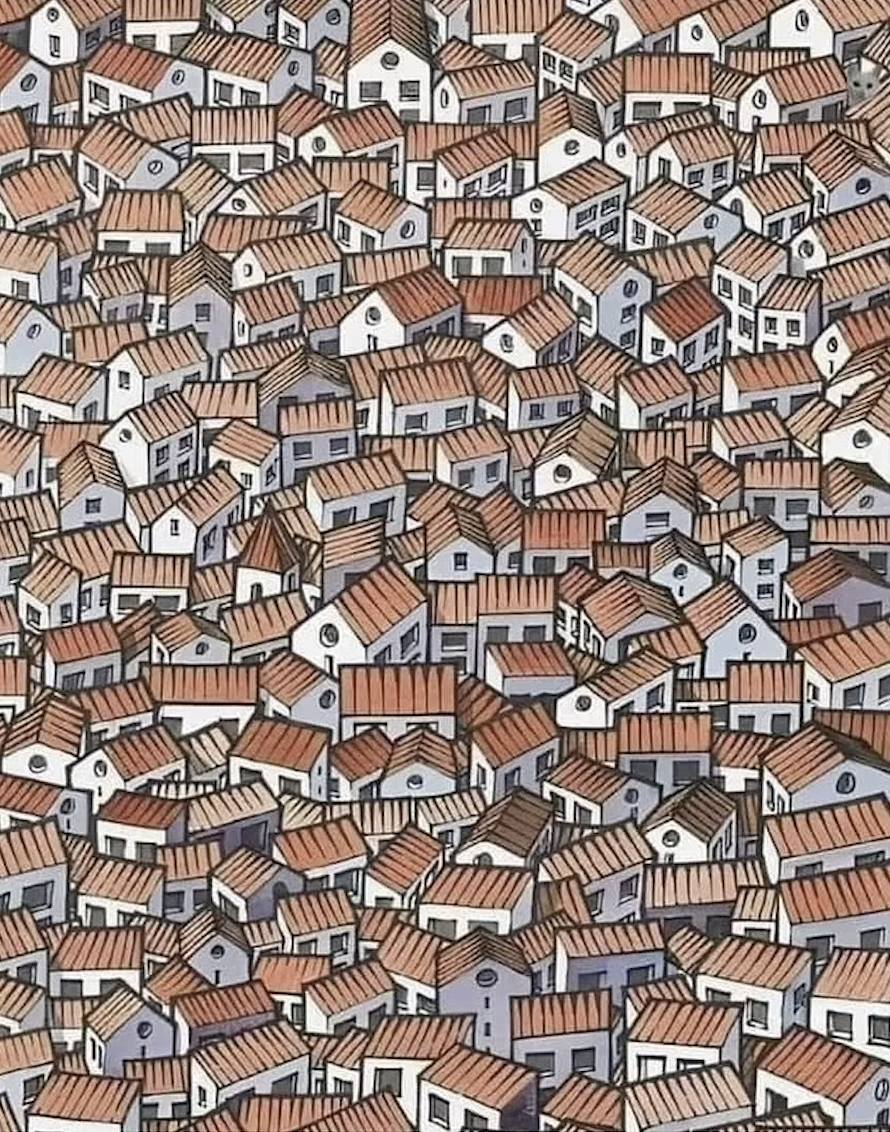
What makes this illusion so gripping is not just the hidden cat, but how it exposes the limits of our perception. At first, the rooftops look like a flat, repetitive pattern, tricking the brain into ignoring subtle differences.
Your eyes glaze over the image, seeing only what they expect to see. Tiles. Shadows. Shingles. Nothing more. The cat is there, but your mind refuses to acknowledge it because it does not fit the pattern. That is the genius of the puzzle. It exploits the way we process visual information, the shortcuts our brains take to save time and energy.
Only when you deliberately scan the top right corner does the disguise begin to fail. A faint curve. A shift in texture. The outline of ears breaking the rhythm of tiles. These small anomalies are easy to miss if you are scrolling quickly, but impossible to ignore once you see them. That is the moment everything snaps into focus. The cat, which was hidden in plain sight, suddenly becomes obvious. You wonder how you missed it. You feel a little foolish. And then you feel a little proud. You found it. Not everyone does.
Finding the cat becomes more than a game. It is a small victory of patience over impulse. In a world of instant answers, where Google knows everything and social media feeds demand constant scrolling, you are forced to slow down. To really look. Not glance. Not skim. Look. The image does not reward speed. It rewards attention. It rewards the kind of focused searching that has become rare in the age of distraction. That is why the puzzle goes viral every time it resurfaces. People need the reminder. They need to prove to themselves that they can still focus, still notice, still see past the obvious.
That act of focused searching quietly trains your attention, sharpening the mental muscles that help you notice details in everyday life. The same skills that find the hidden cat can help you catch a mistake in a contract, notice a change in a loved one s mood, or spot a safety hazard before it causes harm. Attention is not just about seeing. It is about caring enough to look. The puzzle is a small exercise in caring. It asks you to invest a few seconds of genuine focus. In return, it gives you a tiny thrill of discovery.
Share the image, compare times, and watch how one hidden cat turns into a test of who truly pays attention. Friends challenge friends. Families compete. Coworkers take breaks to stare at rooftops, searching for a feline that seems determined to remain invisible. The competition is friendly, but the stakes feel real. No one wants to be the person who cannot find the cat. No one wants to admit that they scrolled past without noticing. So they look again. And again. And then they see it. And they feel a rush of satisfaction that has nothing to do with winning and everything to do with proving something to themselves.
The cat is not the point. The point is the search. The point is the moment when your brain shifts from automatic scanning to deliberate observation. That shift is a skill. It can be practiced. It can be strengthened. And puzzles like this one are a fun way to do it. They are not just entertainment. They are training. Training for a world that wants you to be distracted, to move quickly, to skim and scroll and never stop. The hidden cat says no. Slow down. Look closer. Pay attention. You might be surprised by what you find.
The next time you see one of these puzzles, do not scroll past. Do not glance and guess. Take a moment. Breathe. Look. Let your eyes wander. Let your brain search. And when you find the cat, enjoy the feeling. It is not just about spotting a hidden animal. It is about reclaiming a little bit of your attention from the machines that want to consume it. That is a victory worth celebrating. Share the image. Challenge your friends. See who finds it first. But more importantly, see who takes the time to really look. That person is the real winner. Not because they spotted the cat, but because they refused to be rushed. They refused to settle for surface level perception. They looked deeper. And in a world that rewards speed over depth, that is a rare and valuable quality. The hidden cat is just a cat. But the habit of looking closely is a superpower. And it is one that anyone can develop. One puzzle at a time. One rooftop at a time. One hidden cat at a time. So go ahead. Look again. The cat is waiting. And so is the satisfaction of finding it. That is the real prize. Not the answer, but the process. Not the destination, but the journey. And in this case, the journey takes only a few seconds. But those seconds can change the way you see everything else. That is the magic of a good puzzle. It stays with you. It teaches you something about yourself. And it makes you want to find the next one. So keep looking. Keep searching. Keep paying attention. The world is full of hidden cats. You just have to learn to see them. And that starts right here, right now, with this image. Take your time. You will find it. And when you do, you will smile. Not because the cat is cute, but because you proved something to yourself. You can still focus. You can still see. You can still find what others miss. That is a good feeling. That is a feeling worth chasing. And it starts with a cat. A hidden cat. A cat that was there all along, waiting for someone to really look. Now you have. And the world looks a little different because of it. That is the power of attention. That is the power of you. And that is no small thing. It is everything.