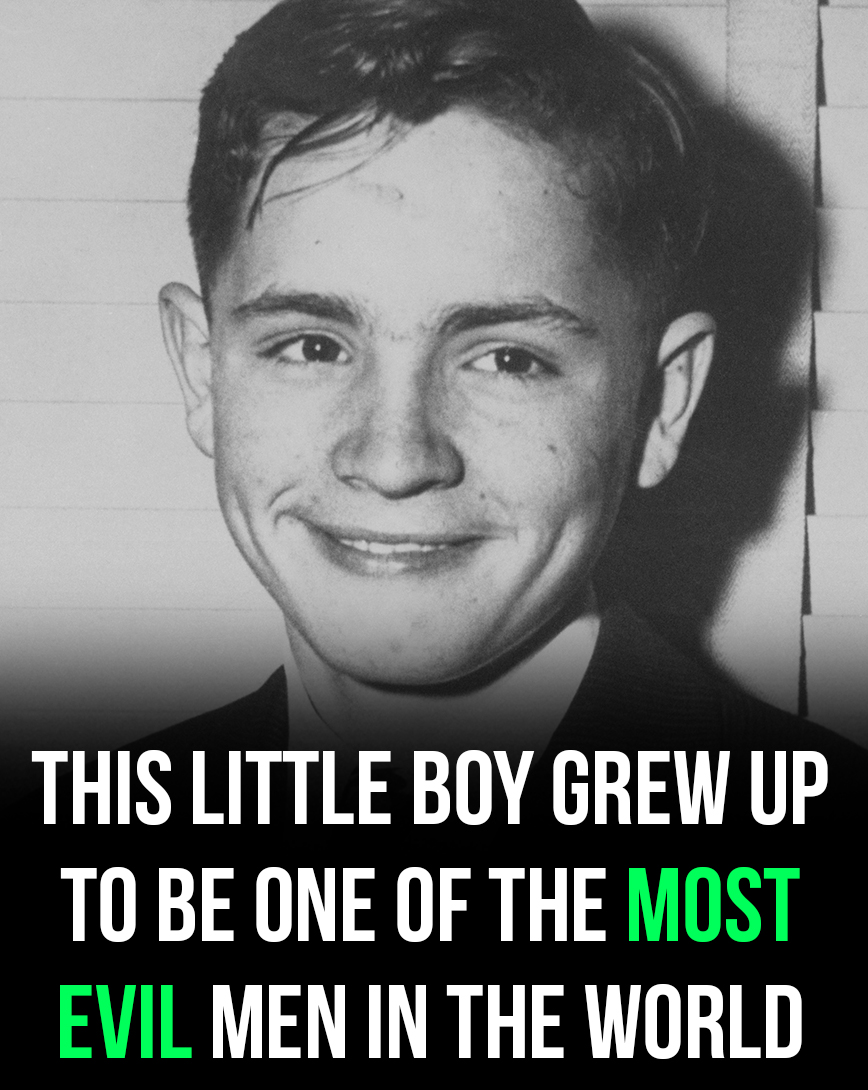
Charles Manson is remembered today as one of the most disturbing figures in modern history, yet his early life tells a story that is far more complex than the image that would later define him.
His childhood was not marked by stability or care, but by a pattern of neglect, uncertainty, and emotional abandonment that shaped the way he would come to see the world.
From an early age, Manson experienced a lack of consistent guidance and affection. The people who were supposed to provide safety and structure were often absent, unreliable, or unable to meet his needs. This environment left him without a clear sense of belonging, forcing him to navigate life on his own terms long before he was ready. In such conditions, survival became less about growth and more about adaptation.
As he moved through his early years, he encountered a series of institutions meant to correct behavior and provide discipline. Reform schools and juvenile facilities became recurring stops in his life. However, rather than offering support or rehabilitation, these environments often reinforced the very traits they were meant to change. Within these systems, he learned not only how to endure hardship, but how to manipulate it.
Over time, Manson developed a keen understanding of people. He learned how to read emotions, how to present himself in ways that would gain trust, and how to shift his personality depending on the situation. These were not skills taught in a classroom, but strategies formed through necessity. In places where vulnerability could be exploited, he adapted by becoming unpredictable and difficult to control.
Instead of being guided toward stability, his experiences seemed to deepen his detachment from conventional norms. Authority figures were not seen as protectors, but as obstacles. Rules were not internalized as values, but understood as tools that could be bent or avoided. This perspective would later play a critical role in how he interacted with others.
By the time he reached adulthood, Manson had spent significant portions of his life within institutional systems. These experiences shaped his identity in ways that made reintegration into society difficult. Rather than developing trust or empathy, he had refined methods of persuasion and control that allowed him to influence those around him.
The cultural landscape of the late 1960s provided a unique backdrop for his next transformation. It was a time defined by social upheaval, shifting values, and a search for meaning among many young people. For individuals who felt disconnected or uncertain, there was a strong desire to find belonging and purpose, often outside traditional structures.
Manson recognized this vulnerability and understood how to position himself within it. He presented himself as someone who could offer answers, community, and a sense of direction. To those who were searching, he appeared confident and certain, qualities that can be especially appealing in times of uncertainty.
He began to gather followers, many of whom were drawn not only by his words but by the sense of inclusion he seemed to provide. He created an environment where individuals felt seen and accepted, but this acceptance came with conditions. Over time, his influence grew stronger, and the line between guidance and control became increasingly blurred.
What made his approach particularly effective was his ability to frame his ideas in ways that resonated with the broader cultural themes of the time. He used language that echoed messages of peace, freedom, and transformation, but beneath these words was a far more troubling reality. The ideals he spoke of were gradually reshaped to serve his own perspective, turning followers into extensions of his will.
As his influence deepened, the dynamic within his group changed. Individual identities began to fade, replaced by a collective mindset that revolved around him. This shift allowed him to exert greater control, as followers increasingly relied on him for direction and validation. The environment he created discouraged independent thinking, reinforcing loyalty above all else.
The events that would eventually bring widespread attention to Manson were not isolated incidents, but the result of a progression that had been building over time. The actions that shocked the world did not emerge suddenly. They were the outcome of a long process in which boundaries had been eroded, and extreme ideas had been normalized within his circle.
Understanding this progression is essential to understanding the broader implications of his story. It highlights how influence can develop gradually, often in ways that are not immediately visible from the outside. What may begin as a search for connection or meaning can, under certain conditions, be redirected toward something far more destructive.
Manson’s life raises difficult questions about the factors that contribute to such outcomes. His early experiences, marked by instability and neglect, undoubtedly played a role in shaping his worldview. However, they do not provide a simple explanation. Many individuals face hardship without following a similar path, which suggests that multiple influences—personal, social, and environmental—intersect in complex ways.
At the same time, his story serves as a reminder of the importance of early intervention and support. Environments that lack stability and care can have lasting effects, particularly when combined with exposure to systems that fail to address underlying needs. The absence of positive guidance can leave individuals searching for identity and purpose in ways that make them vulnerable to harmful influences.
It also underscores the power of charisma and persuasion. The ability to connect with others, to inspire trust, and to shape perception can be used for both positive and negative purposes. In Manson’s case, these abilities were directed toward control, illustrating how influence can be misused when not grounded in responsibility or empathy.
Today, Charles Manson’s name remains associated with some of the most unsettling events in modern history. His story continues to be examined not only for its historical significance but for the insights it offers into human behavior, social dynamics, and the consequences of unchecked influence.
Ultimately, his life is not just a narrative about one individual, but a reflection of broader issues that extend beyond any single person. It challenges us to consider how environments shape behavior, how vulnerability can be exploited, and how important it is to recognize warning signs before they escalate.
The transformation from a neglected child to a figure of such notoriety is not a simple or linear story. It is one marked by missed opportunities, complex influences, and decisions that carried profound consequences. And it leaves behind a question that continues to resonate: how can society better recognize and address the conditions that allow such paths to develop in the first place.