The outrage over the golf course video did not come from nowhere. It landed on a country already exhausted by Trump s long, messy history with golf, power, and public decency. His critics see a pattern.
A president who escapes to luxury fairways while crises burn. A man who allegedly cheats so routinely that caddies have nicknames for him. A leader who boasts that everyone around him should cheat too. So when he is filmed, nearly eighty years old, openly commenting on a woman s appearance in front of his grandson, many Americans see more than an offhand remark. They see a man who treats women like props and the presidency like a private club.
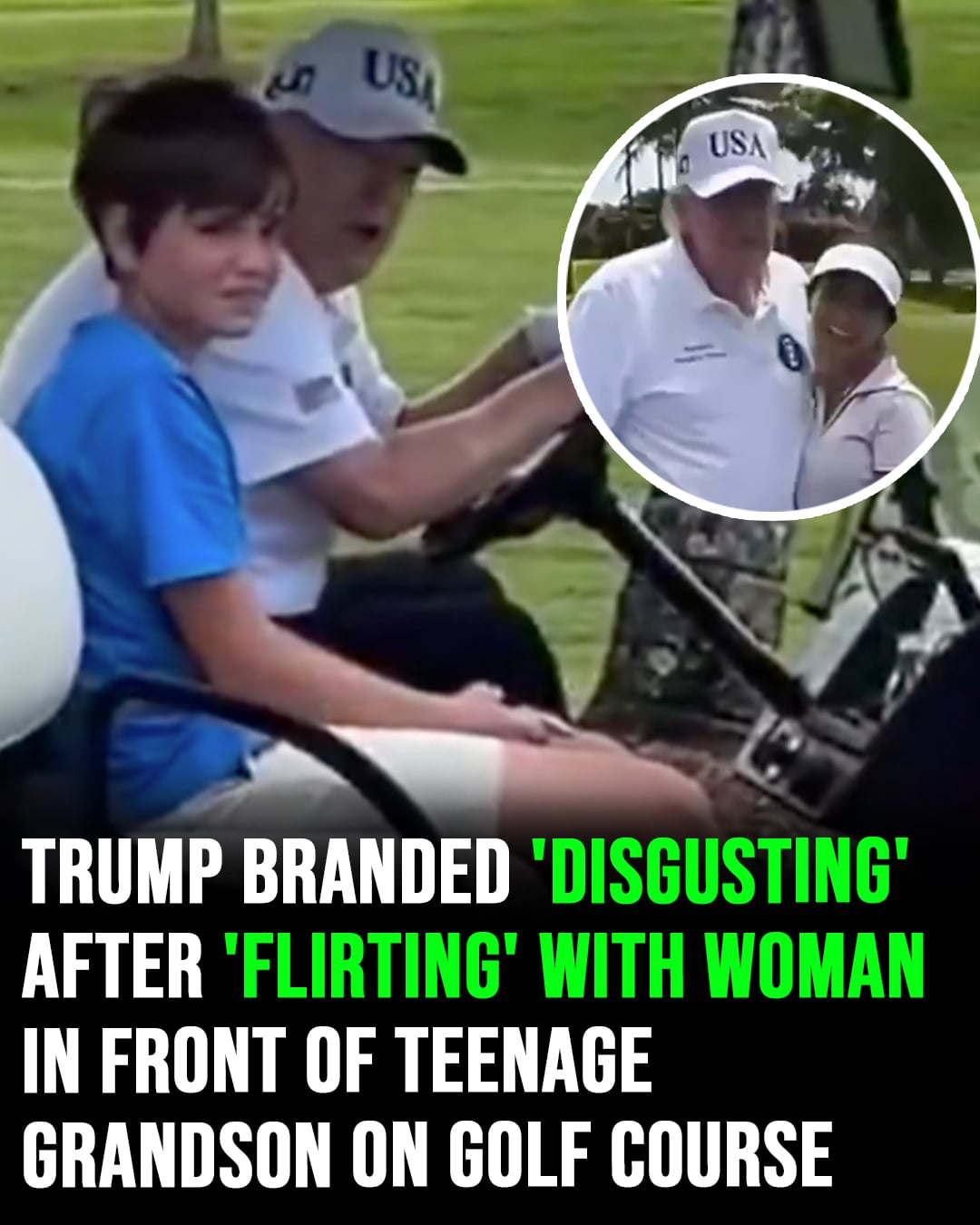
The video spread quickly across social media platforms. It showed the former president leaving a golf cart, turning toward a woman nearby, and making a remark that many interpreted as flirtatious or objectifying. His teenage grandson sat just a few feet away, visible in the frame, watching the exchange. The contrast was jarring. An older man, in a position of immense influence, behaving in a way that many parents would not want their own children to witness. The backlash was immediate and intense. Commentators from both sides of the aisle weighed in. Some defended it as harmless banter between adults. Others called it disrespectful, inappropriate, and emblematic of a larger problem.
Supporters argue that the outrage is manufactured, a product of media bias and political opportunism. They point out that the former president has always had a brash, unpolished style. His supporters love him for it. They see authenticity in his refusal to be scripted. They dismiss the video as much ado about nothing, a gotcha moment that reveals nothing new about a man whose personality has been on display for decades. In this view, the critics are not offended by the remark itself. They are offended by the man who made it. The remark is just an excuse.
Critics counter that context matters. This is not a private citizen making a casual comment among friends. This is a former president, a man who still commands enormous attention and influence, behaving in a way that many consider disrespectful. He was in a public place. He was in front of his grandson. The grandson is at an impressionable age, learning from the adults around him what is acceptable and what is not. The message sent by that moment, critics argue, is that women s bodies are objects to be evaluated, that public spaces are stages for performance, that respect is optional.
The incident also reignited conversations about Trump s broader history with women. From the Access Hollywood tape, in which he bragged about grabbing women without consent, to the numerous accusations of sexual misconduct that followed him through his presidency and beyond, his record has been a persistent vulnerability. Many voters, particularly women and suburban moderates, cited these issues as reasons for opposing him. The golf course video, while less explicitly graphic than previous controversies, fit the same pattern. A pattern of treating women as objects, of disregarding basic norms of decency, of believing that rules do not apply to him.
The timing of the video added to its impact. The country is already divided, already exhausted, already bracing for another contentious election cycle. The former president remains the central figure in his party, the presumptive nominee, the man around whom all Republican politics revolves. For his supporters, the video is a non issue. For his detractors, it is further proof that he is unfit for public office. For everyone else, it is another reminder of the circus that American politics has become.
Trump s team has not officially commented on the video. But allies have dismissed it as a distraction, a hit job by the media, a nothingburger. They argue that the real issues facing the country, the economy, the border, crime, are being ignored while journalists obsess over gotcha moments. They accuse the left of using personal attacks to avoid debating policy. They insist that voters care about results, not about whether the former president made a joke on a golf course.
But the video is not just about one joke. It is about what that joke represents. A certain kind of masculinity. A certain kind of entitlement. A certain kind of leadership. For those who have long criticized Trump, the video is a symptom, not a cause. It reveals what they believe has always been there. Disrespect. Impulsiveness. A lack of self awareness. Whether the video will have any lasting political impact is unclear. In the past, controversies that would have ended other politicians only seemed to strengthen Trump s bond with his base. His supporters see him as a fighter, under constant attack, unfairly targeted by a system that despises him.
But the presence of his grandson in the video added a new dimension. It forced a conversation about legacy, about the example being set for the next generation. The boy in the passenger seat will one day be a man. What will he remember about his grandfather. What lessons will he carry forward. For some, those questions are sentimental, irrelevant to the serious business of politics. For others, they go to the heart of what leadership means. Not just policies and platforms, but character. Not just what a person says on stage, but how they treat people when they think no one is watching. Or when they do not care who is watching. The video is now part of the public record. It will be replayed, analyzed, debated. And the country will continue to decide what it sees. A harmless joke or a revealing glimpse. A man having fun or a man who has never learned to behave. The answer, like so much else in this polarized era, depends entirely on who is watching.