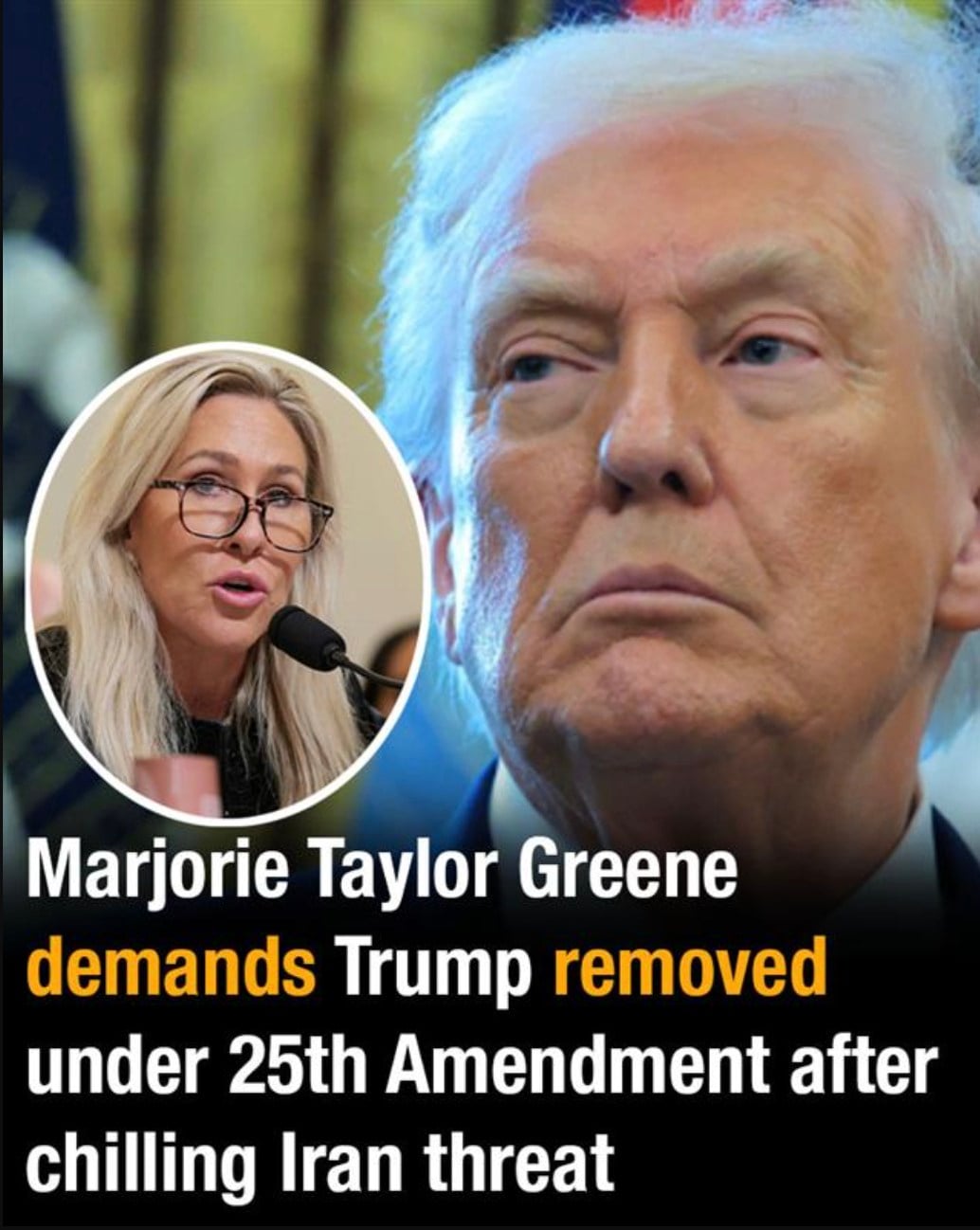
A president musing publicly about erasing an entire civilization crosses a line that even some of his staunchest allies refuse to defend.
When Marjorie Taylor Greene, once one of Trump s loudest defenders, calls for the Twenty fifth Amendment, it signals more than a political spat. It reveals a growing fear that the power to unleash catastrophic war is in the hands of someone speaking in apocalyptic riddles. Greene has stood by Trump through impeachments, investigations, and countless controversies. She has defended him when few others would. But his recent comments about Iran crossed a line that even she could not ignore.
The threat was chilling in its simplicity. Trump spoke of wiping out a whole civilization, a phrase that echoes the darkest moments of human history. He did not specify exactly what that would mean. He did not outline targets or strategies. He simply let the words hang in the air, leaving the world to imagine the worst. For many, that ambiguity was the point. It allowed him to project strength without committing to specifics. But for Greene and others who have long supported him, it was a bridge too far. A president who talks casually about annihilation is not projecting strength. He is projecting instability.
Greene s call for the Twenty fifth Amendment was immediate and unequivocal. She did not couch her criticism in careful language or soften it with praise for his other policies. She stated plainly that Trump was unfit to remain in office and that the constitutional mechanism for removing a president who cannot discharge his duties should be invoked. Coming from her, that statement carried weight. Greene is not a moderate Republican. She is not a never Trumper. She has been one of his most loyal allies in Congress. If she is turning on him, others may follow.
Yet almost in the same breath, Trump agreed to a conditional two week ceasefire with Iran. The announcement came suddenly, catching both allies and adversaries off guard. Trump claimed that U S military objectives had already been exceeded. He described the ceasefire as a victory, a sign that his approach had forced Iran to back down. Shipping lanes in the Strait of Hormuz will reopen under Iranian coordination. Oil prices, which had spiked on fears of conflict, began to stabilize. For a moment, the world breathed a collective sigh of relief.
But the whiplash was disorienting. How could the same man who had just threatened to erase a civilization also broker a ceasefire? The answer, according to his defenders, is that the threat made the ceasefire possible. Iran, they argue, took him seriously because he had demonstrated a willingness to use force. The threat was not a sign of instability. It was a negotiating tactic. A calculated risk that paid off. Critics see it differently. They argue that a president who threatens annihilation one day and offers peace the next is not a master strategist. He is unpredictable in the worst possible way.
Between the threats of annihilation and the language of restraint lies a terrifying uncertainty. Is this brinkmanship, or a warning that the guardrails around presidential power are far weaker than anyone dared to admit? Brinkmanship is the art of pushing a conflict to the edge of disaster to force the other side to back down. It requires a steady hand and a clear understanding of the other side s red lines. When it works, it looks like genius. When it fails, it looks like madness. The problem is that the difference between genius and madness is often only visible in hindsight.
The Twenty fifth Amendment has been invoked only rarely in American history. It allows the vice president and a majority of the cabinet to declare the president unable to discharge his duties, transferring power to the vice president. It was designed for situations where a president is physically or mentally incapacitated, not for policy disagreements or even reckless rhetoric. Greene s call for its use is therefore extraordinary. She is not arguing that Trump is ill. She is arguing that his judgment is so fundamentally flawed that he poses a danger to the nation.
Trump s response to Greene s criticism was predictable. He dismissed her as a publicity seeker, a traitor to the movement, a pawn of the deep state. His supporters rallied to his defense, accusing Greene of betraying the very principles that had elected her. The feud escalated quickly, dominating news cycles and distracting from the actual policy questions at stake. What does the ceasefire actually mean? Will Iran honor its commitments? What happens in two weeks when the ceasefire expires? These are the questions that matter. But they are being drowned out by the drama of allies turning on allies.
For the rest of the world, watching from afar, the spectacle is both bewildering and frightening. The United States remains the world s most powerful nation. Its president commands the largest military in human history. When he speaks of erasing civilizations, people listen. When his own allies call for his removal, they also listen. The mixed signals make it impossible to know what the United States will do next. That uncertainty is not strength. It is a liability.
The coming weeks will be critical. The ceasefire with Iran is temporary. The tensions that led to the crisis have not been resolved. And the political crisis in Washington shows no signs of abating. A president who has lost the confidence of his own allies is a president who cannot lead effectively. Whether the Twenty fifth Amendment is invoked or not, the damage is done. The world has seen that American power can be wielded unpredictably, and that those closest to the president are not sure he can be trusted with it. That is a chilling thought. And it is one that will linger long after the current crisis fades from the headlines.