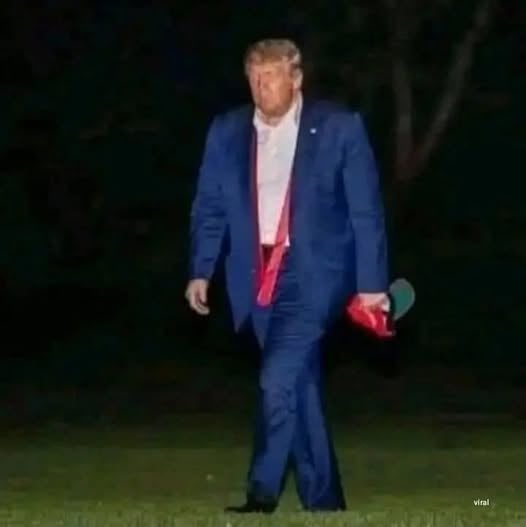
What lingers after the frenzy is less the object itself than what it reveals about us. The photograph surfaced late on a Tuesday night grainy, poorly lit, taken from a distance by someone who may not have realized what they were capturing.
Within minutes, it had been shared hundreds of times. Within hours, millions had seen it. By morning, it was everywhere.
A Quiet Walk Becomes a National Obsession
A quiet walk turns into a national guessing game. The former president, out for an evening stroll, his cap pulled low, his hand clutching something that the camera could not quite resolve. Was it a phone? A document? A device? The image offered no answers, only questions. And questions, in the age of social media, are fuel. They spread faster than facts. They ignite speculation. They transform the mundane into the mysterious.
A grainy photo becomes a canvas for every fear, hope, and political fantasy. For some, the object in Trump’s hand was proof of secret dealings a thumb drive filled with classified information, a communication device linked to foreign powers, evidence of a conspiracy that had long been suspected but never proven. For others, it was nothing more than a wallet, a set of keys, or perhaps a small notebook. The truth, whatever it was, mattered less than the stories people told themselves.
The Absence of Answers
In the absence of answers, people supply their own, projecting meaning onto a man in a cap and something small in his hand. The phenomenon is not new. Humans are pattern-seeking creatures, wired to find significance in randomness. When information is scarce, imagination fills the void. And when the subject is a figure as polarizing as Donald Trump, the void becomes a battleground.
Supporters saw victimhood a man being surveilled, his every move scrutinized by enemies who wished him harm. Critics saw deception a man who could not help himself, who was always hiding something, who treated transparency as weakness. Neither side had evidence. Both sides had conviction. And between them, the truth whatever it was became irrelevant.
The Fragile Line Between Curiosity and Obsession
This late-night sighting underscores how fragile the line is between curiosity and obsession. Public figures live under a magnifying glass where even a private moment becomes content. There was a time when a former president could take an evening walk without being photographed, analyzed, and debated. That time is gone. Every movement is tracked. Every gesture is interpreted. Every object in hand is dissected.
The appetite for such content seems insatiable. News outlets that once would have ignored a grainy photo of a man walking now build segments around it. Social media users who would have scrolled past now stop, zoom, and speculate. The machinery of modern media is designed to amplify the ambiguous, to turn the ordinary into the extraordinary, to keep us watching, clicking, and wondering.
Not Every Shadow Hides a Secret
Yet it also reminds us that not every unanswered question is a conspiracy, and not every shadow hides a secret. Sometimes a walk is just a walk. Sometimes an object is just an object. The impulse to find meaning in everything is understandable, but it is not always wise. It exhausts us. It distracts us. It turns our attention away from what actually matters and toward what we have imagined.
The photograph of Trump with the mysterious item will eventually fade, replaced by the next ambiguous image, the next unanswered question, the next opportunity for projection. The cycle never ends. There is always another late-night sighting, another grainy photo, another chance to see what we want to see.
A Reflection of Ourselves
Sometimes, all we truly see is our own reflection in the stories we rush to tell. The object in Trump’s hand was never the point. The point was what we brought to it our fears, our hopes, our assumptions, our biases. The photograph was a mirror, and in it, we saw ourselves.
This is not to say that all speculation is meaningless or that public figures should be immune from scrutiny. There are legitimate questions to ask about those in power, and a free press has a duty to ask them. But there is a difference between scrutiny and obsession, between legitimate inquiry and endless speculation. The former strengthens democracy. The latter exhausts it.
The Cost of Constant Vigilance
The cost of constant vigilance is not always obvious. It shows up in the way we talk to each other, in the trust we no longer extend, in the exhaustion that settles into our bones. Every ambiguous image becomes a test. Every unanswered question becomes a betrayal. We demand certainty in a world that offers none, and when certainty is withheld, we manufacture our own.
The photograph of Trump with the mysterious item will be forgotten. But the pattern it represents will continue. There will be other late-night sightings, other grainy photos, other moments when a man walking with something in his hand becomes a national crisis. And each time, we will face the same choice: to wonder or to obsess, to ask questions or to invent answers, to see the world as it is or as we fear it might be.
A Final Reflection
In the end, the story of the late-night sighting is not about Donald Trump or the object in his hand. It is about us. About the stories we tell ourselves. About the meaning we project onto ambiguity. About the fragile line between healthy curiosity and consuming obsession.
The next time a grainy photograph surfaces, the next time an ambiguous image appears, we might pause before sharing, before speculating, before assuming. We might ask ourselves whether we are seeking truth or simply feeding a hunger that can never be satisfied. We might remember that sometimes a walk is just a walk, an object is just an object, and a man in a cap is simply a man taking a quiet evening stroll.
And in that pause, we might find something rare: clarity. Not about the photograph, but about ourselves. And that, perhaps, is the only answer worth having.