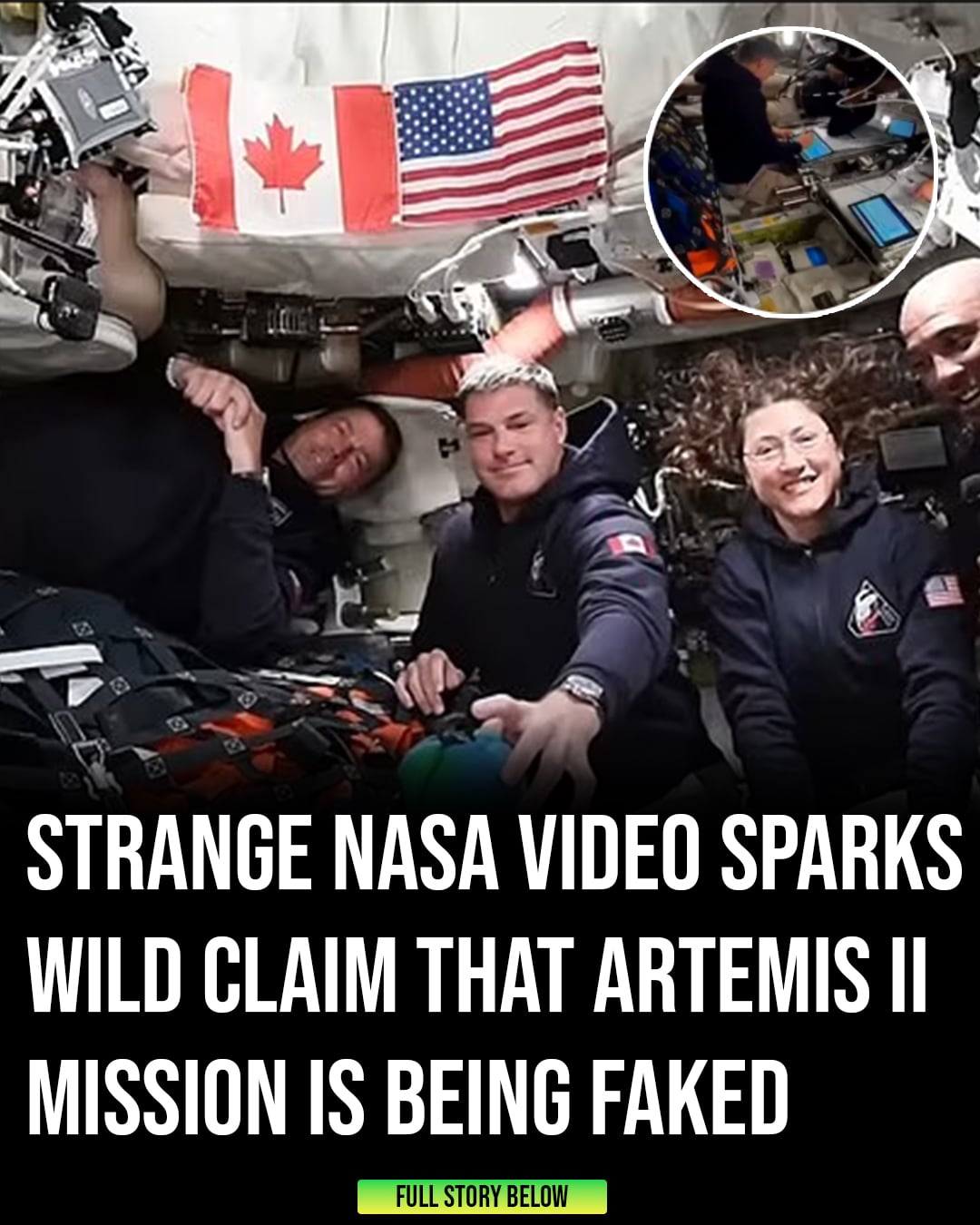
For some, the Artemis II clip is proof that nothing in space can be trusted. Within hours of the footage being released, social media platforms lit up with accusations.
Commenters dissected every frame, zoomed in on suspicious details, and declared that they had finally caught NASA in a lie that had been decades in the making. The evidence, they claimed, was right there on screen undeniable, irrefutable, and damning.
The Moment That Raised Eyebrows
The toy named “Rise” drifts weightless through the capsule, floating gently as the astronauts go about their work. It is a charming detail, a nod to the childhood dreams that launched so many space careers. But behind the toy, something strange happens. Letters seem to flash in and out of existence, appearing briefly before vanishing again. They are not part of any equipment visible in the capsule. They do not correspond to any display or instrument. They simply appear, unbidden, like a bad special effect that the editor forgot to remove.
To those already suspicious, it feels like catching the magician’s hand in the act. A moment that confirms every fear about faked missions and manufactured heroes. The comments sections filled with triumphant declarations: “See? I told you!” “It’s all green screens!” “We never went to the Moon, and we’re not going back now.” The clip was shared, reshared, and dissected across platforms, each new iteration adding fresh layers of certainty.
A Long History of Conspiracy Theories
The Artemis II controversy did not emerge in a vacuum. For decades, a small but vocal minority has insisted that NASA’s achievements are too extraordinary to be believed. Moon landing deniers have argued that the Apollo missions were staged on soundstages, directed by Stanley Kubrick, filmed in secret studios. They have pointed to waving flags, missing stars, and lighting inconsistencies as proof of their claims. Scientists and engineers have patiently debunked each argument, but the conspiracy theories persist, evolving with each new mission.
Artemis II was always going to face similar scrutiny. The moment something looked even slightly off, the accusations would begin. The floating toy and the flashing letters provided exactly the opening skeptics needed.
The Truth Is Painfully Ordinary
But the truth here is painfully ordinary. The “glitch” that has sparked so much speculation is not evidence of a grand conspiracy. It is a quirk of Chroma Key technology, the same layering method used in weather forecasts and movie sets. When broadcasters overlay graphics onto video feeds, they rely on a process that separates foreground from background. Sometimes, when the technology refreshes at slightly different speeds, artifacts appear. Letters that were never meant to be seen flash briefly into view. It is not a sign of deception. It is a sign of imperfect synchronization.
CNN’s on-screen text refreshed out of sync with the rest of the video, momentarily revealing letters that were never meant to be seen. The text in question was likely part of the network’s own graphics package a label, a caption, or a lower-third that briefly became visible due to the technical glitch. It had nothing to do with the Artemis II mission itself. It was simply a broadcasting error, the kind that happens thousands of times a day across networks around the world.
No Grand Cover-Up
No grand cover-up. No studio soundstage. Just a fragile, human attempt to share something wondrous with the world through imperfect tools that, for a heartbeat, made reality look like a lie. The engineers who designed the Artemis II spacecraft did not anticipate that a graphics glitch on CNN would become the focus of global debate. The astronauts floating in that capsule had no idea that their mission would be questioned over a split-second artifact. They were focused on the work, on the science, on the dream of returning to the Moon.
But conspiracy theories do not require evidence. They require uncertainty. And uncertainty is easy to manufacture. A single blurry frame, a single unexplained flash, a single moment that defies instant explanation these are the raw materials from which doubt is built.
Why We Fall for These Claims
Psychologists have studied why people believe in conspiracy theories. The reasons are varied, but several patterns emerge. Some people are drawn to conspiracy theories because they offer simple explanations for complex events. Others are motivated by a desire to feel special to possess knowledge that the general public lacks. Still others are reacting to a sense of powerlessness, finding comfort in the idea that someone, somewhere, is in control, even if that someone is malevolent.
The Artemis II video glitch fed into all of these motivations. It offered a simple explanation (the mission is fake). It made viewers feel like insiders (they spotted something the networks missed). And it reinforced the idea that powerful institutions are hiding the truth.
The Danger of Misinformation
But misinformation has consequences. When large numbers of people believe that space missions are faked, trust in science erodes. Funding for exploration becomes harder to justify. Young people who might have dreamed of becoming astronauts turn away, convinced that the entire enterprise is a lie. The damage is not just intellectual. It is practical and generational.
NASA and other space agencies have struggled to combat these claims. They have released raw footage, invited independent verification, and patiently explained the technology behind their missions. But each new video, each new image, brings fresh opportunities for misinterpretation. The Artemis II glitch is only the latest example of how easily reality can be distorted.
A Fragile Attempt to Share Wonder
What is lost in the debate about green screens and hidden letters is the wonder of the mission itself. Four human beings are circling the Moon, farther from Earth than anyone has traveled in decades. They are conducting experiments, testing systems, and paving the way for humanity’s return to the lunar surface. Their courage, their training, and their dedication are real. The risks they take are real. The achievement they represent is real.
But realness is not always obvious. Sometimes it hides behind technical glitches and broadcast errors. Sometimes it requires patience to see. And sometimes, it is easier to believe in a conspiracy than to accept that ordinary, imperfect humans are doing extraordinary things.
A Final Reflection
The Artemis II video glitch will eventually fade from the headlines. Conspiracy theorists will move on to the next supposed revelation. But the underlying dynamic will remain: a small but determined group of people will always suspect that what they are being shown is not what it seems. They will always look for the hidden hand, the secret studio, the manufactured hero.
For the rest of us, the challenge is to resist that pull. To accept that reality is often messy, that technology is imperfect, and that sometimes a floating toy and a flashing letter are exactly what they appear to be: artifacts of a fragile, human attempt to share something wondrous with the world. No conspiracy. No cover-up. Just imperfect tools, imperfect humans, and a mission that is as real as the Moon itself.