
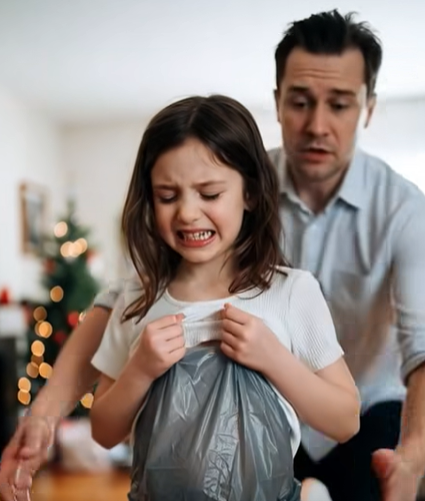
After Christmas, my 7-year-old daughter returned from her grandmother’s place and pulled up her shirt. She said, “Grandma told me I’m too big and made me wear this all day.”
It was a garbage bag. That’s when I also saw welts and bruising. They were caused by a belt. I didn’t contact the police. I didn’t send any messages. I got into my car, drove straight to my mother-in-law’s home, and when she answered the door, I reacted.
Chapter One: Wrapped in Plastic
The bag hung loose on her body. It wasn’t knotted or fitted—just a thin sheet of dull gray plastic drooping from her shoulders, clinging to her skin like it didn’t belong there.
My daughter, Lily, only seven years old, stood quietly at the edge of the kitchen. No tears. No shaking. Just a stillness that felt wrong for someone her age.
“She said I’m too big,” Lily told me softly. “Grandma said pretty clothes aren’t for girls like me.”
Then she raised her arms.
Under the light, the truth revealed itself. Dark blotches shaped like fingers. Angry red lines carved across her back. Marks that told a story no child should ever carry.
I didn’t raise my voice. I didn’t panic. Something inside me shut off instead.
“Sweetheart,” I said evenly, kneeling down, “go get cleaned up. Put on something comfy. Daddy’s got you.”
I kissed her head. She smelled like fear and cold air. When she walked away, I stood, grabbed my keys, and left.
I had convinced myself for years that Margaret—my wife’s mother—was simply strict. Old-fashioned. Sharp-tongued but harmless. I told myself her comments were concern dressed poorly.
“She needs structure.”
“She eats too much.”
“You’re too soft on her.”
Seven years of warnings I ignored.
That was my failure.
The drive to her house was silent. No music. No phone. Just the sound of my pulse pounding as the sky darkened.
When she opened the door, she smiled politely, smoothing her clothes like she was greeting a guest.
“Oh, David. I wasn’t expecting you.”
I didn’t reply. I stepped inside.
Everything looked the same—plastic on the furniture, staged family photos, the smell of control disguised as cleanliness.
“She had a fit today,” Margaret said briskly. “I had to teach her a lesson.”
I wasn’t there to argue.
I was there to understand.
So I did the last thing she expected.
I wrapped my arms around her.
Her body stiffened. Her breathing caught. Fear—real fear—slipped through her composure.
“Thank you,” I murmured calmly. “For caring about my child.”
Then I let go and walked out.
She thought she’d won.
She didn’t realize I had already begun dismantling her world.
Chapter Two: Building the Collapse
Anger wasn’t useful anymore. Rage makes noise. I needed control.
That night, after Lily fell asleep, I documented everything. Every bruise. Every mark. Every scar of humiliation.
I gathered evidence quietly. Medical records. School reports. Messages she’d sent—thinly veiled cruelty wrapped as advice.
“She’s getting heavy.”
“Discipline is love.”
“You’ll thank me later.”
I saved everything.
I hired a lawyer known for precision and silence. I spoke to counselors. Doctors. Administrators. Each face hardened as the truth unfolded.
“This qualifies as abuse,” one doctor said carefully.
“I know,” I answered. “But timing matters.”
Margaret’s pride lived at her church. That was her stage. Her crown.
So I chose Christmas Eve.
The building glowed with lights. Children sang. Parents smiled. Margaret sat proudly in the front row, certain of her image.
When the pastor invited people to speak, I stood.
The room stilled.
I walked to the microphone and met her eyes.
“I want to talk about trust,” I said. “And what happens when it’s misplaced.”
She smiled, expecting praise.
Instead, I handed a flash drive to the tech volunteer.
“Please play the folder marked ‘For the Family.’”
Chapter Three: Exposure
The screen lit up.
A close-up of my daughter’s arm. Bruised. Small.
Gasps filled the room.
Then her back. Then audio.
Margaret’s voice—sharp, cruel, unmistakable.
“Disgusting.”
“Useless.”
“No one will love you.”
Margaret tried to stand but collapsed back into her seat, drained of color.
I didn’t raise my voice.
“This,” I said evenly, “is what cruelty looks like when it hides behind religion and authority.”
The final image appeared: Lily, wrapped in a black garbage bag, eyes hollow.
No one spoke.
I didn’t call the police that night. Public arrest would have turned her into something she wasn’t—a victim.
The consequences came later. Quietly. Thoroughly.
Restraining orders. Civil filings. Official reports.
But the real punishment had already landed.
She lost her standing. Her friends. Her power.
She wasn’t jailed.
She was forgotten.
Chapter Four: What Remained
Years passed.
Lily grew.
She wears clothes she loves now. Laughs freely. Eats without fear. Runs without shame.
Margaret sold her home and disappeared into another state. But reputations follow. Truth lingers.
I saw her once more, months later, in a grocery store.
She looked smaller. Frail.
“I never meant to hurt her,” she whispered.
I looked past her.
“You meant to destroy her,” I replied.
She reached for me. Begging.
I leaned in and said softly, “Now you know what it’s like to be alone.”
Then I walked away.
Epilogue
I don’t replay the pain anymore.
I replay the victory.
A child safe. A monster exposed.
I learned something important:
You don’t defeat evil with violence.
You defeat it with clarity.
You shine light where it hides.
And let it collapse on its own.