Then the K9 was released—and instead of tearing into him, the dog wrapped him in its front legs.
No attack. No struggle.
Just a shattered whisper from the man:
“They said you didn’t make it…”
Every firearm slowly lowered as the truth about the dog’s history surfaced.
There’s a kind of quiet that only exists inside a patrol vehicle at three in the morning. It isn’t calm. It’s tense—compressed—like the world itself is holding its breath. I’ve sat in that silence for over a decade working law enforcement in Washington. For the last four years, I’ve shared it with a partner whose breathing is louder than mine, whose instincts are sharper, and who never truly sleeps.
His name is Thor.
To civilians, Thor is a powerful Dutch Shepherd—nearly a hundred pounds of muscle, teeth, and discipline. Officially, he’s a “deployment unit.” A tool meant to end resistance fast. To me, he’s the only soul I rely on when everything goes sideways. Our arrangement is simple: I guide, I protect, I decide. When chaos erupts, I let go of the leash—and he makes sure I survive.
K9 work is black and white. Threat or safe. Engage or disengage. There’s no room for uncertainty. Hesitation gets officers killed.
At least, that’s what I believed.
That night, driving a forgotten stretch of road near the Cascade foothills, the fog hung low like drifting spirits. I didn’t realize then that truth lives in the gray—and that it would take a broken young man and a disobedient dog to show me that sometimes the most powerful command isn’t “go.”
It’s “remember.”
Officer Lily Grant sat beside me, fresh out of the academy. She scanned the tree line like it might suddenly come alive.
“Does this emptiness ever stop feeling creepy?” she asked quietly.
“Emptiness is good,” I replied, eyes on the windshield streaked with rain. “Means no one’s hurt.”
Behind us, Thor disagreed.
He wasn’t still like usual. The kennel rattled as he paced. Then came the sound—a deep, aching whine. Not excitement. Not aggression. Something closer to grief.
Grant glanced back. “That doesn’t sound right.”
“He’s picking something up,” I said, easing off the gas. “Someone.”
That’s when the shape appeared.
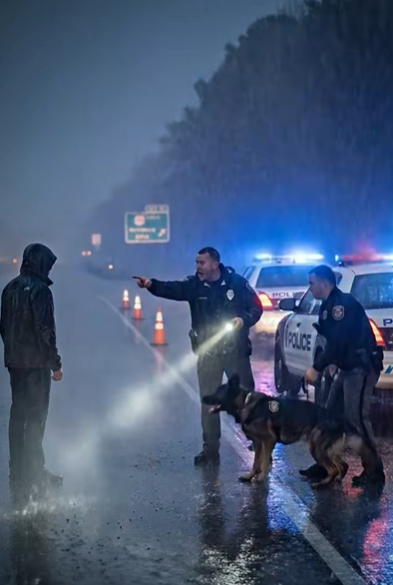
A lone figure emerged straight ahead, walking down the center of the road. No light. No gear. Just a soaked hoodie and slow, unsteady steps.
“Contact ahead,” Grant said sharply, her hand moving to her weapon. “He’s holding something—there’s a reflection.”
I stopped hard, lights flashing. Red and blue tore through the mist.
“Police! Show your hands!” I shouted through the speaker.
The man didn’t run. Didn’t charge. He just kept moving forward.
“He’s not complying,” Grant said, exiting the cruiser. “Distance is closing.”
Thor lost control in the back—not barking, but yelping, slamming into the door.
I made the call.
This is exactly what K9s are for—subdue before lethal force becomes necessary.
“Thor—engage!” I ordered, opening the gate.
He exploded forward, covering the distance in seconds.
The man lifted his head.
Instead of bracing, he opened his arms.
Thor skidded to a stop.
His claws scraped sparks from the asphalt. He didn’t latch on. He stood upright, pressed his front legs around the man’s shoulders, and buried his face against him.
Then he cried.
A raw, broken sound—nothing like a trained police animal.
Grant froze. “Why isn’t he—what is he doing?”
The man collapsed to his knees. Thor followed, licking his face, whining, shielding him with his body.
The object in the man’s hand fell into view.
Not a weapon.
A ruined rubber dog toy, chewed nearly to nothing.
I stepped closer, rain soaking through my jacket.
“What’s your name?” I asked.
“Evan Hale,” he said softly. “And that dog… his name was Bear.”
Grant ran the name. The screen went still.
Missing since age eleven. Gone nine years. Presumed dead.
Evan swallowed. “I fed him every day behind my school. When the man took me… Bear tried to stop him. He was kicked and left bleeding. I thought he died.”
I looked at the scar on Thor’s shoulder—the one I’d never questioned.
“He survived,” I said. “Animal control found him. We trained him.”
“He remembered,” Evan whispered.
Thor rested his head on Evan’s lap like he’d never left.
Evan suddenly tensed. “You can’t take me in yet.”
“There are others,” he said. “Kids. Still trapped. He’ll burn the place if he knows I’m gone.”
We turned around.
No sirens. No delay.
The farmhouse was rotting, sealed, wrong. The air smelled like chemicals and decay.
Dogs charged us—huge, brutal things trained in cruelty.
Thor fought like something possessed.
Smoke began pouring from below.
Locked doors. Barred windows.
Then I saw the coal chute.
“Thor,” I said, pointing. “Find them.”
He didn’t hesitate.
Inside, through his camera feed, I saw cages. Children. A man with a gas can.
The man froze when he saw Thor.
“You’re dead,” he whispered.
Thor didn’t attack right away.
He stood between the cages and the monster.
Then he moved.
The flare hit water. The man screamed. Thor held him down until we breached.
The kids were alive.
Thor collapsed.
At the clinic, Evan waited.
Thor survived.
He retired soon after.
I signed the paperwork myself.
Thor went home with Evan.
Now when I visit, I see them on the porch—an older dog, a healing man, both still here.
Thor didn’t save lives because of training.
He saved them because love outlasts pain.
Sometimes courage isn’t biting.
Sometimes it’s recognizing someone you lost, and holding on.