What appeared to be a celebratory golf video quickly became one of the internet’s most hotly debated sports moments.
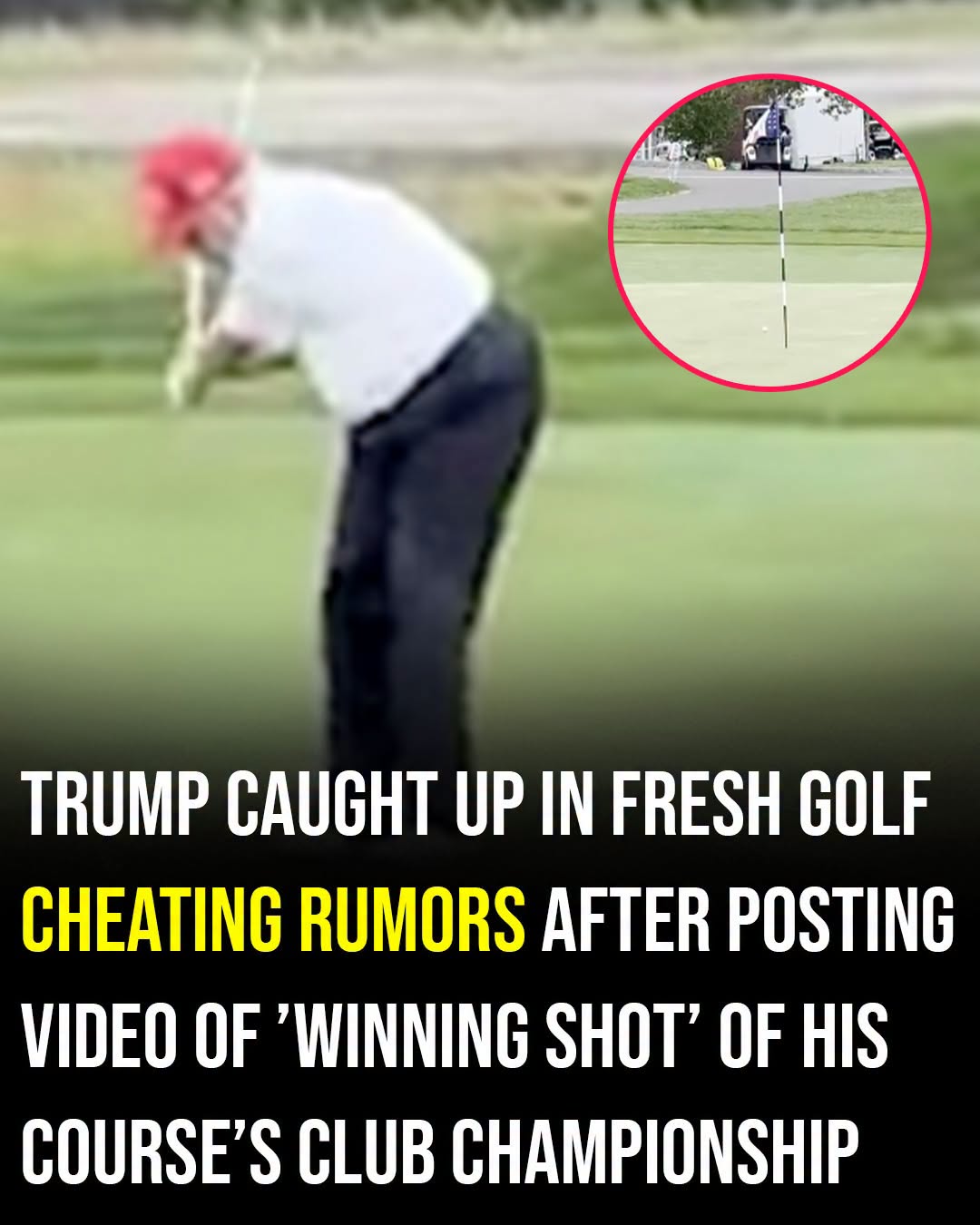
After posting footage highlighting what he described as a tournament-winning shot at his Bedminster golf club, Donald Trump once again found himself at the center of a familiar controversy. The video, accompanied by a confident message celebrating both the shot and his performance, immediately drew praise from supporters while reigniting long-standing criticism from detractors.
For some viewers, it was simply another impressive moment from a president known for his enthusiasm for golf.
For others, it reopened years of questions surrounding his reputation on the course.
Within hours, social media platforms filled with competing interpretations.
Some users admired the confidence displayed in the video.
Others questioned whether the celebration should be taken at face value.
The discussion quickly expanded far beyond a single golf swing.
Instead, it evolved into another chapter in a debate that has followed Trump for decades whenever his golfing accomplishments become public.
Golf has long occupied a unique place in Trump’s public image.
Long before entering politics, he invested heavily in courses around the world, promoted championship events, and frequently spoke about his love for the game.
His properties became destinations for professional tournaments, charity events, business meetings, and high-profile visitors.
He has often described golf as both competition and relaxation, emphasizing the discipline, concentration, and strategy the sport demands.
Throughout the years, Trump has publicly celebrated numerous tournament victories at clubs he owns or regularly visits.
Supporters point to those achievements as evidence that he is an accomplished amateur golfer who has dedicated significant time to improving his game.
Critics, however, have repeatedly challenged those claims.
Whenever Trump announces another victory or shares another memorable shot, questions often emerge almost immediately.
That pattern repeated itself once again after the recent Bedminster video.
The footage itself appeared straightforward.
Trump highlighted what he described as the decisive shot that secured victory, expressing satisfaction with both the execution and the result.
His accompanying message reflected the confidence for which he has become widely known.
Rather than downplaying the accomplishment, he embraced it enthusiastically, suggesting that success came down to skill and experience.
For supporters, the message fit perfectly with his personality.
For critics, it provided another opportunity to revisit longstanding allegations.
Many references quickly resurfaced online.
Sportswriter Rick Reilly’s widely discussed book once again became part of the conversation.
The publication includes numerous stories from golfers, caddies, club members, and acquaintances describing situations in which Trump’s conduct during rounds became the subject of debate.
Those stories have circulated for years and frequently return whenever golf-related news involving Trump gains attention.
Various anecdotes shared by former caddies have also continued fueling discussion.
Some individuals have claimed to witness disputed situations involving scorekeeping, ball placement, or other aspects of casual rounds.
Others have dismissed those accounts entirely, arguing that many stories remain impossible to verify independently.
Over time, celebrity golfers and public figures have occasionally offered their own opinions regarding rounds played with Trump.
Some described him as intensely competitive.
Others questioned specific moments during matches.
Still others praised his passion for the sport while avoiding broader controversy altogether.
The differing perspectives have only contributed to ongoing disagreement.
In recent years, viral video clips from tournaments and public appearances have further amplified the conversation.
Individual moments recorded from different angles have often spread rapidly online, with viewers drawing sharply different conclusions from the same footage.
Supporters frequently argue that clips are taken out of context or selectively edited.
Critics believe the videos reinforce concerns they have held for years.
As often happens in the modern media environment, interpretation depends heavily on prior beliefs.
The same images produce completely different reactions depending on who is watching.
That dynamic extends well beyond golf.
Trump’s public career has repeatedly demonstrated his remarkable ability to divide opinion.
Nearly every statement, appearance, or achievement produces dramatically different responses.
His golfing accomplishments have proven no exception.
Those who admire him often view criticism surrounding his golf game as another example of political opponents refusing to acknowledge success.
They argue that experienced golfers naturally develop confidence after decades of playing.
Many also point out that amateur tournaments frequently rely on honor systems, making accusations especially difficult to prove conclusively without direct evidence.
Others emphasize that Trump’s lifelong involvement in golf makes strong performances entirely believable.
They note his extensive experience playing challenging courses and competing against accomplished partners over many years.
To them, impressive shots should not automatically become sources of suspicion simply because of his political identity.
Critics, meanwhile, see the situation differently.
They argue that repeated allegations spanning many years deserve serious consideration, even if individual stories cannot always be independently verified.
From their perspective, the consistency of numerous anecdotes creates lingering questions difficult to dismiss entirely.
Some believe the issue extends beyond golf itself.
Instead, they view discussions about scorecards, tournament victories, and disputed shots as symbolic of larger debates surrounding honesty, credibility, and public trust.
That broader context explains why relatively ordinary sporting moments often receive extraordinary attention.
For many observers, the golf course has become another arena where competing views of Trump’s personality play out.
Supporters interpret confidence as evidence of determination.
Critics interpret similar behavior as arrogance.
One side sees achievement.
The other sees exaggeration.
Those conflicting perceptions continue shaping nearly every conversation involving his public life.
Interestingly, golf itself depends heavily upon personal integrity.
Unlike many sports with constant official supervision, golfers frequently call penalties on themselves, record their own scores, and rely upon traditions emphasizing honesty and sportsmanship.
That culture makes questions about conduct especially sensitive.
Even unproven allegations can linger because the sport places unusual importance on trust between competitors.
Trump, however, has consistently rejected suggestions that his accomplishments deserve skepticism.
He has repeatedly defended both his abilities and his tournament victories.
Rather than softening his responses when criticism emerges, he generally responds with characteristic confidence, insisting that his performances speak for themselves.
His supporters often appreciate that willingness to stand firm rather than retreat under public pressure.
Whether discussing politics, business, or golf, Trump rarely appears interested in moderating his message simply because controversy develops.
That approach has become one of the defining characteristics of his public identity.
Every new debate seems to reinforce existing opinions rather than changing them.
The latest golf video followed that familiar pattern.
Instead of settling questions, it intensified them.
Praise became louder.
Criticism became sharper.
News coverage expanded.
Social media discussions multiplied.
Yet despite thousands of comments, articles, interviews, and reactions, remarkably little consensus emerged.
Perhaps that reflects something larger than golf.
Modern public life increasingly encourages people to interpret events through existing loyalties.
Facts often matter less than frameworks already established beforehand.
A single video becomes multiple stories depending on who tells it.
One viewer sees confidence.
Another sees controversy.
One celebrates victory.
Another questions credibility.
In that sense, the discussion surrounding Trump’s latest golf triumph reveals as much about today’s deeply divided public conversation as it does about any particular round of golf.
Whether viewed as an accomplished amateur celebrating another successful day on the course or as a figure whose sporting achievements continue attracting skepticism, Trump remains capable of turning even an ordinary golf video into national conversation.
The debate surrounding his latest “winning shot” may eventually fade from headlines.
Another controversy will almost certainly replace it.
Yet the larger question will likely remain.
For supporters, his confidence represents genuine accomplishment earned over decades.
For critics, every remarkable performance invites renewed scrutiny.
Somewhere between admiration and skepticism lies a conversation that has followed Donald Trump across fairways for years and shows little sign of ending anytime soon.