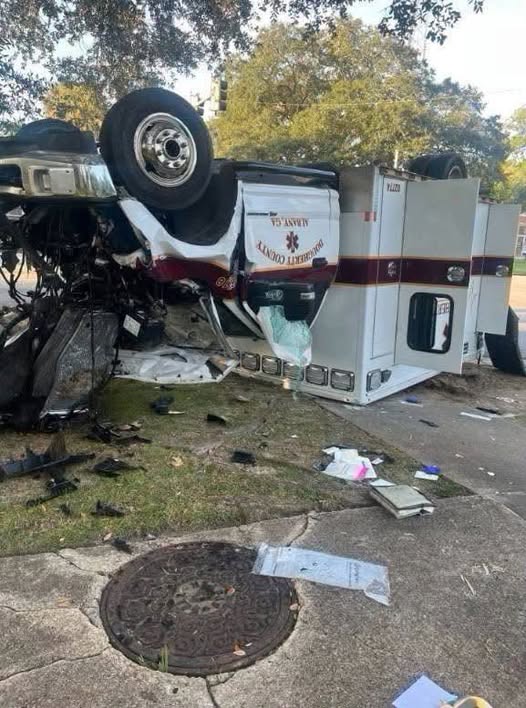
An emergency ambulance was supposed to be the safest place on the road that night.
Inside, every second mattered.
Medical professionals were focused on one mission: transporting a vulnerable newborn to the hospital as quickly and safely as possible. The infant required urgent medical attention, and the experienced crew worked together with the calm precision that defines emergency medicine.
The driver concentrated on the road ahead.
The nurses monitored the baby’s condition.
Equipment hummed quietly in the background.
Everyone inside understood the importance of reaching the hospital without delay.
Then, in a matter of moments, everything changed.
What began as a routine emergency transport suddenly became an emergency of its own.
The ambulance lost control, rolled multiple times, and finally came to rest on its side, leaving twisted metal, shattered glass, scattered medical equipment, and injured occupants trapped inside.
Instead of delivering patients to medical care, the ambulance itself became the center of a major rescue operation.
Witnesses described a scene of confusion unlike anything they had experienced.
The flashing emergency lights that normally bring reassurance now illuminated a devastating crash site.
Debris covered the roadway.
The sound of twisted metal echoed through the night.
People nearby immediately realized this was no ordinary traffic accident.
An ambulance had overturned.
Inside were patients and the very people responsible for saving lives.
Within minutes, additional emergency crews rushed to the location.
Firefighters, police officers, and paramedics arrived knowing that every second remained critical.
Their first challenge was stabilizing the damaged ambulance.
Rescuers carefully assessed the wreckage before beginning the difficult process of reaching those trapped inside.
The overturned vehicle presented significant hazards.
Broken glass surrounded the interior.
Medical equipment had been thrown throughout the cabin.
The confined space made movement extremely difficult.
Despite those obstacles, rescue personnel worked methodically.
Their priority was reaching the newborn.
Medical teams carefully removed the infant from the damaged ambulance before transferring the child to another waiting emergency vehicle.
Officials later confirmed that the baby was transported to the hospital in stable condition.
The news brought enormous relief after the frightening ordeal.
Two nurses who had been caring for the infant during transport also suffered injuries in the crash.
Both were taken to the hospital for evaluation and treatment.
Authorities later indicated that they, too, were in stable condition.
The ambulance driver and several additional occupants were also injured.
In total, nine people were hurt during the incident.
Some sustained relatively minor injuries.
Others required more extensive medical attention.
Fortunately, officials reported that everyone involved is expected to recover.
Although the physical injuries were serious, the outcome could have been far worse considering the severity of the rollover.
Emergency responders at the scene later reflected on how quickly routine operations can become life-threatening.
Ambulance crews spend every shift responding to emergencies involving strangers.
Rarely do they become the victims needing rescue themselves.
Their work requires navigating busy intersections, adverse weather, heavy traffic, and unpredictable road conditions while balancing speed with safety.
Every emergency call involves difficult decisions.
Patients often require immediate transport.
Every minute can influence medical outcomes.
Yet higher speeds and urgent responses naturally increase risks for everyone traveling inside emergency vehicles.
That difficult balance has long been one of the greatest challenges facing emergency medical services.
Investigators immediately began examining what caused the crash.
While the investigation remains ongoing, authorities have already identified several areas of focus.
Road conditions at the time of the incident.
Vehicle speed.
Mechanical performance.
Driver actions.
Environmental factors.
Modern ambulances often contain extensive electronic systems capable of recording valuable information.
Investigators are reviewing data from onboard equipment, including vehicle performance records and any available dash camera footage.
Those records may help establish exactly what occurred during the moments leading up to the rollover.
Officials have not yet reached any final conclusions.
Instead, they continue gathering evidence before determining the primary cause.
Weather conditions frequently complicate emergency transportation.
Rain.
Snow.
Ice.
Reduced visibility.
Even highly trained emergency drivers face difficult circumstances when roads become slippery or unpredictable.
Emergency vehicles are large, heavy machines carrying medical equipment, personnel, and patients.
Their size and weight make sudden maneuvers particularly dangerous.
Investigators will likely consider whether environmental conditions contributed to the accident.
Vehicle maintenance also receives close attention following incidents involving emergency equipment.
Ambulances undergo regular inspections because they operate under demanding conditions every day.
Mechanical reliability is essential.
Any potential equipment issues become important components of the investigation.
The crash has deeply affected the local community.
Residents expressed gratitude that the newborn survived despite the terrifying circumstances.
Many also praised the courage of the emergency responders who arrived to rescue fellow medical workers.
It is a rare and sobering experience when those accustomed to helping others suddenly require rescue themselves.
The incident also highlights the emotional demands placed upon emergency medical personnel.
Every shift brings uncertainty.
Crews never know what situations they will encounter.
They routinely place themselves in dangerous environments while attempting to protect complete strangers.
Traffic collisions.
Fires.
Medical emergencies.
Natural disasters.
They respond regardless of conditions.
Most days end safely.
Occasionally, however, the dangers they face become tragically real.
For the families of everyone involved, the hours following the crash were filled with anxious waiting.
Phone calls.
Hospital updates.
Questions without immediate answers.
Parents waited for news about their child.
Loved ones searched for information about injured nurses and emergency personnel.
Each update brought cautious relief as hospitals confirmed that patients remained stable.
Healthcare workers at the receiving hospital also played an important role.
They quickly prepared to receive multiple injured patients arriving simultaneously.
Doctors, nurses, and trauma teams coordinated treatment for both the original patient and those injured while providing care.
The unusual circumstances required extraordinary teamwork across multiple emergency agencies.
As the investigation continues, officials hope to identify lessons that may improve safety for future emergency transports.
Transportation procedures.
Driver training.
Equipment standards.
Road safety measures.
Every major investigation seeks not only to explain what happened but also to reduce the likelihood of similar tragedies occurring again.
While answers will take time, one truth already stands out clearly.
The individuals inside that ambulance never expected to become patients themselves.
They began their shift determined to save lives.
Within moments, they found themselves relying on fellow first responders for survival.
That shared commitment defines emergency services.
When one crew faces danger, another immediately responds.
When one ambulance cannot complete its mission, another takes over.
When tragedy strikes, professionals across multiple agencies unite with remarkable speed and determination.
For many people, ambulances symbolize hope.
They represent help arriving during life’s worst moments.
This accident serves as a powerful reminder that behind every emergency vehicle are ordinary people performing extraordinary work under immense pressure.
They accept risks most people never experience.
They make difficult decisions in seconds.
They place the needs of patients before their own comfort and safety.
Thankfully, this frightening incident ended without an even greater loss of life.
The newborn survived.
The nurses survived.
The driver survived.
The other injured occupants are expected to recover.
Those outcomes reflect not only resilience but also the remarkable efforts of every firefighter, paramedic, police officer, and hospital worker who answered yet another emergency call this time to rescue the very people who dedicate their lives to rescuing everyone else.