For many people, visiting a nail salon is much more than another appointment on the calendar.
It is a chance to pause.
To relax.
To step away from the stress of work, family responsibilities, and endless daily obligations.
Whether you’re stopping in for a simple manicure, a fresh pedicure, or an elaborate set of custom-designed nails, the experience often combines beauty, self-care, and conversation into a small moment that belongs entirely to you.
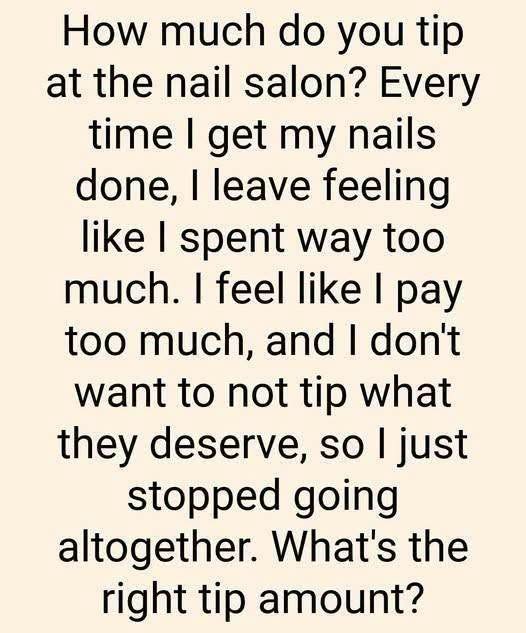
Yet when the service ends, many customers hesitate over one surprisingly common question.
How much should you tip?
Unlike the posted price for a manicure or pedicure, tipping can feel uncertain. Some people worry about leaving too little. Others fear they may be tipping more than necessary. Many first-time salon visitors quietly watch what other customers are doing, hoping someone else will answer the question for them.
The truth is that tipping at a nail salon is not simply about money.
It is a way of acknowledging the time, skill, and care that went into the service you just received.
Most nail technicians spend years developing their craft.
A great manicure requires far more than applying polish.
It involves careful preparation, shaping, cuticle care, precision painting, attention to detail, sanitation, and often a surprising amount of creativity.
When nail art enters the picture, the work becomes even more impressive.
Tiny flowers.
Geometric designs.
Hand-painted patterns.
Chrome finishes.
French tips.
Intricate seasonal artwork.
Each design demands patience and a steady hand.
What may appear effortless to the customer often represents years of practice behind the scenes.
That is one reason tipping has become such an important part of salon culture.
In many places, a tip is viewed as a direct expression of appreciation for quality service.
While exact customs vary depending on location, the most widely accepted guideline is simple.
A tip of around 15 to 20 percent is generally considered appropriate for good service.
For example, if your manicure costs $30, leaving between $4 and $6 is a common practice.
If you receive a more detailed service costing $70, many customers choose to leave somewhere between $10 and $14.
Some clients choose to give even more when their technician goes above and beyond.
Perhaps they stayed late to finish your appointment.
Perhaps they repaired a broken nail without charging extra.
Perhaps they squeezed you into an already full schedule before an important event.
Exceptional service often inspires greater generosity.
Of course, not every appointment is identical.
Sometimes a basic polish change requires only a short visit.
Other times, a full acrylic set with hand-painted artwork may take well over an hour.
The time, effort, and complexity involved naturally influence how many customers choose to tip.
One of the biggest misunderstandings about tipping is the belief that it rewards perfection.
In reality, it more often recognizes effort.
A technician who works carefully, communicates well, keeps everything clean, and genuinely tries to provide an excellent experience deserves appreciation even if every tiny detail is not flawless.
Likewise, respectful communication matters.
Most technicians want customers to leave happy.
If something needs adjusting, politely mentioning it during the appointment usually gives them the opportunity to fix the issue immediately.
Good communication often creates better results than silent disappointment.
For regular salon clients, tipping carries another benefit that many people overlook.
Consistency.
Salon professionals remember loyal customers.
People who arrive on time.
Treat staff respectfully.
Keep appointments.
Tip fairly.
These small habits help build lasting relationships.
Over time, many regular clients find themselves receiving preferred appointment times, extra attention, personalized recommendations, or simply warmer conversations because mutual trust has developed.
That relationship is valuable for both sides.
Customers know they are in capable hands.
Technicians enjoy working with people who appreciate their efforts.
The result is an experience that feels less transactional and more personal.
Another common question involves paying with cash versus credit card.
Some customers assume it makes no difference.
Others specifically carry cash for tips.
In many salons, technicians appreciate cash because they receive it immediately without potential processing delays or transaction fees.
However, many businesses now allow gratuities through credit card payments as well.
If you are unsure how tips are handled at a particular salon, asking politely is perfectly acceptable.
No professional will think less of someone for wanting to understand local customs.
In fact, asking demonstrates consideration.
Another important point is that tipping should fit comfortably within your own budget.
Generosity is meaningful, but consistency matters even more.
Choosing an amount you can reasonably afford and following that practice each visit often means more than one unusually large tip followed by several visits without one.
The goal is appreciation, not financial pressure.
It is also worth remembering that many nail technicians rely heavily on gratuities as part of their overall income.
While salon payment structures vary widely, tips frequently help compensate for long hours spent standing, repetitive physical work, supply costs, and the demands of serving multiple clients throughout the day.
Behind every polished manicure is someone who has likely spent hours working with intense concentration.
Their work requires creativity.
Patience.
Customer service.
Technical skill.
And constant attention to hygiene and safety.
These are not small responsibilities.
Beyond the financial aspect, tipping also carries emotional significance.
It tells someone their work was noticed.
That their effort mattered.
That the experience they created was appreciated.
Sometimes that quiet recognition can brighten an entire day.
Customers often leave feeling refreshed after their appointments.
Technicians, meanwhile, continue serving client after client, hoping each person leaves satisfied.
A sincere thank-you paired with a thoughtful gratuity can become one of the most rewarding parts of their workday.
Ultimately, nail salon etiquette is not about memorizing complicated rules.
It is about respect.
Respect for another person’s expertise.
Respect for the time they invested in helping you feel confident.
Respect for the care they placed into every detail of your appointment.
The next time your manicure or pedicure comes to an end and you wonder what to leave, remember that the tip represents far more than a number.
It is a simple gesture that acknowledges artistry, professionalism, and dedication.
More importantly, it helps create the kind of positive relationship that transforms an ordinary salon visit into an experience you genuinely look forward to repeating.
Sometimes, the smallest expressions of gratitude leave the biggest impression and in the world of nail salons, a thoughtful tip often says everything words cannot.