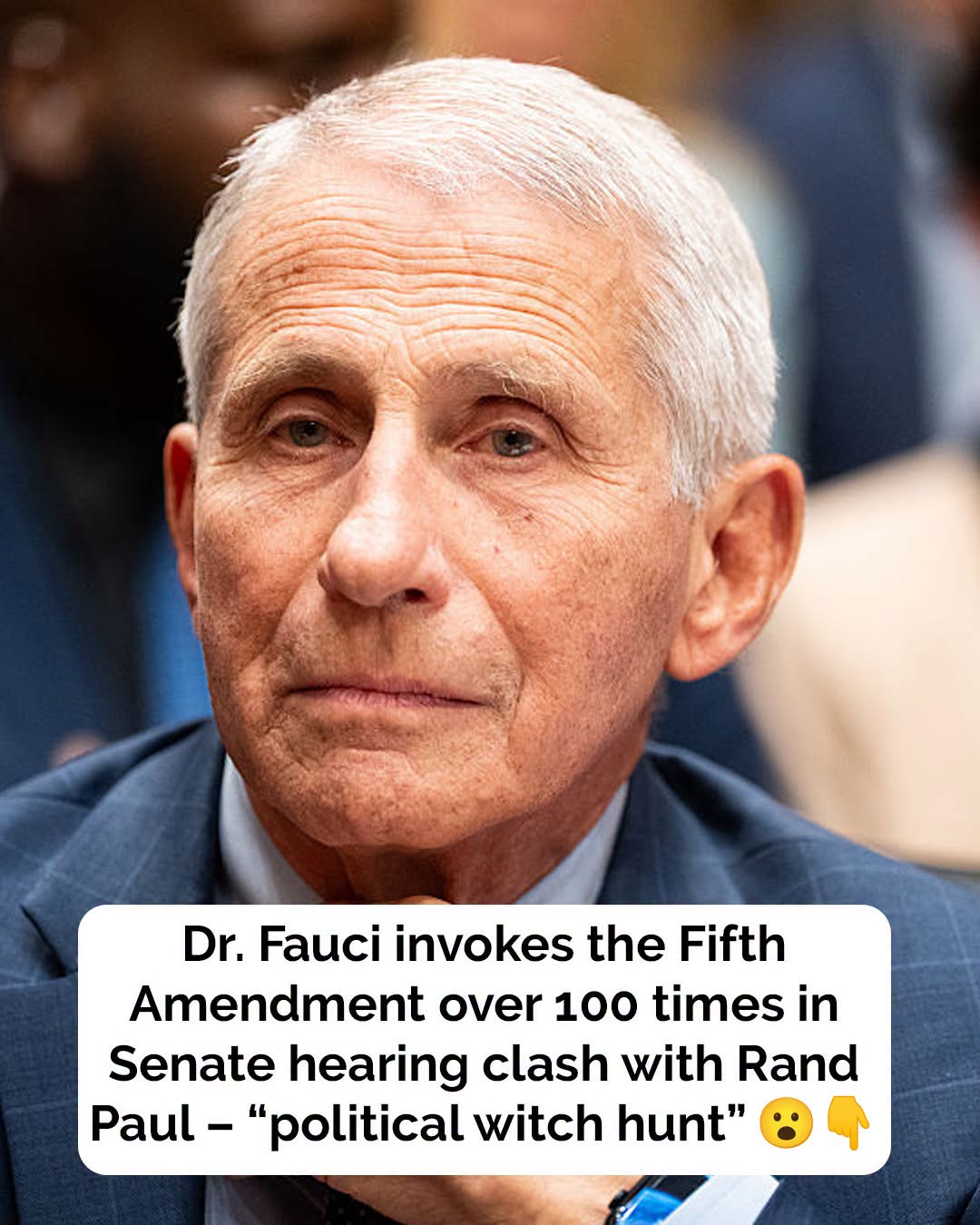
What was expected to be another contentious Senate hearing quickly became one of the most talked-about political moments of the year.
Television cameras rolled.
Lawmakers took their seats.
Questions were prepared.
But as the hearing unfolded, one phrase echoed through the chamber again and again.
“On the advice of counsel, I respectfully invoke my rights under the Fifth Amendment.”
By the time the proceedings ended, Dr. Anthony Fauci had invoked the Fifth Amendment more than 100 times, declining to answer a wide range of questions presented under oath.
The repeated responses immediately transformed the hearing from a routine oversight session into a national debate.
Supporters and critics watched the same testimony and reached dramatically different conclusions.
For some, the repeated invocation raised difficult questions.
For others, it demonstrated the legal realities facing a witness caught in years of political controversy.
Regardless of where people stood, one fact became impossible to ignore.
The hearing produced far more arguments than answers.
For years, Dr. Fauci has remained one of the most recognizable and controversial figures associated with the COVID-19 pandemic.
As the longtime director of the National Institute of Allergy and Infectious Diseases, he became a familiar face during public briefings, offering scientific guidance while the world struggled through an unprecedented public health emergency.
To millions of Americans, he represented expertise during uncertainty.
To others, he became the public symbol of government decisions they believed caused unnecessary harm.
Those opposing views never truly disappeared after the pandemic eased.
Instead, they continued fueling investigations, congressional hearings, television debates, books, documentaries, and countless political speeches.
The latest hearing reflected that continuing divide.
Senators sought answers about decisions made during the pandemic, government communications, research funding, and questions surrounding the origins of COVID-19.
Many observers expected tense exchanges.
Few anticipated how frequently the Fifth Amendment would become central to the proceedings.
The Fifth Amendment to the United States Constitution protects individuals from being compelled to provide testimony that could potentially incriminate themselves.
Although often associated with criminal investigations, constitutional scholars have long emphasized that invoking the Fifth Amendment does not automatically establish guilt or innocence.
Instead, it serves as a legal protection available under specific circumstances.
Even so, public perception rarely treats it as a simple legal procedure.
Throughout American history, high-profile invocations of the Fifth Amendment have often sparked intense political debate.
Supporters typically view it as a constitutional safeguard.
Critics frequently interpret it as evidence that uncomfortable facts remain hidden.
The same pattern unfolded almost immediately after this hearing.
Those skeptical of Fauci argued that refusing to answer so many questions naturally encouraged further suspicion.
They believed the public deserved direct explanations regarding controversial pandemic policies, scientific discussions, research funding decisions, and government communications.
To them, declining to respond only deepened existing doubts.
Some questioned whether unanswered issues surrounding the pandemic’s origins or federal decision-making still remain unresolved.
Others argued that transparency should be expected from officials who played major roles during one of the most significant public health crises in modern history.
Supporters viewed the hearing through an entirely different lens.
They argued that Fauci has spent years facing extraordinary political pressure, public criticism, lawsuits, investigations, and personal threats.
They pointed to repeated promises from political figures calling for criminal investigations and prosecution.
Under those circumstances, they argued, any witness would likely rely heavily on legal counsel before answering detailed questions under oath.
Even statements made honestly could later become the subject of legal disputes, conflicting interpretations, or accusations of inconsistency.
From that perspective, invoking constitutional protections reflected legal caution rather than an admission of wrongdoing.
Much of the hearing featured exchanges between Dr. Fauci and Senator Rand Paul, whose disagreements have become familiar to many Americans over recent years.
The two have publicly clashed on numerous occasions regarding pandemic policy, scientific research, government mandates, and questions involving laboratory funding.
Their disagreements have frequently extended beyond congressional hearings into television interviews and public statements.
As expected, their latest encounter attracted enormous attention.
Observers from across the political spectrum viewed the exchanges as representing far more than a disagreement between two individuals.
Instead, many saw them as symbolizing two fundamentally different interpretations of the pandemic itself.
One perspective emphasizes the extraordinary challenges facing public health officials during an evolving global emergency.
Supporters acknowledge mistakes may have occurred but argue they were made while responding to rapidly changing scientific evidence under immense pressure.
The opposing perspective argues that serious policy failures occurred, important questions went unanswered, and accountability has been insufficient.
Those competing narratives continue shaping public opinion years after the height of the pandemic.
Neither side appears willing to abandon its conclusions easily.
As news spread that Fauci had invoked the Fifth Amendment more than one hundred times, reactions exploded across television, radio, newspapers, podcasts, and social media.
Some described the hearing as historic.
Others dismissed it as political theater.
Commentators debated whether constitutional rights should carry different public perceptions when exercised by high-profile government officials.
Legal analysts reminded audiences that constitutional protections exist precisely because individuals should not be forced to choose between answering potentially damaging questions and preserving their legal rights.
Political analysts focused instead on perception.
In politics, appearances often shape public opinion as much as facts themselves.
Repeatedly declining to answer questions inevitably created powerful images that supporters and critics interpreted in dramatically different ways.
Some argued that public trust depends upon openness.
Others countered that constitutional rights cannot depend upon popularity.
Neither argument appeared likely to persuade the opposing side.
Another issue quickly emerged following the hearing.
Members of the committee began discussing possible next steps, including a potential contempt vote.
Supporters of additional action argued that congressional oversight requires meaningful cooperation from witnesses.
Opponents questioned whether pursuing contempt under these circumstances would be appropriate given the constitutional protections involved.
Those discussions added yet another layer of political uncertainty.
Meanwhile, many Americans watching from home expressed a simpler frustration.
Regardless of political affiliation, they had hoped the hearing might provide greater clarity regarding lingering questions from one of the most disruptive periods in recent history.
Instead, they watched hours of testimony that ultimately resolved very little.
The broader conversation extends well beyond one hearing or one individual.
It reflects continuing disagreement over how history will remember the COVID-19 era.
Was it primarily a story of public servants making extraordinarily difficult decisions during an unprecedented crisis?
Or will future generations conclude that significant mistakes, poor judgment, or preventable failures were never fully examined?
Those questions remain deeply contested.
Years after the pandemic transformed daily life around the world, many debates surrounding it remain remarkably unresolved.
Scientific discussions continue.
Political disagreements persist.
Investigations move forward.
Public trust remains divided.
The Senate hearing illustrated just how enduring those divisions have become.
Supporters left believing constitutional rights had been exercised appropriately under extraordinary legal and political circumstances.
Critics left believing the unanswered questions themselves demanded even greater scrutiny.
Neither side appeared satisfied.
Neither side appeared persuaded.
When the hearing finally concluded, lawmakers departed, cameras shut down, and headlines spread across the country.
Yet despite hours of testimony, Americans were left confronting many of the same uncertainties that existed before the hearing began.
The proceedings produced intense debate, renewed political conflict, and widespread public discussion.
What they did not produce was broad agreement.
Instead, they reinforced a larger national question that has lingered since the pandemic itself.
When future crises emerge, who will Americans trust—and what level of transparency will they expect from the people asked to lead them?