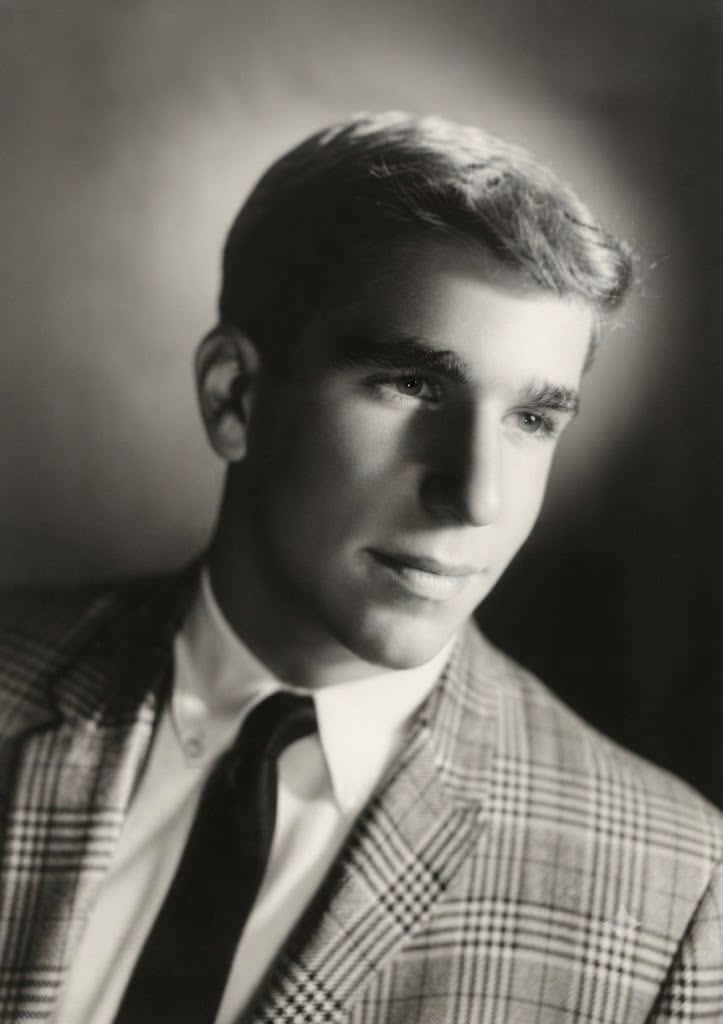
Before millions of people knew him as one of television’s most beloved stars, Henry Winkler spent much of his childhood believing something was deeply wrong with him.
Long before the applause.
Long before the fame.
Long before the leather jacket, the unforgettable smile, and the role that would make him a household name.
There was only a frightened little boy struggling to understand why everyone else seemed able to do something that felt impossible to him.
Reading.
Every page looked like an impossible puzzle.
Words refused to stay still.
Letters blurred together.
Homework that took classmates minutes could consume entire evenings, ending in frustration rather than success.
Teachers saw poor grades.
His parents saw failure.
Henry simply wondered why his hardest efforts never seemed to be enough.
Born in New York City to parents who had escaped Nazi Germany before World War II, Henry grew up in a household shaped by survival.
His parents had endured unimaginable hardship.
They believed discipline, education, and professional success were the only paths to security.
Failure, in their eyes, was dangerous.
Excuses were unacceptable.
They expected their son to excel academically before eventually taking over the family’s business.
Instead, every report card brought disappointment.
Tests returned covered in corrections.
Assignments seemed impossible.
No matter how hard he tried, his results never matched his effort.
At the time, almost no one understood learning differences such as dyslexia.
Children who struggled with reading were often labeled careless, lazy, or unintelligent.
That became Henry’s reality.
He has spoken openly about the painful names he heard growing up.
Among the harshest was the nickname his parents sometimes used for him.
“Dumb dog.”
Those words stayed with him.
When criticism is repeated often enough during childhood, it can become an inner voice.
For years, Henry questioned his own intelligence.
He assumed everyone else possessed abilities he simply lacked.
Yet even during those difficult years, something remarkable was quietly developing.
Because reading failed him, Henry learned to listen with extraordinary attention.
He memorized conversations.
He observed body language.
He noticed emotion.
Instead of depending on written words, he became deeply connected to people themselves.
Without realizing it, he was developing many of the very skills that would later make him an exceptional actor.
Performing offered something school never could.
On stage, there were no spelling tests.
No report cards.
No pages full of words that refused to cooperate.
There were only emotions.
Characters.
Stories.
Connection.
For the first time, Henry discovered a place where he felt capable instead of defeated.
He realized he could communicate through instinct rather than perfect reading.
Acting became more than an interest.
It became freedom.
Still, pursuing that dream proved far from easy.
College admissions brought another painful chapter.
One rejection followed another.
Twenty-six different colleges declined his applications.
Each letter seemed to reinforce everything he had been told growing up.
Maybe he truly wasn’t smart enough.
Maybe everyone else had been right.
Many people would have stopped trying.
Henry refused.
Eventually, one opportunity changed everything.
The Yale School of Drama agreed to audition him.
Instead of relying heavily on prepared reading, Henry impressed evaluators through improvisation.
He demonstrated imagination, emotional intelligence, and creativity that couldn’t be measured by traditional academic performance.
Yale took a chance.
That decision altered the course of his entire life.
At Yale, he worked tirelessly to overcome challenges that remained invisible to many classmates.
Reading scripts required enormous effort.
Memorization often took far longer than expected.
He developed techniques that allowed him to compensate.
He listened repeatedly.
He practiced constantly.
He learned scenes through repetition rather than simply reading them.
Every success required determination that audiences would never see.
After graduation, acting jobs arrived slowly.
Like countless young performers, Henry accepted whatever opportunities appeared.
Small roles.
Brief appearances.
Tiny parts that offered little security.
One of those auditions introduced him to a television series called Happy Days.
Originally, his character wasn’t intended to become the show’s central attraction.
Arthur “Fonzie” Fonzarelli entered as a supporting mechanic with only a handful of lines.
No one predicted what would happen next.
Audiences immediately connected with the character.
The leather jacket.
The confidence.
The coolness.
The humor.
“The Fonz” quickly became one of the most recognizable television characters in history.
Suddenly, the boy who had been told he would never succeed was entertaining millions of viewers every week.
Ironically, even after becoming famous, the struggle with reading never disappeared.
Henry continued hiding his learning difficulties.
He worried people might think less of him if they discovered how hard scripts remained.
Success often creates the illusion that life’s earlier struggles have vanished.
In reality, many continued quietly behind the scenes.
The turning point came years later.
When Henry was in his early fifties, his stepson experienced similar learning challenges.
Medical evaluations finally identified the cause.
Dyslexia.
Watching his stepson receive that diagnosis triggered an emotional realization.
The same condition explained decades of confusion in Henry’s own life.
At last, everything made sense.
The endless frustration.
The poor grades.
The feeling of working twice as hard for half the result.
His brain had never been broken.
It had simply processed information differently.
Receiving that understanding brought both relief and sadness.
Relief because the mystery had finally been solved.
Sadness because countless years had been spent believing cruel labels that were never true.
Rather than keeping that realization private, Henry decided to help others.
He became an outspoken advocate for children with learning differences.
Together with author Lin Oliver, he created the hugely successful Hank Zipzer children’s book series.
The stories follow a young boy with dyslexia navigating school, friendships, and everyday life.
Millions of children recognized themselves in Hank.
For perhaps the first time, they saw a character who struggled exactly as they did.
The books carried an important message.
Learning differently does not mean learning less.
Henry frequently visits schools, speaks with students, and encourages families facing similar challenges.
He tells children something he desperately needed to hear when he was young.
Your struggles do not define your future.
Grades do not determine your worth.
Your brain is not defective.
It simply works differently.
That message has transformed countless lives.
Parents who once feared for their children’s future have found hope through his story.
Students who believed they were unintelligent discovered examples proving otherwise.
Teachers gained greater understanding of challenges often hidden beneath poor academic performance.
Today, Henry Winkler is celebrated not only as an actor but also as an author, advocate, producer, and mentor.
Awards have recognized both his performances and his humanitarian work.
Yet many people believe his greatest achievement reaches beyond television.
He transformed personal pain into compassion.
Instead of allowing childhood criticism to define him, he used it to help future generations avoid similar suffering.
Looking back, it becomes clear that the qualities once mistaken for weakness eventually became strengths.
His ability to listen carefully.
His sensitivity toward others.
His remarkable memory.
His creativity.
His empathy.
They all emerged from years spent adapting to a world that misunderstood him.
The child who struggled to read eventually helped millions feel understood.
The boy called “dumb dog” became one of television’s most beloved stars.
More importantly, he became living proof that labels imposed during childhood never have the final word.
His journey reminds us that success does not belong only to those who fit traditional expectations.
Sometimes the people who seem to struggle most simply travel a different road.
And sometimes, those very struggles become the foundation for lives that inspire millions.
Henry Winkler’s story is not really about fame.
It is about resilience.
It is about refusing to believe the worst things others say about you.
It is about discovering that intelligence comes in many forms.
And it is about understanding that the chapter people call your greatest weakness may ultimately become the beginning of your greatest purpose.