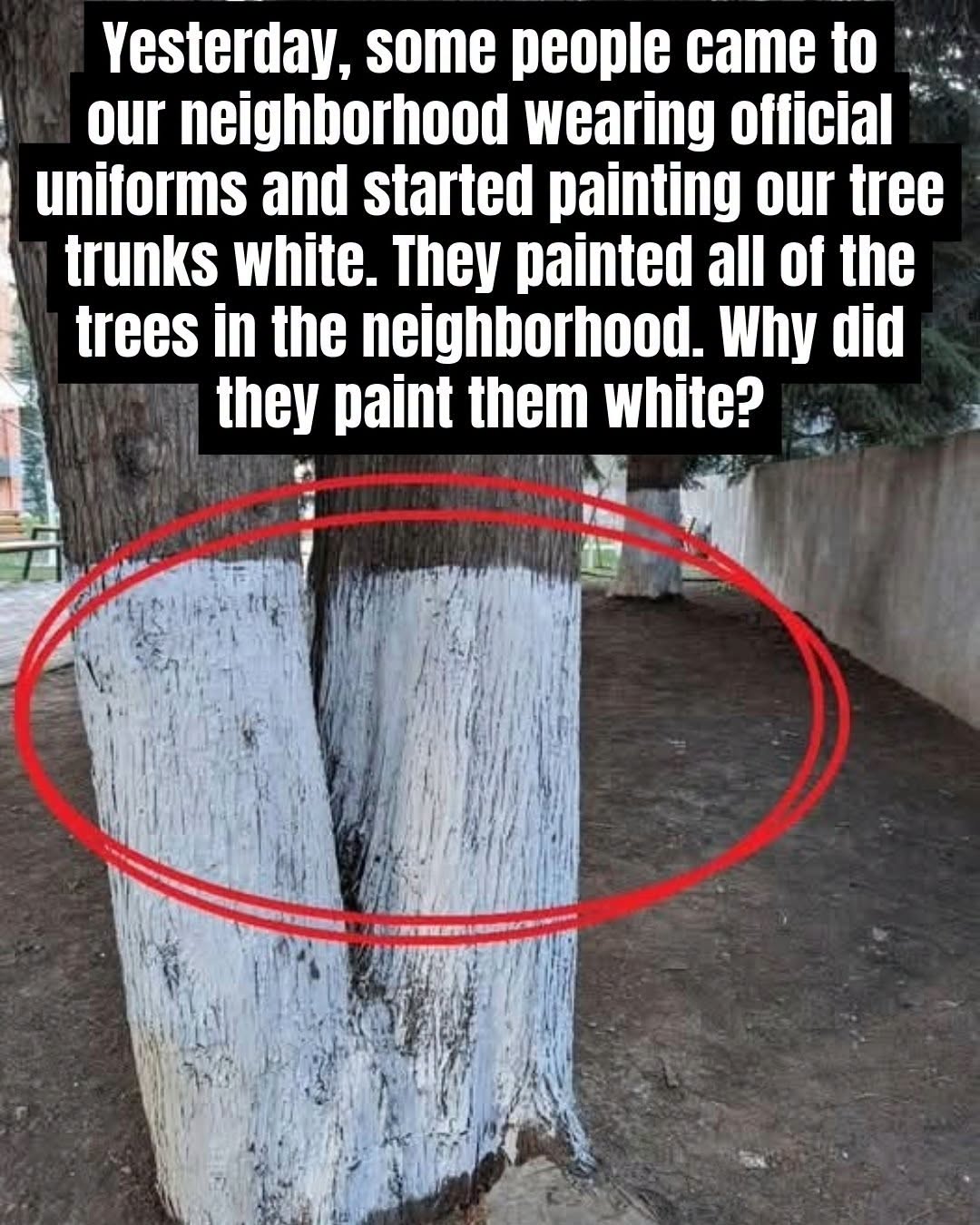
Have you ever driven down a country road, walked through an orchard, or visited a public park and noticed rows of trees with bright white trunks?
At first glance, it can seem unusual.
Some people assume the paint marks trees scheduled for removal.
Others believe it is simply decorative, or perhaps part of a landscaping tradition.
A few even think it is meant to keep insects away.
The truth is far more practical and surprisingly important.
Those white trunks represent one of the oldest and simplest methods of protecting trees from one of nature’s most overlooked threats.
Far from being cosmetic, the white coating serves as a protective shield that can help young and vulnerable trees survive some of the harshest conditions of the year.
To understand why, it helps to know what happens to a tree during winter.
Although trees appear dormant, they are constantly responding to changes in temperature.
On sunny winter days, especially when snow reflects additional light, the sun can warm one side of a tree’s trunk significantly more than the shaded side.
The bark absorbs that heat throughout the afternoon.
Everything seems perfectly normal.
Then the sun disappears.
Temperatures can drop rapidly after sunset.
Within just a few hours, bark that was warmed during the day may suddenly freeze.
That rapid expansion and contraction places enormous stress on the tree’s outer layers.
Eventually, something has to give.
The bark can split open with long vertical cracks.
This condition is commonly known as sunscald or southwest injury because it most often affects the southwest-facing side of the trunk.
These cracks are more than cosmetic.
They expose the tree’s living tissue beneath the bark.
Once that protective barrier is damaged, insects, fungi, and disease-causing organisms have an easier path into the tree.
Moisture can enter.
Decay can begin.
Growth may slow dramatically.
In severe cases, young trees may never fully recover.
Some eventually die from damage that began with nothing more than ordinary winter sunshine.
This is where the white paint becomes surprisingly effective.
Rather than allowing the bark to absorb excessive heat, the white surface reflects much of the sunlight away.
The trunk remains cooler throughout the day.
Because it never becomes excessively warm, the temperature difference between day and night becomes much smaller.
The bark experiences less stress.
The chances of cracking decrease dramatically.
In many ways, the paint functions like sunscreen.
Instead of protecting human skin from ultraviolet rays, it protects tree bark from dangerous temperature swings.
The concept is remarkably simple.
Sometimes the simplest solutions are the most effective.
The paint itself also surprises many people.
Professional growers do not simply grab any leftover paint from the garage.
Most experts recommend using plain white interior latex paint diluted with water.
The mixture is often prepared at approximately equal parts paint and water, creating a thinner coating that allows the bark to breathe while still reflecting sunlight effectively.
Oil-based paints are generally avoided because they can interfere with normal bark function.
The goal is protection, not suffocation.
The coating is usually applied from the ground upward several feet along the trunk.
Some growers also paint the lower portions of major branches if they receive significant sun exposure.
Application is often done during autumn before the coldest months arrive.
In regions with particularly harsh winters, the paint may be refreshed annually.
For commercial orchards, this has become a routine part of seasonal maintenance.
Rows of white trunks stretching across fruit farms have become a familiar sight in many agricultural communities.
Young fruit trees benefit especially from this protection.
Apple trees.
Peach trees.
Cherry trees.
Pear trees.
Citrus in certain climates.
Their thinner bark makes them more vulnerable than older, mature specimens.
As trees age, their bark usually becomes thicker and better able to tolerate environmental stress.
Even so, many growers continue protecting valuable trees for years because prevention is far less expensive than replacing damaged orchards.
Interestingly, temperature protection is only one benefit.
The white coating also discourages certain insects.
Some boring insects prefer dark bark that warms quickly in the sun.
Reflecting sunlight keeps the trunk cooler and less attractive to these pests.
Although the paint is not an insecticide, it can become one small part of a broader strategy for maintaining healthy trees.
Rodents sometimes avoid freshly painted trunks as well, particularly when combined with other protective measures.
Gardeners have also discovered another advantage.
The bright white surface makes damage much easier to spot.
Cracks.
Borer holes.
Chewing marks.
Disease symptoms.
All become more visible against the clean background, allowing problems to be identified before they become serious.
Early detection often makes treatment far more successful.
Despite these advantages, misconceptions remain widespread.
One of the most common myths is that painted trees are dying.
In reality, the opposite is often true.
The paint is usually applied because someone wants that tree to survive.
Another misunderstanding is that municipalities use white paint to identify trees scheduled for removal.
While certain forestry departments may use temporary paint markings during surveys, those markings are usually small symbols or dots rather than an entire painted trunk.
Completely white trunks almost always indicate protection rather than destruction.
Some people also believe the practice is outdated.
Modern arborists disagree.
Although new protective wraps and commercial tree guards are available, white latex paint remains inexpensive, highly effective, and widely recommended in many situations.
Tree wraps provide excellent insulation but sometimes trap moisture or insects if left on too long.
Paint avoids many of those concerns while remaining simple to apply.
In warmer climates, painted trunks can serve additional purposes.
Strong sunlight does not disappear simply because winters are mild.
In certain regions, intense sun exposure can still damage bark throughout the year.
Reflective paint helps reduce overheating while protecting sensitive young trees from excessive stress.
This explains why painted trunks appear not only in northern orchards but also in some southern agricultural regions.
The practice has existed for generations.
Long before sophisticated agricultural research confirmed its effectiveness, experienced farmers noticed that painted trees often survived difficult winters better than untreated ones.
Those observations gradually became accepted farming wisdom.
Scientific studies later explained why the method worked so well.
Today, what may appear old-fashioned is actually supported by modern understanding of plant physiology.
Perhaps the most remarkable aspect of the entire practice is its simplicity.
There are no expensive machines.
No advanced technology.
No complicated chemicals.
Just diluted white latex paint applied carefully at the right time.
One inexpensive afternoon of work can spare a tree years of damage.
For homeowners planting young shade trees, fruit trees, or ornamental species, this simple precaution can make the difference between a thriving landscape and years of slow recovery from preventable injury.
The next time you notice a row of white-painted trunks along a roadside or orchard, you’ll likely see them differently.
They are not strange decorations.
They are not mysterious codes.
They are quiet evidence that someone understood what those trees could not protect themselves from.
Every white trunk represents a small act of care.
A practical decision made months before winter arrives.
A silent promise that someone is investing in the future of those trees.
Because while a tree cannot move away from freezing nights or shield itself from sudden temperature swings, a simple coat of white paint can help it endure season after season.
Sometimes the strongest protection isn’t loud or complicated.
Sometimes it is as simple as a brush, a bucket of white paint, and the decision to give nature a helping hand when it needs it most.