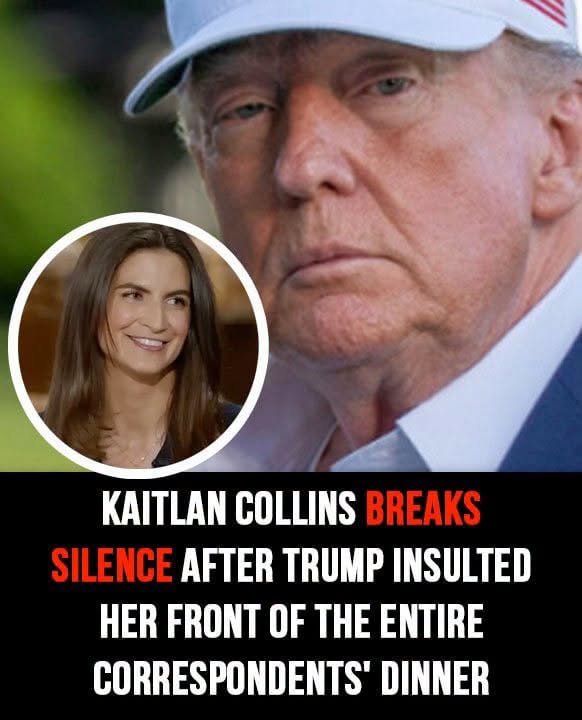
The annual White House Correspondents’ Dinner has long been known as an evening where politics, journalism, and comedy collide under one roof. Presidents joke about reporters, comedians poke fun at politicians, and journalists celebrate the importance of a free press. But one particular moment involving CNN anchor Kaitlan Collins quickly became one of the most talked-about episodes of the night, sparking conversations that extended far beyond the ballroom.
What began as another high-profile appearance soon transformed into a national discussion about public criticism, professional resilience, and the role of journalists in an increasingly polarized political climate.
During the event, Donald Trump directed remarks toward Kaitlan Collins that immediately drew widespread attention.
Among his comments were references to an award Collins had received, dismissing it as “fake” while also making personal observations about her smile in front of the assembled audience.
For many watching, the exchange felt less like the traditional political humor often associated with the dinner and more like a direct personal attack delivered on one of journalism’s biggest stages.
The room’s reaction became almost as significant as the remarks themselves.
Some attendees laughed politely.
Others appeared visibly uncomfortable.
Many simply remained silent.
It was that silence, according to numerous observers, that ultimately became one of the defining images of the evening.
The Correspondents’ Dinner has always balanced celebration with satire.
Public officials expect criticism.
Journalists often become part of the jokes as well.
Yet many people questioned whether this particular moment crossed an invisible line separating political humor from personal ridicule.
Supporters of Trump argued that public figures, including prominent journalists, should expect criticism and sharp humor, especially during events historically built around political roasting.
Critics viewed the remarks differently.
They believed targeting an individual reporter in such a personal manner shifted attention away from journalism itself and toward unnecessary humiliation.
While reactions continued pouring across television programs and social media, many people wondered how Kaitlan Collins would respond.
Some expected an immediate rebuttal.
Others anticipated a pointed television segment or public statement criticizing Trump’s comments.
Instead, Collins remained remarkably composed.
She did not respond from the podium.
She did not interrupt the evening.
She allowed the event to continue without escalating the confrontation.
That decision quickly became its own story.
Rather than engaging emotionally in the moment, Collins waited until afterward to address the situation in a measured and thoughtful way.
When she eventually commented publicly, her response surprised many observers.
Instead of focusing primarily on the personal criticism directed toward her, Collins chose to broaden the conversation.
She referenced a famous quote from Eleanor Roosevelt:
“No one can make you feel inferior without your consent.”
The quotation immediately resonated with many supporters, who interpreted it as a calm rejection of personal attacks without descending into the same style of confrontation.
Rather than centering herself, Collins redirected attention toward the principles that had originally brought everyone together.
She spoke about journalism.
She spoke about the First Amendment.
She emphasized the importance of independent reporting regardless of political pressure.
For many observers, that shift demonstrated exactly why the moment had become so significant.
Instead of allowing the discussion to revolve around personalities, Collins attempted to move it back toward institutions and democratic values.
Her response was widely described as restrained.
Some praised it as dignified.
Others viewed it as strategic.
By refusing to respond emotionally, she avoided extending the controversy while reinforcing the professional role she believes journalists should play.
The episode also reopened broader discussions about the relationship between politicians and the media.
For years, tensions between Donald Trump and numerous news organizations have remained among the defining characteristics of modern American politics.
Throughout his political career, Trump frequently criticized journalists, challenged media organizations, and accused reporters of unfair coverage.
Many supporters applauded his willingness to confront outlets they believed demonstrated political bias.
Many critics argued those repeated confrontations weakened public trust in journalism and increased hostility toward reporters simply performing their jobs.
Kaitlan Collins has frequently found herself at the center of those exchanges.
As one of CNN’s leading White House correspondents before becoming a primetime anchor, she regularly questioned presidents, press secretaries, and senior officials during highly visible press briefings.
Those interactions often became headline news themselves.
Supporters describe Collins as persistent, direct, and unafraid to ask difficult questions regardless of political affiliation.
Critics sometimes accuse her of pursuing confrontation rather than information.
Regardless of differing opinions, few dispute that she has become one of the most recognizable political journalists in the country.
The Correspondents’ Dinner incident therefore carried symbolic importance beyond the individuals involved.
Many journalists viewed it as another example of the increasingly tense relationship between elected officials and members of the press.
Others saw it as evidence of how political polarization now shapes even events traditionally intended to celebrate shared democratic traditions.
The evening also generated discussion because of additional remarks reportedly directed toward other public figures.
Some commentators noted that Trump also made comments involving influencer Dylan Mulvaney, continuing a pattern of using humor to criticize individuals who have frequently become subjects of broader cultural debates.
Supporters considered the remarks consistent with Trump’s outspoken political style.
Critics argued they reflected a broader tendency to single out individuals as symbols within larger political conflicts.
As clips from the dinner spread online, millions of viewers who had not attended the event formed their own opinions.
Some focused on the jokes.
Others focused on the audience’s reaction.
Many concentrated on Collins’ calm response afterward rather than the original exchange itself.
That response arguably became the lasting image of the controversy.
Instead of participating in an escalating public argument, Collins appeared determined to reinforce the professional responsibilities she associates with journalism.
She repeatedly emphasized that reporters should remain focused on informing the public rather than becoming the central story themselves.
That philosophy resonated with many colleagues across the journalism profession.
Numerous reporters and media organizations expressed support, arguing that criticism of journalism should remain separate from personal attacks on individual reporters.
Others maintained that public figures including journalists must accept criticism from political leaders just as politicians regularly face scrutiny from the press.
The debate highlighted how differently Americans continue interpreting the relationship between media and politics.
To some, Collins represented the resilience of independent journalism.
To others, she represented media institutions that deserve vigorous public criticism.
Those contrasting interpretations ensured the conversation extended well beyond one evening.
Perhaps the most striking aspect of the entire episode was not the criticism itself but how differently participants chose to respond.
Trump relied on sharp humor and direct confrontation.
Collins answered with restraint, historical perspective, and a renewed emphasis on constitutional principles.
Those contrasting approaches reflected two very different philosophies regarding public conflict.
As the headlines gradually faded, the Correspondents’ Dinner left behind questions that continue shaping public life.
What responsibilities do journalists carry when they themselves become the story?
Where should political humor end and personal attacks begin?
How should audiences respond when public disagreements become deeply personal?
There may never be universal agreement on those questions.
But the exchange between Donald Trump and Kaitlan Collins ensured they would once again become part of the national conversation.
In the end, the night’s most memorable moment may not have been the remarks delivered from the stage.
It may have been the response that came afterward a deliberate decision to answer criticism not with louder words, but with composure, perspective, and a reminder that the strongest defense of journalism often begins by refusing to abandon its principles.