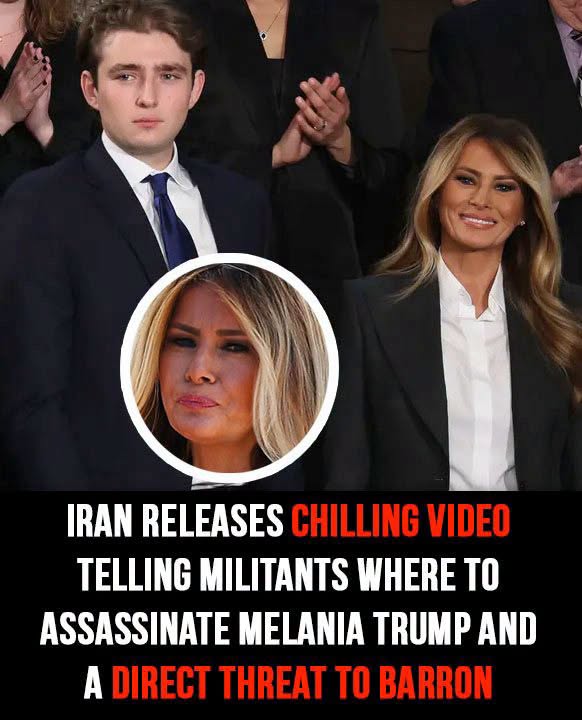
A newly circulated video has ignited widespread concern after appearing to target former First Lady Melania Trump and her son, Barron Trump, with disturbing threats that many observers say cross every imaginable line.
The footage, reportedly produced by Iran’s Tasnim News Agency, has drawn international attention because of its detailed references to Melania Trump’s public appearances, personal interests, and daily routines. Rather than delivering broad political rhetoric, the video reportedly focuses on specific scenarios involving the former first lady, prompting renewed debate over political extremism, personal security, and the growing use of propaganda during periods of international tension.
For many who viewed or learned about the video, what stood out most was not simply the hostile language but the intensely personal nature of the message.
According to reports, the production portrays Melania Trump as a symbolic target, referring to her by the nickname “Muse” while discussing her well-known interest in fashion and luxury shopping. It reportedly references upscale areas of Manhattan and discusses ways hostile individuals could identify or anticipate her public movements.
The inclusion of such details immediately raised concerns among security analysts and political observers, who argued that the video moves beyond political messaging and into territory that many consider deeply alarming.
Even more troubling for many viewers was the alleged discussion of methods by which attackers could exploit public spaces or insiders to harm a protected individual.
Rather than remaining abstract, the video’s narrative reportedly presents hypothetical attack scenarios in a manner that has unsettled many observers.
The concern intensified further when the video allegedly mentioned Barron Trump directly.
The reported statement directed toward the youngest member of the Trump family transformed what might otherwise have been viewed as another piece of inflammatory propaganda into something far more personal.
Across social media and news platforms, reactions quickly shifted away from politics and toward questions of safety.
Many commentators argued that regardless of political beliefs, the inclusion of family members—particularly children or young adults—should remain outside political conflict.
The reported threat toward Barron prompted expressions of concern from people across different political perspectives, many emphasizing that relatives of public officials should never become targets of intimidation or violence.
The controversy arrives during a period of already heightened tensions between the United States and Iran.
Relations between the two countries have deteriorated following military operations, retaliatory strikes, and increasingly confrontational public statements from leaders on both sides.
Recent months have seen exchanges involving missile attacks, drone operations, and escalating rhetoric that has raised fears of a broader regional conflict.
Against that backdrop, inflammatory media productions have become increasingly common.
Political messaging often serves multiple purposes.
It can attempt to influence domestic audiences.
It can send symbolic messages to foreign governments.
It can project strength or determination during periods of conflict.
But critics argue that when such messaging appears to encourage or glorify violence against identifiable individuals, it raises serious ethical and security concerns.
Security experts have long warned that detailed public discussions about prominent figures can increase risks by attracting unwanted attention from individuals who may already hold extremist views.
For that reason, authorities typically monitor threatening communications involving high-profile public officials and their families with great seriousness.
Melania Trump has largely maintained a lower public profile since leaving the White House.
Although she occasionally appears alongside Donald Trump during campaign events or official functions, she has generally avoided constant political engagement compared with many other former first ladies.
Her appearances often focus on family, charitable activities, and selected public events rather than daily political commentary.
Barron Trump has maintained an even more private life.
Growing up under extraordinary public attention, he has rarely spoken publicly and has generally remained outside partisan political debates.
That privacy has made references to him particularly sensitive.
Many observers noted that political disagreements become fundamentally different when they extend beyond elected officials and begin targeting family members who have played little or no public political role.
The reported video has also renewed discussion about the growing influence of state-affiliated media during geopolitical conflicts.
Governments and organizations around the world increasingly use digital platforms, documentaries, videos, and social media campaigns to shape international narratives.
Supporters often describe these productions as legitimate political expression or information campaigns.
Critics argue they can blur the line between propaganda and dangerous incitement.
As clips circulate online, they frequently reach audiences far beyond their original intended viewers.
A video created for domestic political messaging may quickly become an international news story viewed by millions of people across multiple countries.
That rapid global distribution amplifies both the message itself and the public reaction surrounding it.
Political leaders, intelligence agencies, and security services closely monitor these developments because rhetoric can sometimes influence real-world behavior.
Although most propaganda never results in direct action, history has shown that inflammatory messaging can contribute to heightened tensions and unpredictable consequences.
For security professionals, evaluating potential threats requires balancing context, intent, and capability.
Every threatening statement does not automatically indicate an imminent attack.
At the same time, credible threats involving protected public figures are generally taken seriously regardless of their origin.
Modern protective services routinely review public communications, assess potential risks, and adjust security procedures when necessary.
The controversy has also sparked a broader conversation about the limits of political conflict.
Democratic societies have long accepted vigorous debate, criticism, and even harsh rhetoric toward political leaders.
However, many argue there remains a clear distinction between criticizing public officials and appearing to celebrate or encourage violence against them or their families.
That distinction becomes especially significant during periods of international confrontation, when emotions often run high and political messaging grows increasingly aggressive.
Many commentators have emphasized that political disagreements should never erase basic principles of humanity.
Families, they argue, should not become symbols of retaliation.
Children and relatives should not become instruments in geopolitical disputes.
Whatever position individuals hold regarding international policy, many believe there must remain boundaries that protect innocent family members from becoming part of public threats.
As governments continue responding to rising tensions between the United States and Iran, incidents like this serve as reminders that modern conflicts are fought not only through military operations and diplomacy but also through information, symbolism, and media.
Words, images, and videos can shape public opinion, deepen hostility, or fuel fear long before any physical confrontation occurs.
Whether viewed as propaganda, intimidation, or political theater, the reported video has already achieved one undeniable outcome.
It has intensified international attention.
It has reignited debates about security.
And it has reminded many people how quickly political conflict can expand beyond governments and institutions to touch the lives of individual families.
For now, officials continue monitoring developments while broader geopolitical tensions remain unresolved.
The controversy surrounding the video underscores a reality that extends beyond any single country or political movement: when public discourse begins targeting families instead of policies, the consequences reach far beyond politics, raising questions about security, responsibility, and the boundaries that should never be crossed.