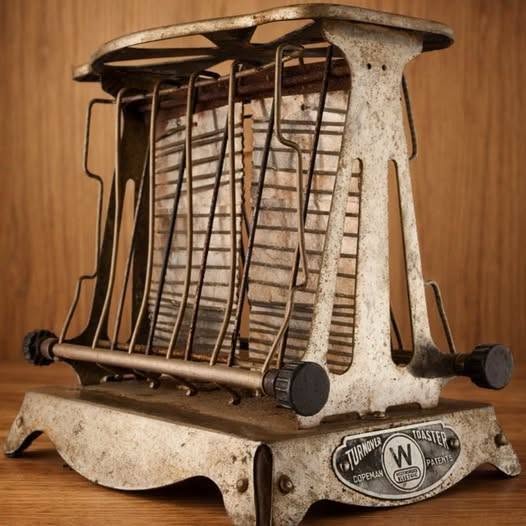
At first glance, it looks almost impossible to understand.
A small metal frame.
A few exposed wires.
A design that seems too simple, too old-fashioned, and almost too dangerous to belong in a modern kitchen.
For many people today, seeing this unusual appliance raises an immediate question:
What exactly was this thing?
Before smart ovens, touchscreen appliances, and automatic kitchen gadgets became part of everyday life, there was a time when even making a simple piece of toast required attention, patience, and a little bit of skill.
This forgotten device was a turnover toaster, one of the earliest electric toasters that helped transform the way families prepared breakfast nearly a century ago.
Long before modern pop-up toasters became a standard appliance in homes around the world, turnover toasters introduced families to a new kind of convenience. They represented a major shift in household technology, bringing electricity directly into everyday routines and changing something as ordinary as making toast into a symbol of progress.
But unlike today’s appliances that complete tasks with almost no effort, the turnover toaster demanded participation.
It did not simply accept a slice of bread, disappear behind a metal shell, and announce when breakfast was ready.
It required you to watch.
You had to place the bread carefully between the heated elements, wait as the coils slowly turned bright red, and judge the perfect moment to flip the bread yourself. Timing mattered. Attention mattered. The final result depended on the person operating the machine.
For families living during the early days of electrical appliances, this was a completely different experience.
Electricity itself was still something exciting and unfamiliar in many homes. Appliances powered by electricity represented a future that promised cleaner, easier, and more efficient living.
The turnover toaster became part of that transformation.
Before electric toasters became common, people often relied on open flames, stovetops, or metal racks placed near heat sources to prepare toast. These methods worked, but they could be messy and inconsistent. Smoke, soot, uneven heating, and constant monitoring were normal parts of the process.
The arrival of electric heating elements changed everything.
Suddenly, families could create a warm, crispy breakfast without dealing with the same problems caused by traditional cooking methods.
The turnover toaster may look primitive compared with today’s technology, but at the time, it represented innovation.
It was proof that electricity could do more than power lights.
It could improve daily life.
It could save time.
It could bring a sense of modern comfort into ordinary homes.
However, compared with modern appliances, these early toasters were incredibly simple.
Their designs often featured exposed heating elements, metal frames, and manual mechanisms. There were no digital settings, no automatic sensors, and no precise controls for different levels of browning.
The user had to become part of the machine’s operation.
That is one reason these appliances feel so fascinating today.
They reveal a completely different relationship between people and technology.
Modern appliances are designed to disappear into the background. They are built to be quiet, automatic, and effortless.
Vintage appliances were different.
They were visible.
They moved.
They made sounds.
They reminded people that a machine was working.
The glowing coils of a turnover toaster were not hidden away. They were part of the experience. Watching the metal heat up and transform a simple piece of bread into something golden and crisp created a small moment of connection between the person and the appliance.
In many ways, it turned breakfast into a ritual.
Families gathered around kitchen tables while someone prepared toast by hand. Children watched the glowing wires with curiosity. Adults learned the small tricks needed to get the perfect result.
A little more time near the heat for darker toast.
A quicker flip for softer bread.
A careful eye to prevent burning.
These small details became part of everyday life.
Today, that level of involvement may seem unnecessary. Most people expect appliances to work instantly and independently.
But there is something charming about technology from that era.
It was not designed to hide the process.
It celebrated it.
The exposed construction also tells a story about how engineers approached household inventions at the time. Early appliance makers were experimenting, discovering what worked, and creating products that would eventually shape the future.
Every modern toaster owes something to these early designs.
The basic idea of using electrical heat to toast bread evolved over decades, eventually leading to the automatic pop-up toaster that became a kitchen staple.
Safety features improved.
Designs became more compact.
Controls became more accurate.
The machines became faster and easier to use.
But the original concept remained the same.
Electricity could transform a simple daily task.
Today, collectors and history enthusiasts search for vintage turnover toasters because they represent more than an old kitchen gadget.
They represent a moment when technology was entering homes in a completely new way.
They remind us that progress often begins with imperfect inventions.
The first versions are rarely flawless.
They may look strange.
They may require more effort.
They may eventually be replaced by better designs.
But without those early experiments, modern conveniences would never exist.
A turnover toaster sitting in a museum, antique shop, or private collection is not just a piece of forgotten equipment.
It is a snapshot of a changing world.
It captures the excitement of a time when electricity was reshaping everyday life and ordinary families were discovering new possibilities inside their own kitchens.
The device also reflects something many people miss about the past: patience.
Older generations often interacted with their tools differently. They repaired things instead of replacing them. They learned how objects worked. They developed skills through repetition.
A turnover toaster was not just something you owned.
It was something you understood.
You knew how long the bread needed.
You knew when to turn it.
You knew how to get the best result.
That personal connection is part of why vintage appliances continue to attract attention today.
In an age filled with smart devices and automated technology, many people find themselves drawn to objects that feel more human.
Objects that show their purpose.
Objects that carry evidence of the hands that used them.
The turnover toaster may seem like a strange piece of metal from another era, but it represents a much bigger story.
It tells the story of innovation entering the home.
It shows how everyday routines slowly changed.
It reminds us that even something as simple as toast once represented the excitement of a new technological age.
What looks outdated today was once a symbol of the future.
And that is what makes these forgotten kitchen devices so fascinating.
They are not merely old appliances.
They are reminders of how far we have come and how every modern convenience began with a simple idea, a little experimentation, and a machine that changed the way people lived one breakfast at a time.