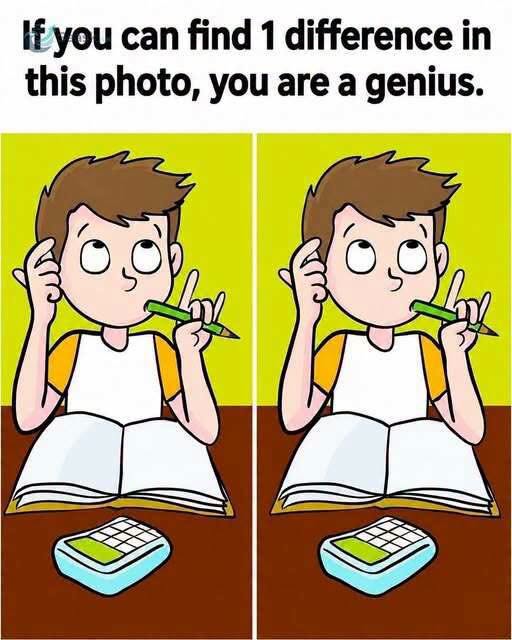
At first glance, it looks almost disappointingly simple.
A plain study desk.
A few everyday objects.
Nothing flashy.
Nothing complicated.
No bright colors competing for your attention or dramatic scenes demanding your focus.
It feels like the kind of picture you could understand in less than a second.
That assumption is exactly why so many people fail.
What begins as a harmless visual challenge quickly turns into something much more revealing. Participants often rush to find the hidden object or solve the puzzle within seconds, only to realize they have overlooked details that were sitting in front of them the entire time.
They look again.
And again.
Still, something refuses to appear.
The longer they stare, the stranger the experience becomes.
Suddenly, they start questioning their own eyesight.
“How did I miss that?”
“I’ve looked at this five times.”
“It was right there the whole time.”
These reactions are surprisingly common because the puzzle isn’t really testing your vision.
It’s testing your attention.
Most of us believe we observe the world carefully.
In reality, our brains are constantly taking shortcuts.
Every second, your eyes collect an enormous amount of visual information. If your brain attempted to process every tiny detail equally, you would become overwhelmed almost instantly.
Instead, it filters.
It simplifies.
It predicts.
Rather than examining everything individually, your mind fills in gaps using experience and expectation.
That strategy is incredibly efficient.
It allows you to drive a car, recognize familiar faces, walk through crowded streets, and complete everyday tasks without consciously analyzing every object around you.
But efficiency comes with a hidden cost.
Sometimes, your brain decides something isn’t important before you’ve actually seen it.
That is precisely what this study desk puzzle exposes.
Because the scene appears ordinary, your brain immediately labels it as familiar.
Desk.
Chair.
Books.
Lamp.
Done.
Instead of carefully examining every inch of the image, you rely on assumptions about what belongs there.
The puzzle quietly takes advantage of those assumptions.
Hidden objects blend naturally into surrounding shapes.
Lines merge together.
Shadows disguise outlines.
Items become part of completely unrelated objects.
The more convinced you become that you’ve already searched everywhere, the more likely it is that you’re overlooking the correct answer.
That frustration teaches an important lesson.
Seeing and observing are not the same thing.
Most people spend their lives looking.
Very few truly observe.
Observation requires intention.
It requires slowing down.
It asks you to resist your first conclusion and remain curious a little longer.
Modern life makes this increasingly difficult.
Every day we scroll through hundreds of images, videos, headlines, advertisements, and notifications.
Our attention jumps constantly.
We skim instead of study.
We glance instead of inspect.
Our brains become incredibly fast at recognizing patterns but less practiced at examining details.
This puzzle quietly interrupts that habit.
It forces you to pause.
To move your eyes deliberately.
To inspect corners you would normally ignore.
To question whether you’ve actually looked or merely assumed.
Something interesting begins happening after enough practice.
The improvement doesn’t stay inside the puzzle.
People who regularly complete visual observation challenges often notice changes in everyday life.
They begin spotting small details they previously ignored.
A misplaced set of keys.
A tiny crack in a windshield.
An email containing one incorrect number.
A friend’s unusual expression.
The missing ingredient in a recipe.
These aren’t superpowers.
They’re simply the result of paying closer attention.
Observation strengthens just like any other skill.
The more deliberately you practice it, the more naturally it becomes part of everyday thinking.
Professional investigators understand this well.
Detectives rarely solve cases because they possess extraordinary intelligence alone.
They succeed because they notice details other people dismiss.
Architects inspect tiny measurements before constructing enormous buildings.
Doctors identify subtle symptoms before illnesses become severe.
Pilots monitor countless instruments simultaneously.
Artists spend hours studying how light falls across ordinary objects.
Scientists often make breakthroughs by noticing patterns others overlooked.
Observation is one of humanity’s most valuable abilities.
Yet it is also one of the easiest to neglect.
Technology encourages speed.
Social media rewards instant reactions.
Productivity celebrates multitasking.
Few environments encourage careful attention anymore.
The study desk puzzle quietly rebels against that culture.
It asks for patience.
It rewards curiosity.
It reminds you that important discoveries often appear only after the first impression fades.
There is another psychological reason these puzzles feel so satisfying.
Your brain loves solving uncertainty.
When you know something is hidden, your attention becomes increasingly focused.
Every unsuccessful attempt creates a small amount of tension.
Finding the answer releases that tension, producing a feeling of satisfaction and accomplishment.
This reward system explains why people often spend far longer on visual puzzles than they originally intended.
The challenge becomes addictive.
Not because the object itself matters.
Because solving it proves your brain capable of seeing what it initially missed.
Perhaps the most valuable lesson comes after the puzzle is finished.
Once someone points out the hidden object, most people immediately wonder how they failed to notice it before.
Suddenly, the answer feels obvious.
They cannot imagine missing it again.
Psychologists sometimes call this hindsight bias.
After learning the solution, the brain rewrites the experience, making the answer appear much easier than it truly was.
The same phenomenon occurs throughout everyday life.
Mistakes seem obvious after they happen.
Solutions feel simple once someone explains them.
Observation teaches humility.
It reminds us that certainty is often an illusion.
There is almost always something we haven’t considered yet.
Something we haven’t examined carefully enough.
Something hiding in plain sight.
The simple desk becomes more than a piece of furniture inside a puzzle.
It becomes a metaphor.
How many opportunities have we overlooked because we assumed we already understood the situation?
How many conversations have we half-heard because our attention wandered?
How many beautiful moments have disappeared while we stared at our phones?
How many warning signs have gone unnoticed because our minds filled in familiar patterns instead of examining reality?
Observation changes far more than puzzle-solving ability.
It changes relationships.
People who truly listen notice emotions beneath words.
Parents recognize subtle changes in their children’s behavior.
Teachers identify struggling students before grades reveal the problem.
Managers catch small issues before they become major crises.
Friends recognize when someone says “I’m fine” but clearly isn’t.
Attention becomes an act of care.
The more present you become, the richer your understanding of people and situations grows.
Even creativity depends on observation.
Great writers notice conversations others forget.
Photographers capture moments everyone else walks past.
Inventors solve problems because they see flaws hidden inside ordinary routines.
Innovation often begins with one simple decision.
To look longer than everyone else.
The study desk puzzle offers no life-changing prize.
No money.
No trophy.
No certificate.
Yet it quietly develops something far more valuable.
It reminds you that attention is a choice.
Every day, the world offers countless details waiting to be noticed.
Most disappear because we’re moving too fast.
The next time you encounter a puzzle like this, resist the temptation to rush.
Take a breath.
Slow your eyes.
Question your assumptions.
Search with intention instead of habit.
Because the greatest discovery may not be the hidden object itself.
It may be realizing that the world has always contained far more than you were allowing yourself to see.
Sometimes all it takes is one simple desk to remind us that the extraordinary often hides inside the ordinary and that learning to truly observe can transform not only how we solve puzzles, but how we experience life itself.