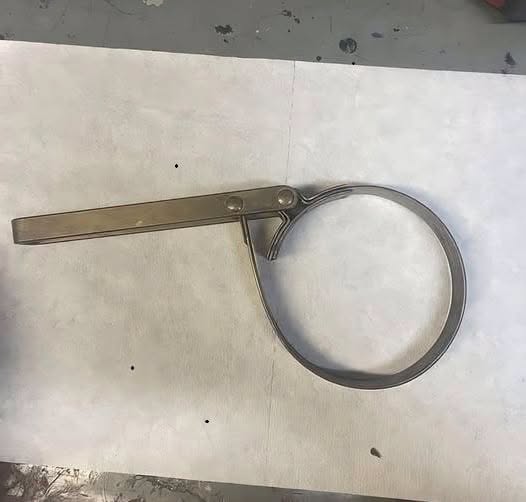
At first glance, it looks like a strange piece of metal with an uncertain purpose.
Some people guess it belongs in a carpenter’s toolbox.
Others insist it must be part of old farming equipment.
A few even suggest it was designed for plumbing, construction, or some long-forgotten household chore.
When photographs of the tool began circulating online, thousands of people confidently offered completely different answers.
Comment sections filled with debates.
Families asked older relatives if they recognized it.
Mechanics weighed in.
Collectors joined the discussion.
Everyone seemed certain they had solved the mystery.
Most of them were wrong.
The truth turned out to be far simpler and far more fascinating.
The mysterious object was an oil filter wrench.
Although millions of vehicles have relied on tools like it for decades, many younger drivers had never seen one before.
Modern maintenance has changed dramatically, and many people no longer perform routine oil changes themselves.
As a result, one of the most useful tools ever created for automotive maintenance has quietly faded from everyday recognition.
Yet without it, countless mechanics would have faced an almost impossible challenge.
To understand why the oil filter wrench became so important, it helps to imagine the early days of automobile repair.
Engines required regular oil changes to continue operating properly.
Old oil collected dirt, metal particles, and contaminants that gradually reduced engine performance.
Replacing the oil was straightforward enough.
Removing the oil filter was another story entirely.
After thousands of miles of driving, filters often became tightly sealed in place.
Heat from the engine caused metal parts to expand and contract repeatedly.
Oil residue coated the filter’s smooth exterior.
Mechanics quickly discovered that bare hands often could not generate enough grip to loosen it.
The harder they pulled, the more their hands slipped.
Improvised solutions appeared everywhere.
Some wrapped cloth around the filter.
Others tried leather belts.
Chains.
Pieces of rubber.
Anything capable of creating enough friction.
Eventually, toolmakers recognized the need for something specifically designed for the task.
The earliest oil filter wrenches were practical rather than elegant.
Many used chains that wrapped tightly around the filter.
As pressure increased, the chain gripped the metal firmly enough to break the filter loose.
Other versions relied on heavy-duty straps that tightened automatically when force was applied.
Neither design was particularly glamorous.
Both were incredibly effective.
What began as a simple solution soon evolved alongside the automotive industry itself.
As engine designs became more sophisticated, manufacturers introduced oil filters in different sizes and positions.
Some sat openly beneath the engine.
Others were buried deep inside crowded engine compartments where reaching them required remarkable patience.
Tool designers responded with new innovations.
Cup-style oil filter wrenches appeared.
Rather than squeezing around the outside of the filter, these fit directly over its end like a socket.
When attached to a ratchet, they provided secure grip while allowing mechanics to work in extremely confined spaces.
Adjustable strap wrenches followed.
Their flexible design allowed one tool to accommodate many different filter sizes.
Claw-style wrenches became another popular option.
These clever devices automatically tightened around the filter as torque increased.
The more force applied, the tighter they gripped.
Each design solved slightly different problems.
Together, they transformed one of vehicle maintenance’s most frustrating tasks into a routine procedure.
The improvements did not stop there.
Engineers began paying closer attention to comfort.
Mechanics often spent entire days working with their hands.
Poorly designed tools increased fatigue and sometimes caused injuries.
Manufacturers introduced ergonomic handles that reduced strain.
Better materials improved durability.
Ratcheting mechanisms allowed faster movement without constantly repositioning the tool.
Small refinements accumulated year after year.
None seemed revolutionary individually.
Together, they dramatically improved everyday work.
Modern automotive workshops still rely heavily on these principles.
Although today’s oil filter wrenches may feature stronger alloys, improved coatings, and more refined engineering, their essential purpose remains unchanged.
They exist because smooth, oil-covered filters refuse to cooperate with human hands alone.
Even experienced mechanics appreciate having the right tool available.
Attempting to remove a stubborn filter without one often leads to frustration, damaged parts, scraped knuckles, and wasted time.
Professional technicians understand that efficiency rarely comes from strength alone.
It comes from using equipment specifically designed for the job.
Interestingly, oil filter wrenches have also developed an unexpected following among collectors.
Early examples from the first half of the twentieth century now represent fascinating pieces of industrial history.
Collectors search antique markets, estate sales, and vintage tool auctions hoping to discover original chain wrenches, early strap models, or manufacturer-specific designs produced for classic automobiles.
To many enthusiasts, these tools symbolize an era when nearly every car owner performed routine maintenance personally.
Garages were places of learning.
Children watched parents repair vehicles on weekends.
Neighbors borrowed tools from one another.
Mechanical knowledge passed naturally between generations.
An old oil filter wrench therefore represents much more than steel and moving parts.
It represents self-reliance.
Craftsmanship.
Patience.
Problem-solving.
Classic car restorers especially appreciate authentic tools from the period matching their vehicles.
Using original equipment creates a stronger connection to automotive history.
Each oil change becomes more than routine maintenance.
It becomes a small tribute to the mechanics who kept earlier generations of automobiles running long before computerized diagnostics and electric vehicles transformed the industry.
Even as technology continues evolving, the underlying lesson remains surprisingly relevant.
The best tools often solve problems so effectively that people eventually stop noticing them altogether.
Few drivers think about the engineering behind an oil filter wrench.
Most simply expect mechanics to complete an oil change quickly.
Hidden behind that convenience stands over a century of practical innovation.
Countless designers refined small details.
Manufacturers improved materials.
Mechanics offered feedback.
Each improvement saved time, protected engines, and reduced unnecessary effort.
That quiet progress rarely makes headlines.
Yet millions of vehicles have benefited from it.
Perhaps that explains why photographs of old oil filter wrenches generate such curiosity online.
Removed from their original context, they appear mysterious.
Almost artistic.
People naturally search for complicated explanations.
Sometimes the simplest answer turns out to be the correct one.
A tool created for one specific purpose.
One problem.
One practical solution.
In the end, the oil filter wrench reminds us that history is often shaped not only by grand inventions but also by modest tools that quietly make everyday life better.
It may never receive the recognition of an engine, an automobile, or a groundbreaking technological breakthrough.
Yet every successful oil change owes something to its design.
Every protected engine carries a small piece of its legacy.
And every mechanic who reaches for one continues a tradition that stretches back more than a century—a tradition proving that sometimes the simplest tools leave the most lasting impact.