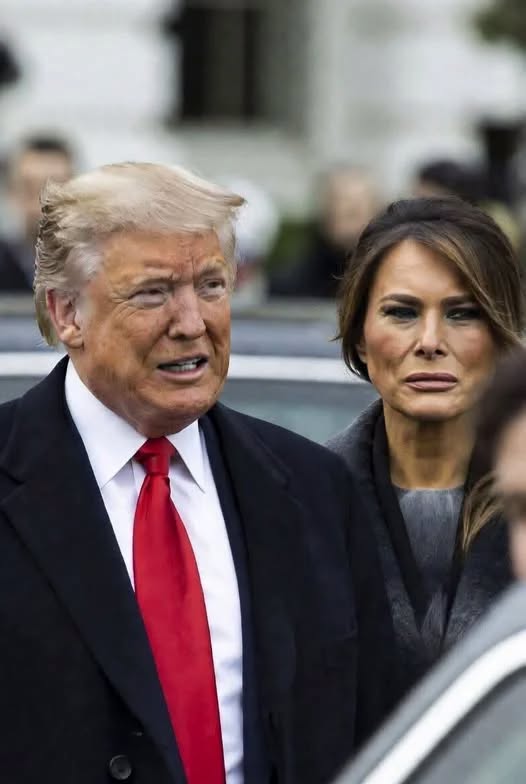
For years, they appeared to represent the perfect political partnership.
Every public appearance seemed carefully timed. Every photograph captured the same familiar image: two powerful figures standing side by side, united by ambition, loyalty, and a shared vision. To supporters, they looked like a team built to withstand anything. To critics, they looked like a carefully constructed performance designed for cameras, campaigns, and public approval.
But behind the polished speeches and carefully managed appearances, questions began to emerge.
Was the relationship as strong as it appeared?
Or had the pressure of political life slowly transformed a personal bond into something more strategic than emotional?
In Washington, where reputation can be as valuable as policy and perception can shape careers, marriages involving public figures often become more than private relationships. They become symbols. They become part of a larger story about leadership, stability, and trust.
For this couple, their marriage was not simply a partnership between two people.
It became a brand.
Their shared moments carried meaning far beyond the room they were standing in. A supportive gesture during a speech, a smile during a campaign event, or a quiet interaction in front of cameras could become a message carefully interpreted by voters, journalists, and political opponents.
Together, they projected confidence.
They projected unity.
They projected the image of two people moving forward with complete faith in each other.
But maintaining that image came with a cost.
Behind closed doors, the demands of public life created pressures that few outsiders could fully understand. Politics requires constant compromise, endless appearances, and a willingness to put personal emotions aside for a larger goal. The same qualities that can make someone successful in public office can sometimes create distance in private life.
Schedules become impossible.
Conversations become strategic.
Private disagreements become risks.
Even ordinary relationship problems can become complicated when every action is viewed through a political lens.
For many powerful couples, the challenge is not simply staying together.
It is remembering who they are when the cameras are gone.
Over time, some relationships can begin to feel less like partnerships and more like professional alliances. Decisions are discussed in terms of consequences. Conversations are shaped by public reactions. Personal struggles are carefully hidden because vulnerability can be viewed as weakness.
The home that should provide comfort can slowly become another place where image management continues.
The relationship that once represented love and connection can become another responsibility to maintain.
That is where many observers believe the cracks began to appear.
Not necessarily through one dramatic moment, but through years of small changes.
Less time together.
More pressure.
More focus on outside expectations.
Two people who once understood each other may eventually find themselves living separate emotional lives while still appearing together in public.
One may become focused on survival in the political world.
The other may feel forgotten, unheard, or pushed aside by constant demands.
Over time, they may begin speaking different emotional languages.
One person may seek solutions.
The other may seek understanding.
One may prioritize reputation.
The other may prioritize connection.
And without honest communication, even the strongest relationships can begin to weaken.
The public often sees only the final chapter.
They see the headlines.
They see the rumors.
They see the carefully selected moments that become part of a larger narrative.
But relationships rarely collapse because of one single event. More often, they are shaped by countless moments that happen quietly, away from public attention.
A conversation that never happened.
A feeling that was ignored.
A problem that was postponed until it became impossible to avoid.
For couples living under intense public pressure, those private struggles become even more difficult because admitting weakness can have consequences.
Political opponents may use personal challenges as ammunition.
Supporters may question loyalty.
Media outlets may analyze every interaction.
A simple disagreement can become a national conversation.
That constant attention can create an environment where protecting the image becomes more important than protecting the relationship itself.
And when that happens, something deeply human can get lost.
The people involved.
The family behind the headlines.
The children who never asked to become part of a public story.
For families connected to politics, children often experience the consequences without having any control over them. Their lives can become subjects of speculation, their emotions overlooked while the public debates the adults around them.
They may find themselves watching strangers analyze their family like a political strategy document instead of recognizing it as a personal experience involving real people.
Behind every headline is a family trying to navigate something painful.
Behind every public controversy are individuals dealing with emotions that cannot be measured by polls or public statements.
That is perhaps the most important lesson hidden beneath the drama surrounding powerful couples.
Success does not make people immune to ordinary human struggles.
Fame does not eliminate the need for affection.
Influence does not protect someone from loneliness.
A person can stand in front of thousands of people and still feel unseen by the person closest to them.
A marriage can look perfect in photographs while quietly struggling in private.
And a relationship built around public admiration can still need the same things every relationship requires: honesty, patience, trust, and genuine care.
The downfall of a political power couple is often treated as entertainment. Commentators debate motives, critics assign blame, and supporters defend their preferred version of events.
But beneath all of that is a much simpler story.
Two people.
A relationship.
A series of choices.
A reminder that no amount of power can replace emotional connection.
When love becomes part of a carefully designed image, it risks losing the very thing that made it meaningful in the first place.
Because eventually, every performance ends.
The cameras turn away.
The speeches stop.
The public moves on.
And what remains is not the brand, the campaign, or the carefully created image.
What remains is the relationship itself.
And that is where the true story has always been.