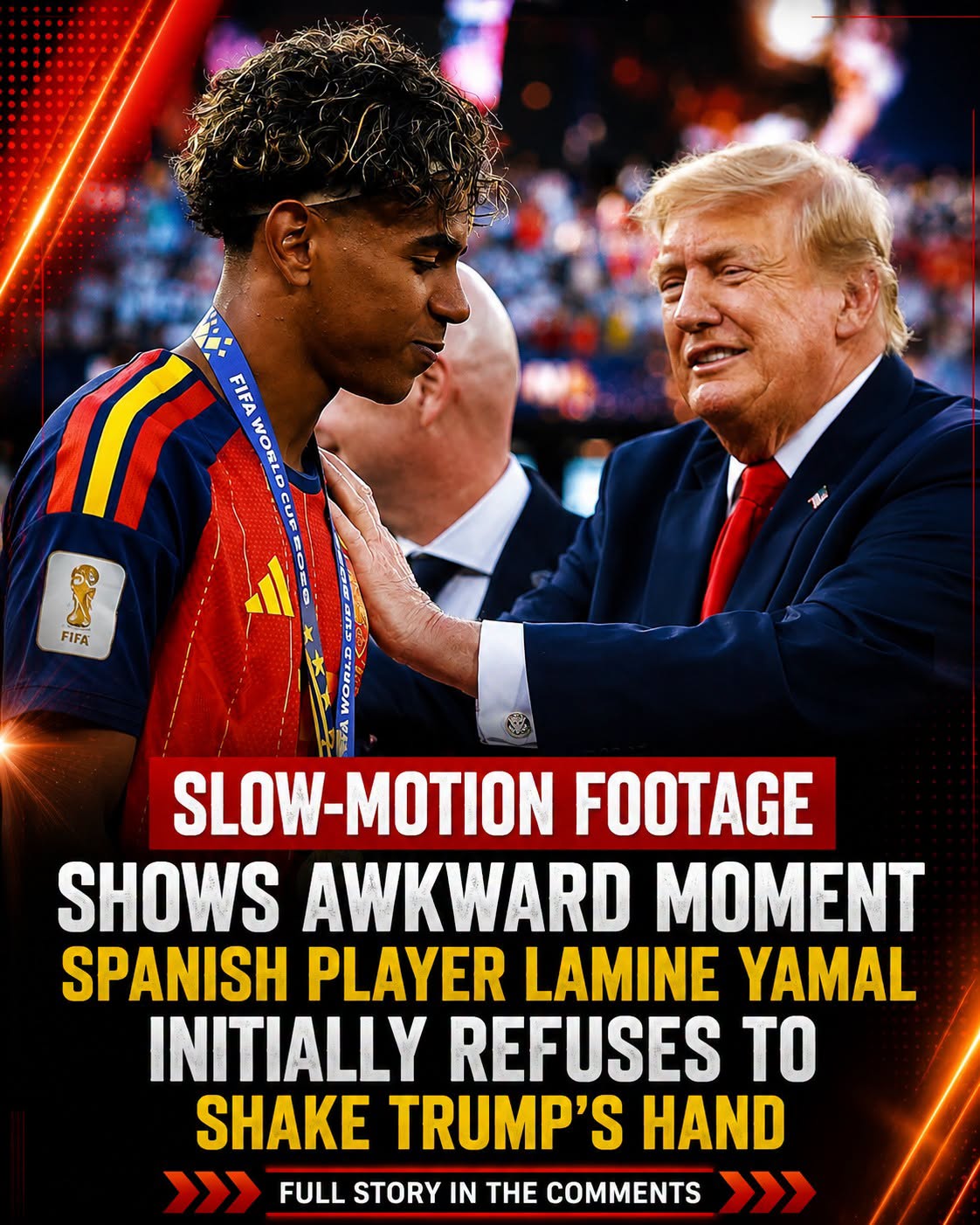
Spain had just completed one of the greatest nights in its football history.
After an intense World Cup final that stretched into extra time, the Spanish players finally stood where every footballer dreams of standing.
World champions.
The celebrations had already begun.
Confetti filled the air.
Supporters roared from every corner of the stadium.
Players embraced one another, overwhelmed by the realization that years of sacrifice had finally led to this unforgettable moment.
But amid the joy, one brief interaction during the medal ceremony unexpectedly stole attention across the internet.
It lasted only a second.
Yet when replayed in slow motion, it quickly became one of the most discussed moments of the entire evening.
The focus centered on Spain’s young superstar, Lamine Yamal.
Still only nineteen years old, Yamal had just helped his country capture football’s biggest prize.
The teenager approached the presentation line alongside his teammates, where FIFA officials and world leaders waited to congratulate the newly crowned champions.
Among them stood FIFA President Gianni Infantino and former United States President Donald Trump.
As television cameras followed each player across the stage, viewers noticed something unusual.
Yamal warmly embraced Infantino before moving toward Trump.
Then, for what appeared to be only a fraction of a second, he seemed to hesitate.
His movement slowed.
His eyes briefly shifted.
For an instant, it looked as though he paused before deciding whether to accept Trump’s outstretched hand.
Within minutes, social media transformed that tiny hesitation into an international debate.
Videos slowed to half speed.
Then quarter speed.
Frame-by-frame analysis appeared across countless online platforms.
Some users insisted the teenager had deliberately tried to avoid the handshake.
Others believed he looked uncomfortable.
Many interpreted the pause as a political statement.
The clip spread rapidly, accumulating millions of views as people offered dramatically different interpretations of the exact same footage.
Yet additional camera angles soon complicated the original narrative.
Photographs taken from different positions around the stage clearly showed that Yamal did, in fact, shake Trump’s hand before continuing through the receiving line.
The interaction occurred quickly and without obvious confrontation.
Rather than a refusal, many observers concluded that the moment reflected little more than a brief hesitation.
Sports psychologists and commentators suggested several possible explanations.
For a teenager standing on the biggest stage in football after winning the World Cup, emotions naturally run high.
The medal ceremony itself can feel overwhelming.
Players often experience exhaustion, adrenaline, disbelief, and excitement simultaneously.
Meeting political leaders, royalty, and international officials immediately after such an emotionally draining match only adds to the intensity.
Others pointed out that Yamal had moments earlier embraced FIFA President Gianni Infantino with visible warmth.
That greeting appeared natural and relaxed.
By comparison, the interaction with Trump seemed noticeably shorter and more formal.
Whether that reflected personal preference, nervousness, or simply the flow of the ceremony remains impossible to determine from the footage alone.
What happened afterward attracted even greater attention.
When Spain’s King Felipe VI approached the players, cameras captured an unmistakably different reaction.
Yamal smiled broadly.
His expression immediately relaxed.
The greeting appeared joyful and spontaneous, prompting many viewers to compare it with the more reserved interaction that had preceded it.
Those comparisons fueled another wave of online discussion.
Meanwhile, the atmosphere inside the stadium provided its own dramatic backdrop.
As Trump entered the field alongside FIFA officials during the ceremony, sections of the crowd responded with loud boos.
Although applause could also be heard throughout the stadium, the mixture of reactions created an unusually charged environment for what is traditionally one of football’s most celebratory moments.
FIFA President Gianni Infantino also received criticism from parts of the audience, reflecting broader debates surrounding the tournament itself.
Political discussions that had simmered throughout the competition suddenly became impossible to separate from the sporting spectacle unfolding on the podium.
While Yamal’s brief hesitation dominated social media, another interaction involving Argentina defender Cristian Romero attracted similar attention.
Unlike the Spanish teenager, Romero appeared to move past Trump’s extended hand without accepting the greeting at all.
Video of that exchange quickly circulated alongside Yamal’s clip, encouraging even more speculation about players’ intentions during the medal ceremony.
Neither player publicly commented on the interactions immediately afterward.
Without direct explanations, viewers continued drawing their own conclusions.
That uncertainty illustrates how modern sporting events often extend far beyond the action on the field.
Today, every gesture is recorded.
Every expression is analyzed.
Every pause can become a headline.
A moment lasting less than two seconds may generate days of discussion across television, newspapers, podcasts, and social media.
Sometimes those conversations reveal meaningful insights.
Other times they simply demonstrate how easily people project their own expectations onto ambiguous situations.
For Yamal, the evening should have been remembered solely for football.
The teenager had already established himself as one of the brightest young talents in world football before the tournament began.
Winning a World Cup at such a young age only strengthened that reputation.
Throughout the competition, he displayed maturity, composure, and remarkable technical ability far beyond his years.
His performances suggested that Spain may have found another player capable of leading its national team for the next decade.
Yet for several days after the final, much of the conversation centered not on his football but on a handshake.
That reality reflects the unique environment surrounding modern global sporting events.
Football remains capable of bringing together billions of viewers from every corner of the world.
It also places athletes at the intersection of politics, public opinion, media attention, and international symbolism.
Sometimes players willingly embrace those conversations.
Sometimes they simply find themselves caught inside them.
Whether Lamine Yamal experienced a moment of hesitation, uncertainty, nervousness, or simply slowed his stride for reasons nobody else can truly know, only one fact remains certain.
He did complete the handshake.
The rest became interpretation.
As Spain celebrated its World Cup triumph beneath showers of confetti, one brief pause reminded everyone how easily a single second can become a worldwide debate.
In the end, however, the lasting image of the night remains far larger than one interaction on a podium.
It is the image of a young champion lifting football’s greatest trophy, beginning what many believe could become one of the most remarkable careers the sport has ever seen.